P0DH41
Gene name |
uvrC |
Protein name |
UvrABC system protein C |
Names |
Protein UvrC, Excinuclease ABC subunit C |
Species |
Streptococcus pyogenes serotype M3 (strain SSI-1) |
KEGG Pathway |
sps:SPs0950 |
EC number |
|
Protein Class |
|
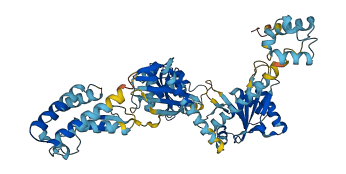
Descriptions
The autoinhibited protein was predicted that may have potential autoinhibitory elements via cis-regPred.
Autoinhibitory domains (AIDs)
Target domain |
|
Relief mechanism |
|
Assay |
cis-regPred |
Accessory elements
No accessory elements
Autoinhibited structure

Activated structure
1 structures for P0DH41
| Entry ID | Method | Resolution | Chain | Position | Source |
|---|---|---|---|---|---|
| AF-P0DH41-F1 | Predicted | AlphaFoldDB |
No variants for P0DH41
| Variant ID(s) | Position | Change | Description | Diseaes Association | Provenance |
|---|---|---|---|---|---|
| No variants for P0DH41 | |||||
No associated diseases with P0DH41
2 GO annotations of cellular component
| Name | Definition |
|---|---|
| cytoplasm | The contents of a cell excluding the plasma membrane and nucleus, but including other subcellular structures. |
| excinuclease repair complex | Any of the protein complexes formed by the UvrABC excinuclease system, which carries out nucleotide excision repair. Three different complexes are formed by the 3 proteins as they proceed through the excision repair process. First a complex consisting of two A subunits and two B subunits bind DNA and unwind it around the damaged site. Then, the A subunits disassociate leaving behind a stable complex between B subunits and DNA. Now, subunit C binds to this B+DNA complex and causes subunit B to nick the DNA on one side of the complex while subunit C nicks the DNA on the other side of the complex. DNA polymerase I and DNA ligase can then repair the resulting gap. |
2 GO annotations of molecular function
| Name | Definition |
|---|---|
| DNA binding | Any molecular function by which a gene product interacts selectively and non-covalently with DNA (deoxyribonucleic acid). |
| excinuclease ABC activity | Catalysis of the hydrolysis of ester linkages within deoxyribonucleic acid at sites flanking regions of damaged DNA to which the Uvr ABC excinuclease complexes bind. |
2 GO annotations of biological process
| Name | Definition |
|---|---|
| nucleotide-excision repair | A DNA repair process in which a small region of the strand surrounding the damage is removed from the DNA helix as an oligonucleotide. The small gap left in the DNA helix is filled in by the sequential action of DNA polymerase and DNA ligase. Nucleotide excision repair recognizes a wide range of substrates, including damage caused by UV irradiation (pyrimidine dimers and 6-4 photoproducts) and chemicals (intrastrand cross-links and bulky adducts). |
| SOS response | An error-prone process for repairing damaged microbial DNA. |
No homologous proteins in AiPD
| UniProt AC | Gene Name | Protein Name | Species | Evidence Code |
|---|---|---|---|---|
| No homologous proteins | ||||
| 10 | 20 | 30 | 40 | 50 | 60 |
| MNELIKHKLE | LLPDSPGCYL | HKDKEGTIIY | VGKAKNLKKR | VRSYFRGSHD | TKTELLVSEI |
| 70 | 80 | 90 | 100 | 110 | 120 |
| VDFEYIVTES | DTEALLLEIN | LIQKNMPKYN | IKLKDDKSYP | FLKITNESFP | RLVITRYIKK |
| 130 | 140 | 150 | 160 | 170 | 180 |
| NDGLYFGPYP | DSYTANEVKK | LLDRIFPFKK | CKNPINKVCF | YYHLGQCCAH | TICHTDKVYW |
| 190 | 200 | 210 | 220 | 230 | 240 |
| DRLIDDVKHF | LNGKDDKIIE | DLRSKMLAAS | EEMAFERAAE | YRDLISGIAT | MRTKQRVMSK |
| 250 | 260 | 270 | 280 | 290 | 300 |
| DLQDRDIFGY | YVDKGWMCVQ | VFFVRQGKLI | QRDVNLFPYY | NDAEEDFLTY | MGQFYQDKQH |
| 310 | 320 | 330 | 340 | 350 | 360 |
| FIPKEVFIPE | AIDEELVAAI | VPTKIIKPKR | GEKKQLVALA | TKNARVSLQQ | KFDLLEKDIK |
| 370 | 380 | 390 | 400 | 410 | 420 |
| KTSGAIENLG | QLLKIDKPVR | IEAFDNSNIQ | GTSPVAAMVV | FVDGKPSKKD | YRKFKIKTVV |
| 430 | 440 | 450 | 460 | 470 | 480 |
| GPDDYASMRE | VLFRRYSRVK | KEGLQAPNLI | IVDGGVGQVN | VAKDVIEKQL | GLTIPVAGLQ |
| 490 | 500 | 510 | 520 | 530 | 540 |
| KNDKHQTHDL | LFGNPLEVVP | LPRRSEEFFL | LHRIQDEVHR | FAVTFHRQVR | RKNSFSSTLD |
| 550 | 560 | 570 | 580 | 590 | |
| HISGLGPKRK | QLLLRHFKTI | TAIASATSEE | IQALGIPKTV | VEAIQQQITD | NKNDRSSP |