P0CM34
Gene name |
ATG3 (CNK00360) |
Protein name |
Autophagy-related protein 3 |
Names |
Autophagy-related E2-like conjugation enzyme ATG3 |
Species |
Cryptococcus neoformans var. neoformans serotype D (strain JEC21 / ATCC MYA-565) (Filobasidiella neoformans) |
KEGG Pathway |
cne:CNK00360 |
EC number |
|
Protein Class |
|
Descriptions
The autoinhibited protein was predicted that may have potential autoinhibitory elements via cis-regPred.
Autoinhibitory domains (AIDs)
Target domain |
|
Relief mechanism |
|
Assay |
cis-regPred |
Accessory elements
No accessory elements
Autoinhibited structure

Activated structure
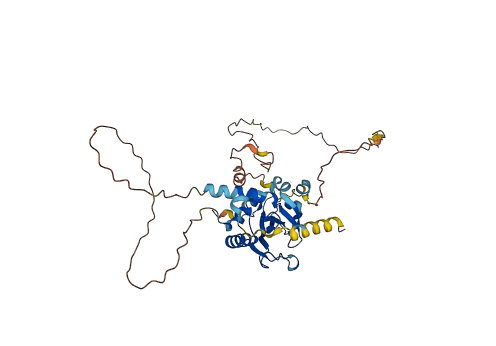
1 structures for P0CM34
| Entry ID | Method | Resolution | Chain | Position | Source |
|---|---|---|---|---|---|
| AF-P0CM34-F1 | Predicted | AlphaFoldDB |
No variants for P0CM34
| Variant ID(s) | Position | Change | Description | Diseaes Association | Provenance |
|---|---|---|---|---|---|
| No variants for P0CM34 | |||||
No associated diseases with P0CM34
No regional properties for P0CM34
| Type | Name | Position | InterPro Accession |
|---|---|---|---|
| No domain, repeats, and functional sites for P0CM34 | |||
2 GO annotations of cellular component
| Name | Definition |
|---|---|
| cytoplasmic ubiquitin ligase complex | A ubiquitin ligase complex found in the cytoplasm. |
| cytosol | The part of the cytoplasm that does not contain organelles but which does contain other particulate matter, such as protein complexes. |
1 GO annotations of molecular function
| Name | Definition |
|---|---|
| Atg8 ligase activity | Catalysis of the covalent attachment of the ubiquitin-like protein Atg8 to substrate molecules; phosphatidylethanolamine is a known substrate. |
4 GO annotations of biological process
| Name | Definition |
|---|---|
| autophagosome assembly | The formation of a double membrane-bounded structure, the autophagosome, that occurs when a specialized membrane sac, called the isolation membrane, starts to enclose a portion of the cytoplasm. |
| autophagy of mitochondrion | The autophagic process in which mitochondria are delivered to a type of vacuole and degraded in response to changing cellular conditions. |
| autophagy of nucleus | A form of autophagy, by which damaged or non-essential parts of the nucleus, or even an entire nucleus is degraded. |
| protein transport | The directed movement of proteins into, out of or within a cell, or between cells, by means of some agent such as a transporter or pore. |
No homologous proteins in AiPD
| UniProt AC | Gene Name | Protein Name | Species | Evidence Code |
|---|---|---|---|---|
| No homologous proteins | ||||
| 10 | 20 | 30 | 40 | 50 | 60 |
| MNNPLLAIQS | QYWAVRDYLS | PVLRESKFKE | HGRITPEEFV | AAGDFLTFKF | PVWQWEKGES |
| 70 | 80 | 90 | 100 | 110 | 120 |
| SRARDFLPPD | KQYLVTRNVP | CLRRATAVDY | TNADEDAEKL | LSFLDDAEEA | PGPDDDWVAT |
| 130 | 140 | 150 | 160 | 170 | 180 |
| HINRSPPHRP | TDMDEIPDIP | DSPTTAPTRE | MAGLNVSSGG | KLEEDEIPDI | DDIPDMDEEG |
| 190 | 200 | 210 | 220 | 230 | 240 |
| LEDLEDDAAV | RIVHPSEAEV | NSTAGKNLLQ | VRTYDCIISY | DKHYQTPRFW | LFGYDEHKNP |
| 250 | 260 | 270 | 280 | 290 | 300 |
| LTPAQVFQDV | PADHAFKTMT | MESFPHSGAQ | LASVHPCKHA | SVMKKFIDRM | EAAQGPAPTA |
| 310 | 320 | 330 | 340 | 350 | 360 |
| EPETISSTSG | TSGSAGGKEE | KEKKKKWGLG | SMVRKVTGGS | VPKVEKDKDE | VVTGVPVDFY |
| 370 | 380 | ||||
| LVIFLKFIAS | IVPTIEVDST | TSTAL |