Descriptions
The autoinhibited protein was predicted that may have potential autoinhibitory elements via cis-regPred.
Autoinhibitory domains (AIDs)
Target domain |
|
Relief mechanism |
|
Assay |
cis-regPred |
Accessory elements
No accessory elements
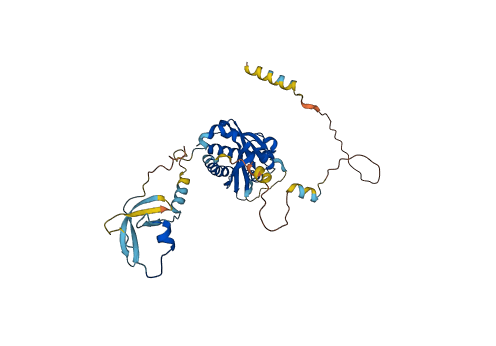
Autoinhibited structure

Activated structure
1 structures for P0CG26
| Entry ID | Method | Resolution | Chain | Position | Source |
|---|---|---|---|---|---|
| AF-P0CG26-F1 | Predicted | AlphaFoldDB |
No variants for P0CG26
| Variant ID(s) | Position | Change | Description | Diseaes Association | Provenance |
|---|---|---|---|---|---|
| No variants for P0CG26 | |||||
No associated diseases with P0CG26
1 regional properties for P0CG26
| Type | Name | Position | InterPro Accession |
|---|---|---|---|
| domain | Flagellar motor switch protein FliN-like, C-terminal domain | 292 - 359 | IPR001543 |
2 GO annotations of cellular component
| Name | Definition |
|---|---|
| bacterial-type flagellum basal body | One of the three major substructures of the bacterial-type flagellum, the basal body is embedded in the cell envelope (the plasma membrane, peptidoglycan cell wall, and, if one is present, the outer membrane); it houses the secretion apparatus that exports the more distal components and the flagellar motor. |
| plasma membrane | The membrane surrounding a cell that separates the cell from its external environment. It consists of a phospholipid bilayer and associated proteins. |
1 GO annotations of molecular function
| Name | Definition |
|---|---|
| cytoskeletal motor activity | Generation of force resulting in movement, for example along a microfilament or microtubule, or in torque resulting in membrane scission or rotation of a flagellum. The energy required is obtained either from the hydrolysis of a nucleoside triphosphate or by an electrochemical proton gradient (proton-motive force). |
2 GO annotations of biological process
| Name | Definition |
|---|---|
| bacterial-type flagellum-dependent cell motility | Cell motility due to the motion of one or more bacterial-type flagella. A bacterial-type flagellum is a motor complex composed of an extracellular helical protein filament coupled to a rotary motor embedded in the cell envelope. |
| chemotaxis | The directed movement of a motile cell or organism, or the directed growth of a cell guided by a specific chemical concentration gradient. Movement may be towards a higher concentration (positive chemotaxis) or towards a lower concentration (negative chemotaxis). |
No homologous proteins in AiPD
| UniProt AC | Gene Name | Protein Name | Species | Evidence Code |
|---|---|---|---|---|
| No homologous proteins | ||||
| 10 | 20 | 30 | 40 | 50 | 60 |
| MADELDDQAA | MAQWASENPP | GGGEGVNEFG | DFSGGMGGWD | DGGGDGASER | ILNQDEIDSL |
| 70 | 80 | 90 | 100 | 110 | 120 |
| LGFDLSGDGS | DDRTGIRAII | NSALVSYERL | PMLEIVFDRL | VRLMTTSLRN | FTSDNVEVSL |
| 130 | 140 | 150 | 160 | 170 | 180 |
| DNISSIRFGD | YLNSIPLPGI | LAVFRAEELD | NYGLLTVDSN | LIYSIVDVLL | GGRRGTAAMR |
| 190 | 200 | 210 | 220 | 230 | 240 |
| IEGRPYTTIE | RVLVQRMIDV | VLHDLKSAFE | PLHPVSFSLD | RLETNPPFAA | IARPANAAIL |
| 250 | 260 | 270 | 280 | 290 | 300 |
| VKLRIDMEDR | GGRIELLLPY | ATLEPIRKML | LQQFMGEKFG | RDNIWEGHLA | TELWTTQMEV |
| 310 | 320 | 330 | 340 | 350 | 360 |
| RAVLDEQQVP | LSRVLNMQVG | DTLMLNATSR | QPGGAARRRI | PLTRGRMGRR | NHSIAVRAEA |
| 370 | |||||
| PVDRRKKAVQ | KLK |