P0C959
Gene name |
AFUA_2G09030 |
Protein name |
Dipeptidyl-peptidase 5 |
Names |
Dipeptidyl-peptidase V, DPP V, DppV |
Species |
Neosartorya fumigata (strain ATCC MYA-4609 / Af293 / CBS 101355 / FGSC A1100) (Aspergillus fumigatus) |
KEGG Pathway |
afm:AFUA_2G09030 |
EC number |
|
Protein Class |
|
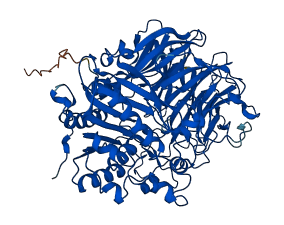
Descriptions
The autoinhibited protein was predicted that may have potential autoinhibitory elements via cis-regPred.
Autoinhibitory domains (AIDs)
Target domain |
|
Relief mechanism |
|
Assay |
cis-regPred |
Accessory elements
No accessory elements
Autoinhibited structure

Activated structure
1 structures for P0C959
| Entry ID | Method | Resolution | Chain | Position | Source |
|---|---|---|---|---|---|
| AF-P0C959-F1 | Predicted | AlphaFoldDB |
No variants for P0C959
| Variant ID(s) | Position | Change | Description | Diseaes Association | Provenance |
|---|---|---|---|---|---|
| No variants for P0C959 | |||||
No associated diseases with P0C959
1 GO annotations of cellular component
| Name | Definition |
|---|---|
| extracellular region | The space external to the outermost structure of a cell. For cells without external protective or external encapsulating structures this refers to space outside of the plasma membrane. This term covers the host cell environment outside an intracellular parasite. |
2 GO annotations of molecular function
| Name | Definition |
|---|---|
| peptidase activity | Catalysis of the hydrolysis of a peptide bond. A peptide bond is a covalent bond formed when the carbon atom from the carboxyl group of one amino acid shares electrons with the nitrogen atom from the amino group of a second amino acid. |
| serine-type endopeptidase activity | Catalysis of the hydrolysis of internal, alpha-peptide bonds in a polypeptide chain by a catalytic mechanism that involves a catalytic triad consisting of a serine nucleophile that is activated by a proton relay involving an acidic residue (e.g. aspartate or glutamate) and a basic residue (usually histidine). |
1 GO annotations of biological process
| Name | Definition |
|---|---|
| proteolysis | The hydrolysis of proteins into smaller polypeptides and/or amino acids by cleavage of their peptide bonds. |
No homologous proteins in AiPD
| UniProt AC | Gene Name | Protein Name | Species | Evidence Code |
|---|---|---|---|---|
| No homologous proteins | ||||
| 10 | 20 | 30 | 40 | 50 | 60 |
| MGAFRWLSIA | AAASTALALT | PEQLITAPRR | SEAIPDPSGK | VAVFSTSQYS | FETHKRTSWW |
| 70 | 80 | 90 | 100 | 110 | 120 |
| SLLDLKTGQT | KVLTNDSSVS | EIVWLSDDSI | LYVNSTNADI | PGGVELWVTQ | ASSFAKGYKA |
| 130 | 140 | 150 | 160 | 170 | 180 |
| ASLPASFSGL | KTAKTKSGDI | RFVAYGQSYP | NGTAYNEELA | TAPLSSARIY | DSIYVRHWDY |
| 190 | 200 | 210 | 220 | 230 | 240 |
| WLSTTFNAVF | SGTLKKGHGK | NGYSLDGELK | NLVSPVKNAE | SPYPPFGGAS | DYDLSPDGKW |
| 250 | 260 | 270 | 280 | 290 | 300 |
| VAFKSKAPEL | PKANFTTSYI | YLVPHDASET | ARPINGPDSP | GTPKGIKGDS | SSPVFSPNGD |
| 310 | 320 | 330 | 340 | 350 | 360 |
| KLAYFQMRDE | TYESDRRVLY | VYSLGSKKTI | PSVAGDWDRS | PDSVKWTPDG | KTLIVGSEDL |
| 370 | 380 | 390 | 400 | 410 | 420 |
| GRTRLFSLPA | NAKDDYKPKN | FTDGGSASAY | YFLPDSSLLV | TGSALWTNWN | VYTAKPEKGV |
| 430 | 440 | 450 | 460 | 470 | 480 |
| IKKIASANEI | DPELKGLGPS | DISEFYFQGN | FTDIHAWVIY | PENFDKSKKY | PLIFFIHGGP |
| 490 | 500 | 510 | 520 | 530 | 540 |
| QGNWADGWST | RWNPKAWADQ | GYVVVAPNPT | GSTGFGQALT | DAIQNNWGGA | PYDDLVKCWE |
| 550 | 560 | 570 | 580 | 590 | 600 |
| YVHENLDYVD | TDHGVAAGAS | YGGFMINWIQ | GSPLGRKFKA | LVSHDGTFVA | DAKVSTEELW |
| 610 | 620 | 630 | 640 | 650 | 660 |
| FMQREFNGTF | WDARDNYRRW | DPSAPERILQ | FATPMLVIHS | DKDYRLPVAE | GLSLFNVLQE |
| 670 | 680 | 690 | 700 | 710 | 720 |
| RGVPSRFLNF | PDENHWVVNP | ENSLVWHQQA | LGWINKYSGV | EKSNPNAVSL | EDTVVPVVNY |
| N |