Descriptions
The autoinhibited protein was predicted that may have potential autoinhibitory elements via cis-regPred.
Autoinhibitory domains (AIDs)
Target domain |
|
Relief mechanism |
|
Assay |
cis-regPred |
Accessory elements
No accessory elements
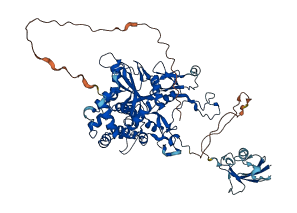
Autoinhibited structure

Activated structure
1 structures for P0C7N6
| Entry ID | Method | Resolution | Chain | Position | Source |
|---|---|---|---|---|---|
| AF-P0C7N6-F1 | Predicted | AlphaFoldDB |
No variants for P0C7N6
| Variant ID(s) | Position | Change | Description | Diseaes Association | Provenance |
|---|---|---|---|---|---|
| No variants for P0C7N6 | |||||
No associated diseases with P0C7N6
Functions
4 GO annotations of cellular component
| Name | Definition |
|---|---|
| endoplasmic reticulum membrane | The lipid bilayer surrounding the endoplasmic reticulum. |
| nuclear membrane | Either of the lipid bilayers that surround the nucleus and form the nuclear envelope; excludes the intermembrane space. |
| nucleus | A membrane-bounded organelle of eukaryotic cells in which chromosomes are housed and replicated. In most cells, the nucleus contains all of the cell's chromosomes except the organellar chromosomes, and is the site of RNA synthesis and processing. In some species, or in specialized cell types, RNA metabolism or DNA replication may be absent. |
| perinuclear region of cytoplasm | Cytoplasm situated near, or occurring around, the nucleus. |
2 GO annotations of molecular function
| Name | Definition |
|---|---|
| ubiquitin binding | Binding to ubiquitin, a protein that when covalently bound to other cellular proteins marks them for proteolytic degradation. |
| ubiquitin protein ligase binding | Binding to a ubiquitin protein ligase enzyme, any of the E3 proteins. |
3 GO annotations of biological process
| Name | Definition |
|---|---|
| mRNA transport | The directed movement of mRNA, messenger ribonucleic acid, into, out of or within a cell, or between cells, by means of some agent such as a transporter or pore. |
| protein transport | The directed movement of proteins into, out of or within a cell, or between cells, by means of some agent such as a transporter or pore. |
| ubiquitin-dependent protein catabolic process | The chemical reactions and pathways resulting in the breakdown of a protein or peptide by hydrolysis of its peptide bonds, initiated by the covalent attachment of a ubiquitin group, or multiple ubiquitin groups, to the protein. |
No homologous proteins in AiPD
| UniProt AC | Gene Name | Protein Name | Species | Evidence Code |
|---|---|---|---|---|
| No homologous proteins | ||||
| 10 | 20 | 30 | 40 | 50 | 60 |
| MILRFVSKEG | QFRLTVQPDS | TFPELLAQIA | EKLPKSVDLQ | SVTVSNRPQG | GDARKISELK |
| 70 | 80 | 90 | 100 | 110 | 120 |
| GVSFKQVGLS | HGAQLFLGFE | DQSTASNGHA | TAPTGANRLN | GKVVEASDMP | SVPLGSPTQV |
| 130 | 140 | 150 | 160 | 170 | 180 |
| IKNPWEVVRQ | SPLDDKLDRQ | DGKIHRKRDA | RMCTHGPKGM | CDYCMPLEPY | AAAYLAEKKI |
| 190 | 200 | 210 | 220 | 230 | 240 |
| KHLSFHSYLR | KVNSAKNRPE | LGSSYIPPLT | EPYYRVRPDC | PSGHKPFPAG | ICTKCQPGAI |
| 250 | 260 | 270 | 280 | 290 | 300 |
| SLKPQEYRMV | DHVEFASIQV | VDDLINFWRN | TGCQRLGFLY | GRYEEYTEVP | LGTKAVVETI |
| 310 | 320 | 330 | 340 | 350 | 360 |
| YEPPQVNELD | GISLGDWDNE | KEIDEIAAQC | GLQRVGVIFT | DLLDADKGDG | SVICKRHIDS |
| 370 | 380 | 390 | 400 | 410 | 420 |
| YYLSSLEIAF | AARYQAKYPR | PTKWSETGKF | GSNFVTCVIS | GDDQGQIGIS | SYQASNDAVE |
| 430 | 440 | 450 | 460 | 470 | 480 |
| MVRADIIEPS | AEPSVMLVQS | EDDNEALNRA | RYIPEVFYRR | INEHGANVQE | NAKPDFPVEY |
| 490 | 500 | 510 | 520 | 530 | 540 |
| LFVTLTHGFP | TQPNPLFTGG | KFPIENREIM | GEMPDVSALG | KSLNAKANGL | ALNTTSGLNA |
| 550 | 560 | 570 | 580 | 590 | 600 |
| ISNFHMLCFI | HNLGILSKDE | ESLLFKVAST | HDTSEGSALQ | HTGGWATLLT | ILKESGERPP |
| 610 | 620 | 630 | 640 | 650 | |
| KRSYASPSFS | ATGRGAAHPG | EKNRLMRQPS | HGSDSDSVQL | AKRLKGASLK | GKE |