P0AFZ3
Gene name |
sspB (b3228, JW3197) |
Protein name |
Stringent starvation protein B |
Names |
Adapter protein SspB, Specificity-enhancing factor SspB |
Species |
Escherichia coli (strain K12) |
KEGG Pathway |
eco:b3228 |
EC number |
|
Protein Class |
|
Descriptions
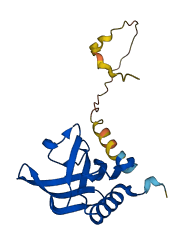
The autoinhibited protein was predicted that may have potential autoinhibitory elements via cis-regPred.
Autoinhibitory domains (AIDs)
Target domain |
|
Relief mechanism |
|
Assay |
cis-regPred |
Accessory elements
No accessory elements
Autoinhibited structure

Activated structure
No variants for P0AFZ3
| Variant ID(s) | Position | Change | Description | Diseaes Association | Provenance |
|---|---|---|---|---|---|
| No variants for P0AFZ3 | |||||
No associated diseases with P0AFZ3
No regional properties for P0AFZ3
| Type | Name | Position | InterPro Accession |
|---|---|---|---|
| No domain, repeats, and functional sites for P0AFZ3 | |||
3 GO annotations of cellular component
| Name | Definition |
|---|---|
| cytosol | The part of the cytoplasm that does not contain organelles but which does contain other particulate matter, such as protein complexes. |
| HslUV protease complex | A protein complex that possesses ATP-dependent protease activity; consists of an ATPase large subunit with homology to other ClpX family ATPases and a peptidase small subunit related to the proteasomal beta-subunits of eukaryotes. In the E. coli complex, a double ring-shaped homohexamer of HslV is capped on each side by a ring-shaped HslU homohexamer. |
| ribosome | An intracellular organelle, about 200 A in diameter, consisting of RNA and protein. It is the site of protein biosynthesis resulting from translation of messenger RNA (mRNA). It consists of two subunits, one large and one small, each containing only protein and RNA. Both the ribosome and its subunits are characterized by their sedimentation coefficients, expressed in Svedberg units (symbol: S). Hence, the prokaryotic ribosome (70S) comprises a large (50S) subunit and a small (30S) subunit, while the eukaryotic ribosome (80S) comprises a large (60S) subunit and a small (40S) subunit. Two sites on the ribosomal large subunit are involved in translation, namely the aminoacyl site (A site) and peptidyl site (P site). Ribosomes from prokaryotes, eukaryotes, mitochondria, and chloroplasts have characteristically distinct ribosomal proteins. |
4 GO annotations of molecular function
| Name | Definition |
|---|---|
| ATPase binding | Binding to an ATPase, any enzyme that catalyzes the hydrolysis of ATP. |
| molecular adaptor activity | The binding activity of a molecule that brings together two or more molecules through a selective, non-covalent, often stoichiometric interaction, permitting those molecules to function in a coordinated way. |
| protein homodimerization activity | Binding to an identical protein to form a homodimer. |
| RNA binding | Binding to an RNA molecule or a portion thereof. |
2 GO annotations of biological process
| Name | Definition |
|---|---|
| positive regulation of ATP-dependent activity | Any process that activates or increases the rate of an ATP-dependent activity. |
| positive regulation of protein catabolic process | Any process that activates or increases the frequency, rate or extent of the chemical reactions and pathways resulting in the breakdown of a protein by the destruction of the native, active configuration, with or without the hydrolysis of peptide bonds. |
No homologous proteins in AiPD
| UniProt AC | Gene Name | Protein Name | Species | Evidence Code |
|---|---|---|---|---|
| No homologous proteins | ||||
| 10 | 20 | 30 | 40 | 50 | 60 |
| MDLSQLTPRR | PYLLRAFYEW | LLDNQLTPHL | VVDVTLPGVQ | VPMEYARDGQ | IVLNIAPRAV |
| 70 | 80 | 90 | 100 | 110 | 120 |
| GNLELANDEV | RFNARFGGIP | RQVSVPLAAV | LAIYARENGA | GTMFEPEAAY | DEDTSIMNDE |
| 130 | 140 | 150 | 160 | ||
| EASADNETVM | SVIDGDKPDH | DDDTHPDDEP | PQPPRGGRPA | LRVVK |