P0AEB2
Gene name |
dacA (pfv, b0632, JW0627) |
Protein name |
D-alanyl-D-alanine carboxypeptidase DacA |
Names |
DD-carboxypeptidase, DD-peptidase, Beta-lactamase, Penicillin-binding protein 5, PBP-5 |
Species |
Escherichia coli (strain K12) |
KEGG Pathway |
eco:b0632 |
EC number |
3.4.16.4: Serine-type carboxypeptidases |
Protein Class |
|
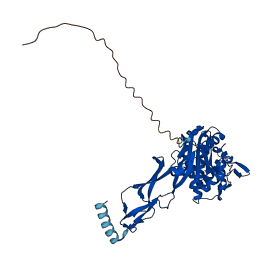
Descriptions
The autoinhibited protein was predicted that may have potential autoinhibitory elements via cis-regPred.
Autoinhibitory domains (AIDs)
Target domain |
|
Relief mechanism |
|
Assay |
cis-regPred |
Accessory elements
No accessory elements
Autoinhibited structure

Activated structure
14 structures for P0AEB2
| Entry ID | Method | Resolution | Chain | Position | Source |
|---|---|---|---|---|---|
| 1HD8 | X-ray | 230 A | A | 30-386 | PDB |
| 1NJ4 | X-ray | 190 A | A | 30-392 | PDB |
| 1NZO | X-ray | 185 A | A | 30-392 | PDB |
| 1NZU | X-ray | 200 A | A | 30-392 | PDB |
| 1SDN | X-ray | 250 A | A | 30-392 | PDB |
| 1Z6F | X-ray | 160 A | A | 30-392 | PDB |
| 3BEB | X-ray | 200 A | A | 30-386 | PDB |
| 3BEC | X-ray | 160 A | A | 30-386 | PDB |
| 3MZD | X-ray | 190 A | A | 30-386 | PDB |
| 3MZE | X-ray | 210 A | A | 30-386 | PDB |
| 3MZF | X-ray | 150 A | A | 30-386 | PDB |
| 5J8X | X-ray | 253 A | A | 30-392 | PDB |
| 6NTZ | X-ray | 220 A | A | 1-403 | PDB |
| AF-P0AEB2-F1 | Predicted | AlphaFoldDB |
1 variants for P0AEB2
| Variant ID(s) | Position | Change | Description | Diseaes Association | Provenance |
|---|---|---|---|---|---|
| 134 | G>D | mutant dacA11191; inactive but still binds penicillin. Blocked in the release of the bound penicilloyl moiety; the mutant also fails to catalyze the D-alanine carboxypeptidase reaction as the hydrolysis of the acyl-enzyme formed with substrate is also blocked and the acyl-enzyme accumulates [UniProt] | No |
No associated diseases with P0AEB2
No regional properties for P0AEB2
| Type | Name | Position | InterPro Accession |
|---|---|---|---|
| No domain, repeats, and functional sites for P0AEB2 | |||
Functions
| Description | ||
|---|---|---|
| EC Number | 3.4.16.4 | Serine-type carboxypeptidases |
| Subcellular Localization |
|
|
| PANTHER Family | ||
| PANTHER Subfamily | ||
| PANTHER Protein Class | ||
| PANTHER Pathway Category | No pathway information available | |
4 GO annotations of cellular component
| Name | Definition |
|---|---|
| integral component of periplasmic side of plasma membrane | The component of the plasma membrane consisting of the gene products that penetrate only the periplasmic side of the membrane. |
| integral component of plasma membrane | The component of the plasma membrane consisting of the gene products and protein complexes having at least some part of their peptide sequence embedded in the hydrophobic region of the membrane. |
| outer membrane-bounded periplasmic space | The region between the inner (cytoplasmic or plasma) membrane and outer membrane of organisms with two membranes such as Gram negative bacteria. These periplasmic spaces are relatively thick and contain a thin peptidoglycan layer (PGL), also referred to as a thin cell wall. |
| plasma membrane | The membrane surrounding a cell that separates the cell from its external environment. It consists of a phospholipid bilayer and associated proteins. |
4 GO annotations of molecular function
| Name | Definition |
|---|---|
| beta-lactamase activity | Catalysis of the reaction: a beta-lactam + H2O = a substituted beta-amino acid. |
| carboxypeptidase activity | Catalysis of the hydrolysis of a single C-terminal amino acid residue from a polypeptide chain. |
| penicillin binding | Binding to penicillin, an antibiotic that contains the condensed beta-lactamthiazolidine ring system. |
| serine-type D-Ala-D-Ala carboxypeptidase activity | Catalysis of the reaction: (Ac)2-L-Lys-D-alanyl-D-alanine + H2O = (Ac)2-L-Lys-D-alanine + D-alanine. |
5 GO annotations of biological process
| Name | Definition |
|---|---|
| cell wall organization | A process that results in the assembly, arrangement of constituent parts, or disassembly of the cell wall, the rigid or semi-rigid envelope lying outside the cell membrane of plant, fungal and most prokaryotic cells, maintaining their shape and protecting them from osmotic lysis. |
| peptidoglycan biosynthetic process | The chemical reactions and pathways resulting in the formation of peptidoglycans, any of a class of glycoconjugates found in bacterial cell walls. |
| peptidoglycan metabolic process | The chemical reactions and pathways involving peptidoglycans, any of a class of glycoconjugates found only in bacterial cell walls and consisting of strands of glycosaminoglycan cross-linked by oligopeptides to form a huge and rigid network. |
| proteolysis | The hydrolysis of proteins into smaller polypeptides and/or amino acids by cleavage of their peptide bonds. |
| regulation of cell shape | Any process that modulates the surface configuration of a cell. |
1 homologous proteins in AiPD
| UniProt AC | Gene Name | Protein Name | Species | Evidence Code |
|---|---|---|---|---|
| Q8WVT3 | TRAPPC12 | Trafficking protein particle complex subunit 12 | Homo sapiens (Human) | PR |
| 10 | 20 | 30 | 40 | 50 | 60 |
| MNTIFSARIM | KRLALTTALC | TAFISAAHAD | DLNIKTMIPG | VPQIDAESYI | LIDYNSGKVL |
| 70 | 80 | 90 | 100 | 110 | 120 |
| AEQNADVRRD | PASLTKMMTS | YVIGQAMKAG | KFKETDLVTI | GNDAWATGNP | VFKGSSLMFL |
| 130 | 140 | 150 | 160 | 170 | 180 |
| KPGMQVPVSQ | LIRGINLQSG | NDACVAMADF | AAGSQDAFVG | LMNSYVNALG | LKNTHFQTVH |
| 190 | 200 | 210 | 220 | 230 | 240 |
| GLDADGQYSS | ARDMALIGQA | LIRDVPNEYS | IYKEKEFTFN | GIRQLNRNGL | LWDNSLNVDG |
| 250 | 260 | 270 | 280 | 290 | 300 |
| IKTGHTDKAG | YNLVASATEG | QMRLISAVMG | GRTFKGREAE | SKKLLTWGFR | FFETVNPLKV |
| 310 | 320 | 330 | 340 | 350 | 360 |
| GKEFASEPVW | FGDSDRASLG | VDKDVYLTIP | RGRMKDLKAS | YVLNSSELHA | PLQKNQVVGT |
| 370 | 380 | 390 | 400 | ||
| INFQLDGKTI | EQRPLVVLQE | IPEGNFFGKI | IDYIKLMFHH | WFG |