P0ACV3
Gene name |
lpxP |
Protein name |
Lipid A biosynthesis palmitoleoyltransferase |
Names |
Kdo(2)-lipid IV(A) palmitoleoyltransferase |
Species |
Shigella flexneri |
KEGG Pathway |
sfx:S2582 |
EC number |
2.3.1.242: Transferring groups other than amino-acyl groups |
Protein Class |
|
Descriptions
The autoinhibited protein was predicted that may have potential autoinhibitory elements via cis-regPred.
Autoinhibitory domains (AIDs)
Target domain |
|
Relief mechanism |
|
Assay |
cis-regPred |
Accessory elements
No accessory elements
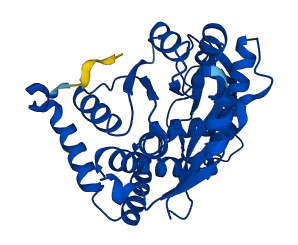
Autoinhibited structure

Activated structure
1 structures for P0ACV3
| Entry ID | Method | Resolution | Chain | Position | Source |
|---|---|---|---|---|---|
| AF-P0ACV3-F1 | Predicted | AlphaFoldDB |
No variants for P0ACV3
| Variant ID(s) | Position | Change | Description | Diseaes Association | Provenance |
|---|---|---|---|---|---|
| No variants for P0ACV3 | |||||
No associated diseases with P0ACV3
No regional properties for P0ACV3
| Type | Name | Position | InterPro Accession |
|---|---|---|---|
| No domain, repeats, and functional sites for P0ACV3 | |||
Functions
| Description | ||
|---|---|---|
| EC Number | 2.3.1.242 | Transferring groups other than amino-acyl groups |
| Subcellular Localization |
|
|
| PANTHER Family | ||
| PANTHER Subfamily | ||
| PANTHER Protein Class | ||
| PANTHER Pathway Category | No pathway information available | |
1 GO annotations of cellular component
| Name | Definition |
|---|---|
| integral component of plasma membrane | The component of the plasma membrane consisting of the gene products and protein complexes having at least some part of their peptide sequence embedded in the hydrophobic region of the membrane. |
1 GO annotations of molecular function
| Name | Definition |
|---|---|
| palmitoleoyl [acyl-carrier-protein]-dependent acyltransferase activity | Catalysis of the reaction: a palmitoleoyl- + alpha-KDO-(2->4)-alpha-KDO-(2->6)-lipid IVA = KDO2-(palmitoleoyl)-lipid IVA + a holo- |
4 GO annotations of biological process
| Name | Definition |
|---|---|
| Kdo2-lipid A biosynthetic process | The chemical reactions and pathways resulting in the formation of Kdo2-lipid A, a lipopolysaccharide (LPS) component. |
| lipid A biosynthetic process | The chemical reactions and pathways resulting in the formation of lipid A, the glycolipid group of bacterial lipopolysaccharides, consisting of four to six fatty acyl chains linked to two glucosamine residues. Further modifications of the backbone are common. |
| lipopolysaccharide biosynthetic process | The chemical reactions and pathways resulting in the formation of lipopolysaccharides, any of a group of related, structurally complex components of the outer membrane of Gram-negative bacteria. |
| response to cold | Any process that results in a change in state or activity of a cell or an organism (in terms of movement, secretion, enzyme production, gene expression, etc.) as a result of a cold stimulus, a temperature stimulus below the optimal temperature for that organism. |
No homologous proteins in AiPD
| UniProt AC | Gene Name | Protein Name | Species | Evidence Code |
|---|---|---|---|---|
| No homologous proteins | ||||
| 10 | 20 | 30 | 40 | 50 | 60 |
| MFPQCKFSRE | FLHPRYWLTW | FGLGVLWLWV | QLPYPVLCFL | GTRIGAMARP | FLKRRESIAR |
| 70 | 80 | 90 | 100 | 110 | 120 |
| KNLELCFPQH | SAEEREKMIA | ENFRSLGMAL | VETGMAWFWP | DSRVRKWFDV | EGLDNLKRAQ |
| 130 | 140 | 150 | 160 | 170 | 180 |
| MQNRGVMVVG | VHFMSLELGG | RVMGLCQPMM | ATYRPHNNQL | MEWVQTRGRM | RSNKAMIGRN |
| 190 | 200 | 210 | 220 | 230 | 240 |
| NLRGIVGALK | KGEAVWFAPD | QDYGRKGSSF | APFFAVENVA | TTNGTYVLSR | LSGAAMLTVT |
| 250 | 260 | 270 | 280 | 290 | 300 |
| MVRKADYSGY | RLFITPEMEG | YPTDENQAAA | YMNKIIEKEI | MRAPEQYLWI | HRRFKTRPVG |
| ESSLYI |