P0A9H9
Gene name |
cheZ (b1881, JW1870) |
Protein name |
Protein phosphatase CheZ |
Names |
Chemotaxis protein CheZ |
Species |
Escherichia coli (strain K12) |
KEGG Pathway |
eco:b1881 |
EC number |
|
Protein Class |
|
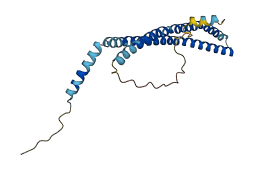
Descriptions
The autoinhibited protein was predicted that may have potential autoinhibitory elements via cis-regPred.
Autoinhibitory domains (AIDs)
Target domain |
|
Relief mechanism |
|
Assay |
cis-regPred |
Accessory elements
No accessory elements
Autoinhibited structure

Activated structure
2 structures for P0A9H9
| Entry ID | Method | Resolution | Chain | Position | Source |
|---|---|---|---|---|---|
| 1KMI | X-ray | 290 A | Z | 1-214 | PDB |
| AF-P0A9H9-F1 | Predicted | AlphaFoldDB |
No variants for P0A9H9
| Variant ID(s) | Position | Change | Description | Diseaes Association | Provenance |
|---|---|---|---|---|---|
| No variants for P0A9H9 | |||||
No associated diseases with P0A9H9
No regional properties for P0A9H9
| Type | Name | Position | InterPro Accession |
|---|---|---|---|
| No domain, repeats, and functional sites for P0A9H9 | |||
4 GO annotations of cellular component
| Name | Definition |
|---|---|
| bacterial-type flagellum | A motor complex composed of an extracellular helical protein filament coupled to a rotary motor embedded in the cell envelope. |
| cytosol | The part of the cytoplasm that does not contain organelles but which does contain other particulate matter, such as protein complexes. |
| methyl accepting chemotaxis protein complex | A transmembrane protein complex that consists of multiple methyl-accepting chemoreceptor protein subunits, a histidine kinase and a connector protein and which functions in the regulation of flagellar rotary motor activity in response to an external chemical stimulus. |
| plasma membrane | The membrane surrounding a cell that separates the cell from its external environment. It consists of a phospholipid bilayer and associated proteins. |
2 GO annotations of molecular function
| Name | Definition |
|---|---|
| identical protein binding | Binding to an identical protein or proteins. |
| phosphoprotein phosphatase activity | Catalysis of the reaction: a phosphoprotein + H2O = a protein + phosphate. Together with protein kinases, these enzymes control the state of phosphorylation of cellular proteins and thereby provide an important mechanism for regulating cellular activity. |
5 GO annotations of biological process
| Name | Definition |
|---|---|
| bacterial-type flagellum-dependent swarming motility | Bacterial-type flagellum-dependent cell motility in which the action of numerous flagella results in the smooth movement of a group of cells along a solid surface. Swarming motility is observed in groups of bacteria. |
| chemotaxis | The directed movement of a motile cell or organism, or the directed growth of a cell guided by a specific chemical concentration gradient. Movement may be towards a higher concentration (positive chemotaxis) or towards a lower concentration (negative chemotaxis). |
| protein dephosphorylation | The process of removing one or more phosphoric residues from a protein. |
| regulation of bacterial-type flagellum-dependent cell motility | Any process that modulates the frequency, rate or extent of bacterial-type flagellum-dependent cell motility. |
| regulation of chemotaxis | Any process that modulates the frequency, rate or extent of the directed movement of a motile cell or organism in response to a specific chemical concentration gradient. |
No homologous proteins in AiPD
| UniProt AC | Gene Name | Protein Name | Species | Evidence Code |
|---|---|---|---|---|
| No homologous proteins | ||||
| 10 | 20 | 30 | 40 | 50 | 60 |
| MMQPSIKPAD | EHSAGDIIAR | IGSLTRMLRD | SLRELGLDQA | IAEAAEAIPD | ARDRLYYVVQ |
| 70 | 80 | 90 | 100 | 110 | 120 |
| MTAQAAERAL | NSVEASQPHQ | DQMEKSAKAL | TQRWDDWFAD | PIDLADAREL | VTDTRQFLAD |
| 130 | 140 | 150 | 160 | 170 | 180 |
| VPAHTSFTNA | QLLEIMMAQD | FQDLTGQVIK | RMMDVIQEIE | RQLLMVLLEN | IPEQESRPKR |
| 190 | 200 | 210 | |||
| ENQSLLNGPQ | VDTSKAGVVA | SQDQVDDLLD | SLGF |