P0A855
Gene name |
tolB |
Protein name |
Tol-Pal system protein TolB |
Names |
|
Species |
Escherichia coli (strain K12) |
KEGG Pathway |
eco:b0740 |
EC number |
|
Protein Class |
|
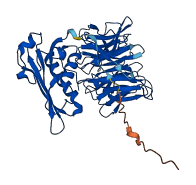
Descriptions
The autoinhibited protein was predicted that may have potential autoinhibitory elements via cis-regPred.
Autoinhibitory domains (AIDs)
Target domain |
|
Relief mechanism |
|
Assay |
cis-regPred |
Accessory elements
No accessory elements
Autoinhibited structure

Activated structure
9 structures for P0A855
| Entry ID | Method | Resolution | Chain | Position | Source |
|---|---|---|---|---|---|
| 1C5K | X-ray | 200 A | A | 1-430 | PDB |
| 1CRZ | X-ray | 195 A | A | 28-430 | PDB |
| 2HQS | X-ray | 150 A | A/B/D/F | 23-430 | PDB |
| 2IVZ | X-ray | 200 A | A/B/C/D | 1-430 | PDB |
| 2W8B | X-ray | 186 A | A/B/D/F | 22-430 | PDB |
| 3IAX | X-ray | 260 A | A | 1-430 | PDB |
| 7NST | EM | 370 A | E | 1-430 | PDB |
| 7NSU | EM | 470 A | E | 1-430 | PDB |
| AF-P0A855-F1 | Predicted | AlphaFoldDB |
No variants for P0A855
| Variant ID(s) | Position | Change | Description | Diseaes Association | Provenance |
|---|---|---|---|---|---|
| No variants for P0A855 | |||||
No associated diseases with P0A855
5 regional properties for P0A855
| Type | Name | Position | InterPro Accession |
|---|---|---|---|
| domain | TolB, N-terminal | 24 - 121 | IPR007195 |
| repeat | WD40-like beta propeller | 199 - 223 | IPR011659-1 |
| repeat | WD40-like beta propeller | 237 - 272 | IPR011659-2 |
| repeat | WD40-like beta propeller | 281 - 315 | IPR011659-3 |
| repeat | WD40-like beta propeller | 369 - 396 | IPR011659-4 |
Functions
5 GO annotations of cellular component
| Name | Definition |
|---|---|
| cell division site | The eventual plane of cell division (also known as cell cleavage or cytokinesis) in a dividing cell. In Eukaryotes, the cleavage apparatus, composed of septin structures and the actomyosin contractile ring, forms along this plane, and the mitotic, or meiotic, spindle is aligned perpendicular to the division plane. In bacteria, the cell division site is generally located at mid-cell and is the site at which the cytoskeletal structure, the Z-ring, assembles. |
| membrane | A lipid bilayer along with all the proteins and protein complexes embedded in it an attached to it. |
| outer membrane-bounded periplasmic space | The region between the inner (cytoplasmic or plasma) membrane and outer membrane of organisms with two membranes such as Gram negative bacteria. These periplasmic spaces are relatively thick and contain a thin peptidoglycan layer (PGL), also referred to as a thin cell wall. |
| periplasmic space | The region between the inner (cytoplasmic) and outer membrane (Gram-negative Bacteria) or cytoplasmic membrane and cell wall (Fungi and Gram-positive Bacteria). |
| protein-containing complex | A stable assembly of two or more macromolecules, i.e. proteins, nucleic acids, carbohydrates or lipids, in which at least one component is a protein and the constituent parts function together. |
2 GO annotations of molecular function
| Name | Definition |
|---|---|
| protein domain specific binding | Binding to a specific domain of a protein. |
| protein-containing complex binding | Binding to a macromolecular complex. |
7 GO annotations of biological process
| Name | Definition |
|---|---|
| bacteriocin transport | The directed movement of a bacteriocin into, out of or within a cell, or between cells, by means of some agent such as a transporter or pore. Bacteriocins are a group of antibiotics produced by bacteria and are encoded by a group of naturally occurring plasmids, e.g. Col E1. Bacteriocins are toxic to bacteria closely related to the bacteriocin producing strain. |
| cell cycle | The progression of biochemical and morphological phases and events that occur in a cell during successive cell replication or nuclear replication events. Canonically, the cell cycle comprises the replication and segregation of genetic material followed by the division of the cell, but in endocycles or syncytial cells nuclear replication or nuclear division may not be followed by cell division. |
| cell division | The process resulting in division and partitioning of components of a cell to form more cells; may or may not be accompanied by the physical separation of a cell into distinct, individually membrane-bounded daughter cells. |
| cellular response to bacteriocin | Any process that results in a change in state or activity of a cell (in terms of movement, secretion, enzyme production, gene expression, etc.) as a result of a bacteriocin stimulus. A bacteriocin is a protein substance released by certain bacteria that kills but does not lyse closely related strains of bacteria. Specific bacteriocins attach to specific receptors on cell walls and induce specific metabolic block, e.g. cessation of nucleic acid or protein synthesis of oxidative phosphorylation. |
| protein import | The targeting and directed movement of proteins into a cell or organelle. Not all import involves an initial targeting event. |
| protein transport | The directed movement of proteins into, out of or within a cell, or between cells, by means of some agent such as a transporter or pore. |
| regulation of membrane invagination | Any process that modulates the frequency, rate or extent of membrane invagination. |
No homologous proteins in AiPD
| UniProt AC | Gene Name | Protein Name | Species | Evidence Code |
|---|---|---|---|---|
| No homologous proteins | ||||
| 10 | 20 | 30 | 40 | 50 | 60 |
| MKQALRVAFG | FLILWASVLH | AEVRIVIDSG | VDSGRPIGVV | PFQWAGPGAA | PEDIGGIVAA |
| 70 | 80 | 90 | 100 | 110 | 120 |
| DLRNSGKFNP | LDRARLPQQP | GSAQEVQPAA | WSALGIDAVV | VGQVTPNPDG | SYNVAYQLVD |
| 130 | 140 | 150 | 160 | 170 | 180 |
| TGGAPGTVLA | QNSYKVNKQW | LRYAGHTASD | EVFEKLTGIK | GAFRTRIAYV | VQTNGGQFPY |
| 190 | 200 | 210 | 220 | 230 | 240 |
| ELRVSDYDGY | NQFVVHRSPQ | PLMSPAWSPD | GSKLAYVTFE | SGRSALVIQT | LANGAVRQVA |
| 250 | 260 | 270 | 280 | 290 | 300 |
| SFPRHNGAPA | FSPDGSKLAF | ALSKTGSLNL | YVMDLASGQI | RQVTDGRSNN | TEPTWFPDSQ |
| 310 | 320 | 330 | 340 | 350 | 360 |
| NLAFTSDQAG | RPQVYKVNIN | GGAPQRITWE | GSQNQDADVS | SDGKFMVMVS | SNGGQQHIAK |
| 370 | 380 | 390 | 400 | 410 | 420 |
| QDLATGGVQV | LSSTFLDETP | SLAPNGTMVI | YSSSQGMGSV | LNLVSTDGRF | KARLPATDGQ |
| VKFPAWSPYL |