P0A812
Gene name |
ruvB |
Protein name |
Holliday junction ATP-dependent DNA helicase RuvB |
Names |
|
Species |
Escherichia coli (strain K12) |
KEGG Pathway |
eco:b1860 |
EC number |
3.6.4.12: Acting on ATP; involved in cellular and subcellular movement |
Protein Class |
|
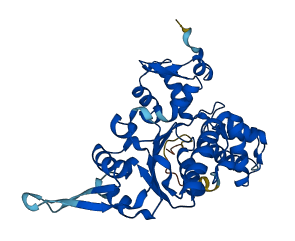
Descriptions
The autoinhibited protein was predicted that may have potential autoinhibitory elements via cis-regPred.
Autoinhibitory domains (AIDs)
Target domain |
|
Relief mechanism |
|
Assay |
cis-regPred |
Accessory elements
No accessory elements
Autoinhibited structure

Activated structure
1 structures for P0A812
| Entry ID | Method | Resolution | Chain | Position | Source |
|---|---|---|---|---|---|
| AF-P0A812-F1 | Predicted | AlphaFoldDB |
No variants for P0A812
| Variant ID(s) | Position | Change | Description | Diseaes Association | Provenance |
|---|---|---|---|---|---|
| No variants for P0A812 | |||||
No associated diseases with P0A812
Functions
| Description | ||
|---|---|---|
| EC Number | 3.6.4.12 | Acting on ATP; involved in cellular and subcellular movement |
| Subcellular Localization |
|
|
| PANTHER Family | ||
| PANTHER Subfamily | ||
| PANTHER Protein Class | ||
| PANTHER Pathway Category | No pathway information available | |
3 GO annotations of cellular component
| Name | Definition |
|---|---|
| cytosol | The part of the cytoplasm that does not contain organelles but which does contain other particulate matter, such as protein complexes. |
| Holliday junction helicase complex | A DNA helicase complex found at Holliday junctions where the helicase activity is involved in the migration of the junction branch point. The best-characterized example is the E. coli RuvAB complex, in which a hexamer of RuvB subunits possesses helicase activity that is modulated by association with RuvA. |
| Holliday junction resolvase complex | An endodeoxyribonuclease complex that resolves the 4-way DNA intermediates of a Holliday junction into two separate duplex DNA molecules. Can be branch-migration associated. |
5 GO annotations of molecular function
| Name | Definition |
|---|---|
| ATP binding | Binding to ATP, adenosine 5'-triphosphate, a universally important coenzyme and enzyme regulator. |
| ATP hydrolysis activity | Catalysis of the reaction: ATP + H2O = ADP + H+ phosphate. ATP hydrolysis is used in some reactions as an energy source, for example to catalyze a reaction or drive transport against a concentration gradient. |
| DNA binding | Any molecular function by which a gene product interacts selectively and non-covalently with DNA (deoxyribonucleic acid). |
| DNA helicase activity | Unwinding of a DNA helix, driven by ATP hydrolysis. |
| four-way junction helicase activity | Unwinding a DNA helix of DNA containing four-way junctions, including Holliday junctions, driven by ATP hydrolysis. |
3 GO annotations of biological process
| Name | Definition |
|---|---|
| recombinational repair | A DNA repair process that involves the exchange, reciprocal or nonreciprocal, of genetic material between the broken DNA molecule and a homologous DNA region. |
| response to UV | Any process that results in a change in state or activity of a cell or an organism (in terms of movement, secretion, enzyme production, gene expression, etc.) as a result of an ultraviolet radiation (UV light) stimulus. Ultraviolet radiation is electromagnetic radiation with a wavelength in the range of 10 to 380 nanometers. |
| SOS response | An error-prone process for repairing damaged microbial DNA. |
No homologous proteins in AiPD
| UniProt AC | Gene Name | Protein Name | Species | Evidence Code |
|---|---|---|---|---|
| No homologous proteins | ||||
| 10 | 20 | 30 | 40 | 50 | 60 |
| MIEADRLISA | GTTLPEDVAD | RAIRPKLLEE | YVGQPQVRSQ | MEIFIKAAKL | RGDALDHLLI |
| 70 | 80 | 90 | 100 | 110 | 120 |
| FGPPGLGKTT | LANIVANEMG | VNLRTTSGPV | LEKAGDLAAM | LTNLEPHDVL | FIDEIHRLSP |
| 130 | 140 | 150 | 160 | 170 | 180 |
| VVEEVLYPAM | EDYQLDIMIG | EGPAARSIKI | DLPPFTLIGA | TTRAGSLTSP | LRDRFGIVQR |
| 190 | 200 | 210 | 220 | 230 | 240 |
| LEFYQVPDLQ | YIVSRSARFM | GLEMSDDGAL | EVARRARGTP | RIANRLLRRV | RDFAEVKHDG |
| 250 | 260 | 270 | 280 | 290 | 300 |
| TISADIAAQA | LDMLNVDAEG | FDYMDRKLLL | AVIDKFFGGP | VGLDNLAAAI | GEERETIEDV |
| 310 | 320 | 330 | |||
| LEPYLIQQGF | LQRTPRGRMA | TTRAWNHFGI | TPPEMP |