P0A7G6
Gene name |
recA |
Protein name |
Protein RecA |
Names |
Recombinase A |
Species |
Escherichia coli (strain K12) |
KEGG Pathway |
eco:b2699 |
EC number |
|
Protein Class |
|
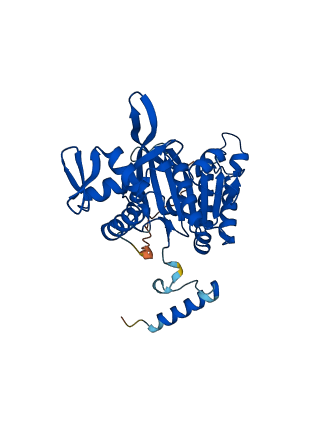
Descriptions
The autoinhibited protein was predicted that may have potential autoinhibitory elements via cis-regPred.
Autoinhibitory domains (AIDs)
Target domain |
|
Relief mechanism |
|
Assay |
cis-regPred |
Accessory elements
No accessory elements
Autoinhibited structure

Activated structure
25 structures for P0A7G6
| Entry ID | Method | Resolution | Chain | Position | Source |
|---|---|---|---|---|---|
| 1AA3 | NMR | - | A | 269-331 | PDB |
| 1N03 | EM | 2000 A | A/B/C/D/E/F/G | 2-353 | PDB |
| 1REA | X-ray | 270 A | A | 2-353 | PDB |
| 1U94 | X-ray | 190 A | A | 2-353 | PDB |
| 1U98 | X-ray | 200 A | A | 2-353 | PDB |
| 1U99 | X-ray | 260 A | A | 2-353 | PDB |
| 1XMS | X-ray | 210 A | A | 2-353 | PDB |
| 1XMV | X-ray | 190 A | A | 2-353 | PDB |
| 2REB | X-ray | 230 A | A | 2-353 | PDB |
| 2REC | EM | - | A/B/C/D/E/F | 1-353 | PDB |
| 3CMT | X-ray | 315 A | A/D | 2-335 | PDB |
| 3CMU | X-ray | 420 A | A | 2-335 | PDB |
| 3CMV | X-ray | 430 A | A/B/C/D/E/F/G/H | 2-335 | PDB |
| 3CMW | X-ray | 280 A | A/C | 2-335 | PDB |
| 3CMX | X-ray | 340 A | A/D | 2-335 | PDB |
| 4TWZ | X-ray | 280 A | A | 2-353 | PDB |
| 7JY6 | EM | 250 A | A/B/C/D/E/F/G/H/I | 1-334 | PDB |
| 7JY7 | EM | 290 A | A/B/C/D/E/F/G/H/I | 1-334 | PDB |
| 7JY8 | EM | 250 A | A/B/C/D/E/F/G/H/I | 1-334 | PDB |
| 7JY9 | EM | 280 A | A/B/C/D/E/F/G/H/I | 1-334 | PDB |
| 7YWA | EM | 326 A | F/G | 1-353 | PDB |
| 8GMT | EM | 331 A | F/G | 1-353 | PDB |
| 8GMU | EM | 278 A | F/G | 1-353 | PDB |
| 8TRG | EM | 293 A | A/B/C/D/E/F/G/H | 1-353 | PDB |
| AF-P0A7G6-F1 | Predicted | AlphaFoldDB |
No variants for P0A7G6
| Variant ID(s) | Position | Change | Description | Diseaes Association | Provenance |
|---|---|---|---|---|---|
| No variants for P0A7G6 | |||||
No associated diseases with P0A7G6
4 regional properties for P0A7G6
| Type | Name | Position | InterPro Accession |
|---|---|---|---|
| domain | AAA+ ATPase domain | 59 - 230 | IPR003593 |
| conserved_site | DNA recombination/repair protein RecA, conserved site | 215 - 223 | IPR020584 |
| domain | DNA recombination and repair protein RecA, monomer-monomer interface | 201 - 274 | IPR020587 |
| domain | DNA recombination and repair protein RecA-like, ATP-binding domain | 37 - 196 | IPR020588 |
2 GO annotations of cellular component
| Name | Definition |
|---|---|
| cytoplasm | The contents of a cell excluding the plasma membrane and nucleus, but including other subcellular structures. |
| DNA polymerase V complex | A DNA polymerase complex that contains two UmuD' and one UmuC subunits, and acts in translesion DNA synthesis. |
5 GO annotations of molecular function
| Name | Definition |
|---|---|
| ATP binding | Binding to ATP, adenosine 5'-triphosphate, a universally important coenzyme and enzyme regulator. |
| ATP-dependent activity, acting on DNA | Catalytic activity that acts to modify DNA, driven by ATP hydrolysis. |
| ATP-dependent DNA damage sensor activity | A molecule that recognises toxic DNA structures, and initiates a signalling response, driven by ATP hydrolysis. |
| damaged DNA binding | Binding to damaged DNA. |
| single-stranded DNA binding | Binding to single-stranded DNA. |
8 GO annotations of biological process
| Name | Definition |
|---|---|
| cell motility | Any process involved in the controlled self-propelled movement of a cell that results in translocation of the cell from one place to another. |
| cellular response to DNA damage stimulus | Any process that results in a change in state or activity of a cell (in terms of movement, secretion, enzyme production, gene expression, etc.) as a result of a stimulus indicating damage to its DNA from environmental insults or errors during metabolism. |
| DNA recombination | Any process in which a new genotype is formed by reassortment of genes resulting in gene combinations different from those that were present in the parents. In eukaryotes genetic recombination can occur by chromosome assortment, intrachromosomal recombination, or nonreciprocal interchromosomal recombination. Interchromosomal recombination occurs by crossing over. In bacteria it may occur by genetic transformation, conjugation, transduction, or F-duction. |
| homologous recombination | A DNA recombination process that results in the exchange of an equal amount of genetic material between highly homologous DNA molecules. |
| recombinational repair | A DNA repair process that involves the exchange, reciprocal or nonreciprocal, of genetic material between the broken DNA molecule and a homologous DNA region. |
| response to ionizing radiation | Any process that results in a change in state or activity of a cell or an organism (in terms of movement, secretion, enzyme production, gene expression, etc.) as a result of a ionizing radiation stimulus. Ionizing radiation is radiation with sufficient energy to remove electrons from atoms and may arise from spontaneous decay of unstable isotopes, resulting in alpha and beta particles and gamma rays. Ionizing radiation also includes X-rays. |
| SOS response | An error-prone process for repairing damaged microbial DNA. |
| translesion synthesis | The replication of damaged DNA by synthesis across a lesion in the template strand; a specialized DNA polymerase or replication complex inserts a defined nucleotide across from the lesion which allows DNA synthesis to continue beyond the lesion. This process can be mutagenic depending on the damaged nucleotide and the inserted nucleotide. |
No homologous proteins in AiPD
| UniProt AC | Gene Name | Protein Name | Species | Evidence Code |
|---|---|---|---|---|
| No homologous proteins | ||||
| 10 | 20 | 30 | 40 | 50 | 60 |
| MAIDENKQKA | LAAALGQIEK | QFGKGSIMRL | GEDRSMDVET | ISTGSLSLDI | ALGAGGLPMG |
| 70 | 80 | 90 | 100 | 110 | 120 |
| RIVEIYGPES | SGKTTLTLQV | IAAAQREGKT | CAFIDAEHAL | DPIYARKLGV | DIDNLLCSQP |
| 130 | 140 | 150 | 160 | 170 | 180 |
| DTGEQALEIC | DALARSGAVD | VIVVDSVAAL | TPKAEIEGEI | GDSHMGLAAR | MMSQAMRKLA |
| 190 | 200 | 210 | 220 | 230 | 240 |
| GNLKQSNTLL | IFINQIRMKI | GVMFGNPETT | TGGNALKFYA | SVRLDIRRIG | AVKEGENVVG |
| 250 | 260 | 270 | 280 | 290 | 300 |
| SETRVKVVKN | KIAAPFKQAE | FQILYGEGIN | FYGELVDLGV | KEKLIEKAGA | WYSYKGEKIG |
| 310 | 320 | 330 | 340 | 350 | |
| QGKANATAWL | KDNPETAKEI | EKKVRELLLS | NPNSTPDFSV | DDSEGVAETN | EDF |