P0A6Y5
Gene name |
hslO |
Protein name |
33 kDa chaperonin |
Names |
Heat shock protein 33, HSP33 |
Species |
Escherichia coli (strain K12) |
KEGG Pathway |
eco:b3401 |
EC number |
|
Protein Class |
|
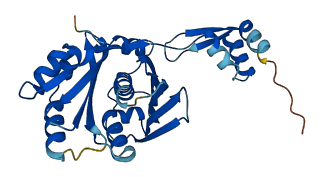
Descriptions
The autoinhibited protein was predicted that may have potential autoinhibitory elements via cis-regPred.
Autoinhibitory domains (AIDs)
Target domain |
|
Relief mechanism |
|
Assay |
cis-regPred |
Accessory elements
No accessory elements
Autoinhibited structure

Activated structure
5 structures for P0A6Y5
| Entry ID | Method | Resolution | Chain | Position | Source |
|---|---|---|---|---|---|
| 1HW7 | X-ray | 220 A | A | 1-253 | PDB |
| 1I7F | X-ray | 270 A | A | 1-292 | PDB |
| 1XJH | NMR | - | A | 225-285 | PDB |
| 3M7M | X-ray | 290 A | X | 1-233 | PDB |
| AF-P0A6Y5-F1 | Predicted | AlphaFoldDB |
No variants for P0A6Y5
| Variant ID(s) | Position | Change | Description | Diseaes Association | Provenance |
|---|---|---|---|---|---|
| No variants for P0A6Y5 | |||||
No associated diseases with P0A6Y5
No regional properties for P0A6Y5
| Type | Name | Position | InterPro Accession |
|---|---|---|---|
| No domain, repeats, and functional sites for P0A6Y5 | |||
2 GO annotations of cellular component
4 GO annotations of molecular function
| Name | Definition |
|---|---|
| identical protein binding | Binding to an identical protein or proteins. |
| protein folding chaperone | Binding to a protein or a protein-containing complex to assist the protein folding process. |
| unfolded protein binding | Binding to an unfolded protein. |
| zinc ion binding | Binding to a zinc ion (Zn). |
4 GO annotations of biological process
| Name | Definition |
|---|---|
| maintenance of unfolded protein | Maintaining a protein in an unfolded, soluble state. |
| protein refolding | The process carried out by a cell that restores the biological activity of an unfolded or misfolded protein, using helper proteins such as chaperones. |
| response to heat | Any process that results in a change in state or activity of a cell or an organism (in terms of movement, secretion, enzyme production, gene expression, etc.) as a result of a heat stimulus, a temperature stimulus above the optimal temperature for that organism. |
| response to oxidative stress | Any process that results in a change in state or activity of a cell or an organism (in terms of movement, secretion, enzyme production, gene expression, etc.) as a result of oxidative stress, a state often resulting from exposure to high levels of reactive oxygen species, e.g. superoxide anions, hydrogen peroxide (H2O2), and hydroxyl radicals. |
No homologous proteins in AiPD
| UniProt AC | Gene Name | Protein Name | Species | Evidence Code |
|---|---|---|---|---|
| No homologous proteins | ||||
| 10 | 20 | 30 | 40 | 50 | 60 |
| MPQHDQLHRY | LFENFAVRGE | LVTVSETLQQ | ILENHDYPQP | VKNVLAELLV | ATSLLTATLK |
| 70 | 80 | 90 | 100 | 110 | 120 |
| FDGDITVQLQ | GDGPMNLAVI | NGNNNQQMRG | VARVQGEIPE | NADLKTLVGN | GYVVITITPS |
| 130 | 140 | 150 | 160 | 170 | 180 |
| EGERYQGVVG | LEGDTLAACL | EDYFMRSEQL | PTRLFIRTGD | VDGKPAAGGM | LLQVMPAQNA |
| 190 | 200 | 210 | 220 | 230 | 240 |
| QQDDFDHLAT | LTETIKTEEL | LTLPANEVLW | RLYHEEEVTV | YDPQDVEFKC | TCSRERCADA |
| 250 | 260 | 270 | 280 | 290 | |
| LKTLPDEEVD | SILAEDGEID | MHCDYCGNHY | LFNAMDIAEI | RNNASPADPQ | VH |