P0A6E6
Gene name |
atpC (papG, uncC, b3731, JW3709) |
Protein name |
ATP synthase epsilon chain |
Names |
ATP synthase F1 sector epsilon subunit, F-ATPase epsilon subunit |
Species |
Escherichia coli (strain K12) |
KEGG Pathway |
eco:b3731 |
EC number |
|
Protein Class |
|
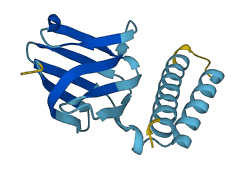
Descriptions
The autoinhibited protein was predicted that may have potential autoinhibitory elements via cis-regPred.
Autoinhibitory domains (AIDs)
Target domain |
|
Relief mechanism |
|
Assay |
cis-regPred |
Accessory elements
No accessory elements
Autoinhibited structure

Activated structure
20 structures for P0A6E6
| Entry ID | Method | Resolution | Chain | Position | Source |
|---|---|---|---|---|---|
| 1AQT | X-ray | 230 A | A | 4-139 | PDB |
| 1BSH | NMR | - | A | 2-139 | PDB |
| 1BSN | NMR | - | A | 2-139 | PDB |
| 1FS0 | X-ray | 210 A | E | 2-139 | PDB |
| 1QO1 | X-ray | 390 A | J | 4-139 | PDB |
| 3OAA | X-ray | 326 A | H/P/X/f | 2-139 | PDB |
| 5T4O | EM | 690 A | H | 1-139 | PDB |
| 5T4P | EM | 777 A | H | 1-139 | PDB |
| 5T4Q | EM | 853 A | H | 1-139 | PDB |
| 6OQR | EM | 310 A | H | 1-139 | PDB |
| 6OQS | EM | 330 A | H | 1-139 | PDB |
| 6OQT | EM | 310 A | H | 1-139 | PDB |
| 6OQU | EM | 320 A | H | 1-139 | PDB |
| 6OQV | EM | 330 A | H | 1-139 | PDB |
| 6OQW | EM | 310 A | H | 1-139 | PDB |
| 6PQV | EM | 330 A | H | 1-139 | PDB |
| 6WNQ | EM | 340 A | H | 1-139 | PDB |
| 6WNR | EM | 330 A | H | 1-139 | PDB |
| 8DBS | EM | 350 A | H | 4-104 | PDB |
| AF-P0A6E6-F1 | Predicted | AlphaFoldDB |
No variants for P0A6E6
| Variant ID(s) | Position | Change | Description | Diseaes Association | Provenance |
|---|---|---|---|---|---|
| No variants for P0A6E6 | |||||
No associated diseases with P0A6E6
3 GO annotations of cellular component
| Name | Definition |
|---|---|
| plasma membrane | The membrane surrounding a cell that separates the cell from its external environment. It consists of a phospholipid bilayer and associated proteins. |
| proton-transporting ATP synthase complex | A proton-transporting two-sector ATPase complex that catalyzes the phosphorylation of ADP to ATP during oxidative phosphorylation. The complex comprises a membrane sector (F0) that carries out proton transport and a cytoplasmic compartment sector (F1) that catalyzes ATP synthesis by a rotational mechanism; the extramembrane sector (containing 3 a and 3 b subunits) is connected via the d-subunit to the membrane sector by several smaller subunits. Within this complex, the g and e subunits and the 9-12 c subunits rotate by consecutive 120 degree angles and perform parts of ATP synthesis. This movement is driven by the hydrogen ion electrochemical potential gradient. |
| proton-transporting ATP synthase complex, catalytic core F(1) | The sector of a hydrogen-transporting ATP synthase complex in which the catalytic activity resides; it comprises the catalytic core and central stalk, and is peripherally associated with a membrane, such as the plasma membrane or the mitochondrial inner membrane, when the entire ATP synthase is assembled. |
2 GO annotations of molecular function
| Name | Definition |
|---|---|
| ATP binding | Binding to ATP, adenosine 5'-triphosphate, a universally important coenzyme and enzyme regulator. |
| proton-transporting ATP synthase activity, rotational mechanism | Enables the synthesis of ATP from ADP and phosphate by the transfer of protons from one side of a membrane to the other by a rotational mechanism driven by a gradient according to the reaction: ADP + H2O + phosphate + H+(in) -> ATP + H+(out). |
2 GO annotations of biological process
| Name | Definition |
|---|---|
| proton motive force-driven ATP synthesis | The transport of protons across a membrane to generate an electrochemical gradient (proton-motive force) that powers ATP synthesis. |
| proton motive force-driven plasma membrane ATP synthesis | The transport of protons across the plasma membrane to generate an electrochemical gradient (proton-motive force) that powers ATP synthesis. |
No homologous proteins in AiPD
| UniProt AC | Gene Name | Protein Name | Species | Evidence Code |
|---|---|---|---|---|
| No homologous proteins | ||||
| 10 | 20 | 30 | 40 | 50 | 60 |
| MAMTYHLDVV | SAEQQMFSGL | VEKIQVTGSE | GELGIYPGHA | PLLTAIKPGM | IRIVKQHGHE |
| 70 | 80 | 90 | 100 | 110 | 120 |
| EFIYLSGGIL | EVQPGNVTVL | ADTAIRGQDL | DEARAMEAKR | KAEEHISSSH | GDVDYAQASA |
| 130 | |||||
| ELAKAIAQLR | VIELTKKAM |