Descriptions
The autoinhibited protein was predicted that may have potential autoinhibitory elements via cis-regPred.
Autoinhibitory domains (AIDs)
Target domain |
|
Relief mechanism |
|
Assay |
cis-regPred |
Accessory elements
No accessory elements
Autoinhibited structure

Activated structure
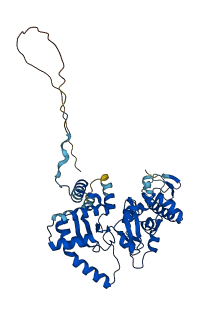
1 structures for P08712
| Entry ID | Method | Resolution | Chain | Position | Source |
|---|---|---|---|---|---|
| AF-P08712-F1 | Predicted | AlphaFoldDB |
No variants for P08712
| Variant ID(s) | Position | Change | Description | Diseaes Association | Provenance |
|---|---|---|---|---|---|
| No variants for P08712 | |||||
No associated diseases with P08712
No regional properties for P08712
| Type | Name | Position | InterPro Accession |
|---|---|---|---|
| No domain, repeats, and functional sites for P08712 | |||
2 GO annotations of cellular component
| Name | Definition |
|---|---|
| melanosome | A tissue-specific, membrane-bounded cytoplasmic organelle within which melanin pigments are synthesized and stored. Melanosomes are synthesized in melanocyte cells. |
| sarcoplasmic reticulum lumen | The volume enclosed by the membranes of the sarcoplasmic reticulum. |
4 GO annotations of molecular function
| Name | Definition |
|---|---|
| ATP binding | Binding to ATP, adenosine 5'-triphosphate, a universally important coenzyme and enzyme regulator. |
| ATP hydrolysis activity | Catalysis of the reaction: ATP + H2O = ADP + H+ phosphate. ATP hydrolysis is used in some reactions as an energy source, for example to catalyze a reaction or drive transport against a concentration gradient. |
| ATP-dependent protein folding chaperone | Binding to a protein or a protein-containing complex to assist the protein folding process, driven by ATP hydrolysis. |
| unfolded protein binding | Binding to an unfolded protein. |
1 GO annotations of biological process
| Name | Definition |
|---|---|
| ubiquitin-dependent ERAD pathway | The series of steps necessary to target endoplasmic reticulum (ER)-resident proteins for degradation by the cytoplasmic proteasome. Begins with recognition of the ER-resident protein, includes retrotranslocation (dislocation) of the protein from the ER to the cytosol, protein ubiquitination necessary for correct substrate transfer, transport of the protein to the proteasome, and ends with degradation of the protein by the cytoplasmic proteasome. |
No homologous proteins in AiPD
| UniProt AC | Gene Name | Protein Name | Species | Evidence Code |
|---|---|---|---|---|
| No homologous proteins | ||||
| 10 | 20 | 30 | 40 | 50 | 60 |
| KKSDYIKLYV | RRVFITDDFH | DMMPKYLNFV | KGVVDSDDLP | LNVSRETLQQ | HKLLKVIRKK |
| 70 | 80 | 90 | 100 | 110 | 120 |
| LVRKTLDMIK | KIADEKYNDT | FWKEFGTNIK | LGVIEDHSNR | TRLAKLLRFQ | SSHHSTDITS |
| 130 | 140 | 150 | 160 | 170 | 180 |
| LDQYVERMKE | KQDKIYFMAG | SSRKEAESSP | FVERLLKKGY | EVIYLTEPVD | EYCIQALPEF |
| 190 | 200 | 210 | 220 | 230 | 240 |
| DGKRFQNVAK | EGVKFDESEK | TKENREATEK | EFEPLLNWMK | DKALKDKIEK | AVVSQRLTES |
| 250 | 260 | 270 | 280 | 290 | 300 |
| PCALVASQYG | WSGNMERIMK | AQAYQTGKDI | STNYYASQKK | TFEINPRHPL | IRDMLRRVKE |
| 310 | 320 | 330 | 340 | 350 | 360 |
| DEDDKTVLDL | AVVLFETATL | RSGYLLPDTK | AYADRIERML | RLSLNIDPEA | QVEEEPEEEP |
| 370 | 380 | 390 | |||
| EDTTEDTEQD | EEEEVDAGTE | EEEEEEQETA | KESTAEKDEL |