P07654
Gene name |
pstA (phoT, b3726, JW3704) |
Protein name |
Phosphate transport system permease protein PstA |
Names |
|
Species |
Escherichia coli (strain K12) |
KEGG Pathway |
eco:b3726 |
EC number |
|
Protein Class |
|
Descriptions
The autoinhibited protein was predicted that may have potential autoinhibitory elements via cis-regPred.
Autoinhibitory domains (AIDs)
Target domain |
|
Relief mechanism |
|
Assay |
cis-regPred |
Accessory elements
No accessory elements
Autoinhibited structure

Activated structure
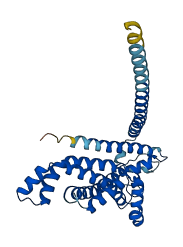
1 structures for P07654
| Entry ID | Method | Resolution | Chain | Position | Source |
|---|---|---|---|---|---|
| AF-P07654-F1 | Predicted | AlphaFoldDB |
No variants for P07654
| Variant ID(s) | Position | Change | Description | Diseaes Association | Provenance |
|---|---|---|---|---|---|
| No variants for P07654 | |||||
No associated diseases with P07654
1 regional properties for P07654
| Type | Name | Position | InterPro Accession |
|---|---|---|---|
| domain | ABC transporter type 1, transmembrane domain MetI-like | 83 - 289 | IPR000515 |
3 GO annotations of cellular component
| Name | Definition |
|---|---|
| ATP-binding cassette (ABC) transporter complex, substrate-binding subunit-containing | A complex for the transport of metabolites into the cell, consisting of 5 subunits: two ATP-binding subunits, two membrane spanning subunits, and one substrate-binding subunit. In organisms with two membranes, the substrate-binding protein moves freely in the periplasmic space and joins the other subunits only when bound with substrate. In organisms with only one membrane the substrate-binding protein is tethered to the cytoplasmic membrane and associated with the other subunits. Transport of the substrate across the membrane is driven by the hydrolysis of ATP. |
| integral component of plasma membrane | The component of the plasma membrane consisting of the gene products and protein complexes having at least some part of their peptide sequence embedded in the hydrophobic region of the membrane. |
| membrane | A lipid bilayer along with all the proteins and protein complexes embedded in it an attached to it. |
1 GO annotations of molecular function
| Name | Definition |
|---|---|
| inorganic phosphate transmembrane transporter activity | Enables the transfer of a inorganic phosphate from one side of a membrane to the other, up its concentration gradient. The transporter binds the solute and undergoes a series of conformational changes. Transport works equally well in either direction and is driven by a chemiosmotic source of energy. Secondary active transporters include symporters and antiporters. |
4 GO annotations of biological process
| Name | Definition |
|---|---|
| cellular response to DNA damage stimulus | Any process that results in a change in state or activity of a cell (in terms of movement, secretion, enzyme production, gene expression, etc.) as a result of a stimulus indicating damage to its DNA from environmental insults or errors during metabolism. |
| phosphate ion transmembrane transport | The process in which a phosphate is transported across a membrane. |
| phosphate ion transport | The directed movement of phosphate into, out of or within a cell, or between cells, by means of some agent such as a transporter or pore. |
| regulation of phosphatase activity | Any process that modulates the rate or frequency of phosphatase activity. Phosphatases catalyze the hydrolysis of phosphoric monoesters, releasing inorganic phosphate. |
No homologous proteins in AiPD
| UniProt AC | Gene Name | Protein Name | Species | Evidence Code |
|---|---|---|---|---|
| No homologous proteins | ||||
| 10 | 20 | 30 | 40 | 50 | 60 |
| MAMVEMQTTA | ALAESRRKMQ | ARRRLKNRIA | LTLSMATMAF | GLFWLIWILM | STITRGIDGM |
| 70 | 80 | 90 | 100 | 110 | 120 |
| SLALFTEMTP | PPNTEGGGLA | NALAGSGLLI | LWATVFGTPL | GIMAGIYLAE | YGRKSWLAEV |
| 130 | 140 | 150 | 160 | 170 | 180 |
| IRFINDILLS | APSIVVGLFV | YTIVVAQMEH | FSGWAGVIAL | ALLQVPIVIR | TTENMLKLVP |
| 190 | 200 | 210 | 220 | 230 | 240 |
| YSLREAAYAL | GTPKWKMISA | ITLKASVSGI | MTGILLAIAR | IAGETAPLLF | TALSNQFWST |
| 250 | 260 | 270 | 280 | 290 | |
| DMMQPIANLP | VTIFKFAMSP | FAEWQQLAWA | GVLIITLCVL | LLNILARVVF | AKNKHG |