P07287
Gene name |
ermE (SACE_0733) |
Protein name |
rRNA adenine N-6-methyltransferase |
Names |
NMT, Erythromycin resistance protein, Macrolide-lincosamide-streptogramin B resistance protein |
Species |
Saccharopolyspora erythraea (strain ATCC 11635 / DSM 40517 / JCM 4748 / NBRC 13426 / NCIMB 8594 / NRRL 2338) |
KEGG Pathway |
sen:SACE_0733 |
EC number |
2.1.1.184: Methyltransferases |
Protein Class |
|
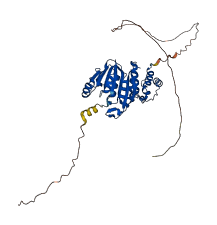
Descriptions
The autoinhibited protein was predicted that may have potential autoinhibitory elements via cis-regPred.
Autoinhibitory domains (AIDs)
Target domain |
|
Relief mechanism |
|
Assay |
cis-regPred |
Accessory elements
No accessory elements
Autoinhibited structure

Activated structure
2 structures for P07287
| Entry ID | Method | Resolution | Chain | Position | Source |
|---|---|---|---|---|---|
| 6NVM | X-ray | 175 A | A | 1-290 | PDB |
| AF-P07287-F1 | Predicted | AlphaFoldDB |
No variants for P07287
| Variant ID(s) | Position | Change | Description | Diseaes Association | Provenance |
|---|---|---|---|---|---|
| No variants for P07287 | |||||
No associated diseases with P07287
Functions
| Description | ||
|---|---|---|
| EC Number | 2.1.1.184 | Methyltransferases |
| Subcellular Localization |
|
|
| PANTHER Family | ||
| PANTHER Subfamily | ||
| PANTHER Protein Class | ||
| PANTHER Pathway Category | No pathway information available | |
No GO annotations of cellular component
| Name | Definition |
|---|---|
| No GO annotations for cellular component |
3 GO annotations of molecular function
| Name | Definition |
|---|---|
| 23S rRNA (adenine(2085)-N(6))-dimethyltransferase activity | Catalysis of the reaction: 2 S-adenosyl-L-methionine + adenine(2085) in 23S rRNA = 2 S-adenosyl-L-homocysteine + N(6)-dimethyladenine(2085) in 23S rRNA. |
| RNA binding | Binding to an RNA molecule or a portion thereof. |
| rRNA (adenine-N6,N6-)-dimethyltransferase activity | Catalysis of the dimethylation of two adjacent adenine residues in a rRNA, using S-adenosyl-L-methionine as a methyl donor. |
1 GO annotations of biological process
| Name | Definition |
|---|---|
| response to antibiotic | Any process that results in a change in state or activity of a cell or an organism (in terms of movement, secretion, enzyme production, gene expression, etc.) as a result of an antibiotic stimulus. An antibiotic is a chemical substance produced by a microorganism which has the capacity to inhibit the growth of or to kill other microorganisms. |
No homologous proteins in AiPD
| UniProt AC | Gene Name | Protein Name | Species | Evidence Code |
|---|---|---|---|---|
| No homologous proteins | ||||
| 10 | 20 | 30 | 40 | 50 | 60 |
| MSSSDEQPRP | RRRNQDRQHP | NQNRPVLGRT | ERDRNRRQFG | QNFLRDRKTI | ARIAETAELR |
| 70 | 80 | 90 | 100 | 110 | 120 |
| PDLPVLEAGP | GEGLLTRELA | DRARQVTSYE | IDPRLAKSLR | EKLSGHPNIE | VVNADFLTAE |
| 130 | 140 | 150 | 160 | 170 | 180 |
| PPPEPFAFVG | AIPYGITSAI | VDWCLEAPTI | ETATMVTQLE | FARKRTGDYG | RWSRLTVMTW |
| 190 | 200 | 210 | 220 | 230 | 240 |
| PLFEWEFVEK | VDRRLFKPVP | KVDSAIMRLR | RRAEPLLEGA | ALERYESMVE | LCFTGVGGNI |
| 250 | 260 | 270 | 280 | 290 | 300 |
| QASLLRKYPR | RRVEAALDHA | GVGGGAVVAY | VRPEQWLRLF | ERLDQKNEPR | GGQPQRGRRT |
| 310 | 320 | 330 | 340 | 350 | 360 |
| GGRDHGDRRT | GGQDRGDRRT | GGRDHRDRQA | SGHGDRRSSG | RNRDDGRTGE | REQGDQGGRR |
| 370 | 380 | ||||
| GPSGGGRTGG | RPGRRGGPGQ | R |