P07023
Gene name |
tyrA (b2600, JW2581) |
Protein name |
T-protein |
Names |
|
Species |
Escherichia coli (strain K12) |
KEGG Pathway |
eco:b2600 |
EC number |
1.3.1.12: With NAD(+) or NADP(+) as acceptor |
Protein Class |
|
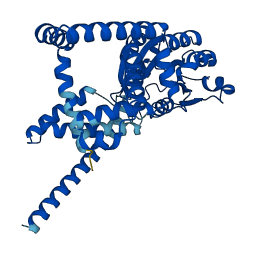
Descriptions
The autoinhibited protein was predicted that may have potential autoinhibitory elements via cis-regPred.
Autoinhibitory domains (AIDs)
Target domain |
|
Relief mechanism |
|
Assay |
cis-regPred |
Accessory elements
No accessory elements
Autoinhibited structure

Activated structure
1 structures for P07023
| Entry ID | Method | Resolution | Chain | Position | Source |
|---|---|---|---|---|---|
| AF-P07023-F1 | Predicted | AlphaFoldDB |
No variants for P07023
| Variant ID(s) | Position | Change | Description | Diseaes Association | Provenance |
|---|---|---|---|---|---|
| No variants for P07023 | |||||
No associated diseases with P07023
5 regional properties for P07023
| Type | Name | Position | InterPro Accession |
|---|---|---|---|
| domain | Chorismate mutase II, prokaryotic-type | 1 - 90 | IPR002701 |
| domain | Prephenate dehydrogenase | 99 - 361 | IPR003099 |
| domain | Chorismate mutase, T-protein | 5 - 87 | IPR011277 |
| domain | Prephenate dehydrogenase, dimerization domain | 243 - 344 | IPR046825 |
| domain | Prephenate dehydrogenase, nucleotide-binding domain | 137 - 225 | IPR046826 |
Functions
| Description | ||
|---|---|---|
| EC Number | 1.3.1.12 | With NAD(+) or NADP(+) as acceptor |
| Subcellular Localization |
|
|
| PANTHER Family | ||
| PANTHER Subfamily | ||
| PANTHER Protein Class | ||
| PANTHER Pathway Category | No pathway information available | |
1 GO annotations of cellular component
| Name | Definition |
|---|---|
| cytoplasm | The contents of a cell excluding the plasma membrane and nucleus, but including other subcellular structures. |
4 GO annotations of molecular function
| Name | Definition |
|---|---|
| chorismate mutase activity | Catalysis of the reaction: chorismate = prephenate. |
| NAD+ binding | Binding to the oxidized form, NAD, of nicotinamide adenine dinucleotide, a coenzyme involved in many redox and biosynthetic reactions. |
| prephenate dehydrogenase (NAD+) activity | Catalysis of the reaction: NAD(+) + prephenate = (4-hydroxyphenyl)pyruvate + CO(2) + NADH. |
| prephenate dehydrogenase (NADP+) activity | Catalysis of the reaction: NADP(+) + prephenate = (4-hydroxyphenyl)pyruvate + CO(2) + NADPH. |
3 GO annotations of biological process
| Name | Definition |
|---|---|
| chorismate metabolic process | The chemical reactions and pathways involving chorismate, the anion of (3R-trans)-3-((1-carboxyethenyl)oxy)-4-hydroxy-1,5-cyclohexadiene-1-carboxylic acid. |
| L-phenylalanine biosynthetic process | The chemical reactions and pathways resulting in the formation of L-phenylalanine, the L-enantiomer of 2-amino-3-phenylpropanoic acid, i.e. (2S)-2-amino-3-phenylpropanoic acid. |
| tyrosine biosynthetic process | The chemical reactions and pathways resulting in the formation of tyrosine, an aromatic amino acid, 2-amino-3-(4-hydroxyphenyl)propanoic acid. |
No homologous proteins in AiPD
| UniProt AC | Gene Name | Protein Name | Species | Evidence Code |
|---|---|---|---|---|
| No homologous proteins | ||||
| 10 | 20 | 30 | 40 | 50 | 60 |
| MVAELTALRD | QIDEVDKALL | NLLAKRLELV | AEVGEVKSRF | GLPIYVPERE | ASMLASRRAE |
| 70 | 80 | 90 | 100 | 110 | 120 |
| AEALGVPPDL | IEDVLRRVMR | ESYSSENDKG | FKTLCPSLRP | VVIVGGGGQM | GRLFEKMLTL |
| 130 | 140 | 150 | 160 | 170 | 180 |
| SGYQVRILEQ | HDWDRAADIV | ADAGMVIVSV | PIHVTEQVIG | KLPPLPKDCI | LVDLASVKNG |
| 190 | 200 | 210 | 220 | 230 | 240 |
| PLQAMLVAHD | GPVLGLHPMF | GPDSGSLAKQ | VVVWCDGRKP | EAYQWFLEQI | QVWGARLHRI |
| 250 | 260 | 270 | 280 | 290 | 300 |
| SAVEHDQNMA | FIQALRHFAT | FAYGLHLAEE | NVQLEQLLAL | SSPIYRLELA | MVGRLFAQDP |
| 310 | 320 | 330 | 340 | 350 | 360 |
| QLYADIIMSS | ERNLALIKRY | YKRFGEAIEL | LEQGDKQAFI | DSFRKVEHWF | GDYAQRFQSE |
| 370 | |||||
| SRVLLRQAND | NRQ |