P06909
Gene name |
Cfh (Hf1) |
Protein name |
Complement factor H |
Names |
Protein beta-1-H |
Species |
Mus musculus (Mouse) |
KEGG Pathway |
mmu:12628 |
EC number |
|
Protein Class |
|
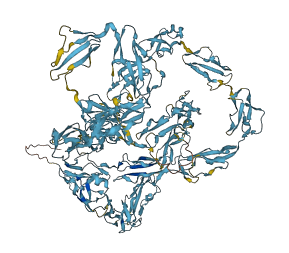
Descriptions
The autoinhibited protein was predicted that may have potential autoinhibitory elements via cis-regPred.
Autoinhibitory domains (AIDs)
Target domain |
|
Relief mechanism |
|
Assay |
cis-regPred |
Accessory elements
No accessory elements
Autoinhibited structure

Activated structure
2 structures for P06909
| Entry ID | Method | Resolution | Chain | Position | Source |
|---|---|---|---|---|---|
| 2YBY | X-ray | 158 A | A | 321-444 | PDB |
| AF-P06909-F1 | Predicted | AlphaFoldDB |
65 variants for P06909
| Variant ID(s) | Position | Change | Description | Diseaes Association | Provenance |
|---|---|---|---|---|---|
| rs36947627 | 48 | A>V | No | EVA | |
| rs3388502799 | 61 | T>I | No | EVA | |
| rs3388502751 | 68 | N>I | No | EVA | |
| rs3388501688 | 71 | W>R | No | EVA | |
| rs3388505838 | 73 | A>S | No | EVA | |
| rs3388500570 | 99 | A>V | No | EVA | |
| rs3388502580 | 132 | D>E | No | EVA | |
| rs3388505134 | 132 | D>V | No | EVA | |
| rs3388503792 | 139 | P>S | No | EVA | |
| rs3388505074 | 140 | L>I | No | EVA | |
| rs3388504331 | 143 | V>I | No | EVA | |
| rs262366520 | 219 | D>E | No | EVA | |
| rs585323518 | 221 | I>L | No | EVA | |
| rs578439397 | 250 | V>I | No | EVA | |
| rs1131891812 | 264 | E>Q | No | EVA | |
| rs251747452 | 266 | R>T | No | EVA | |
| rs3388504978 | 269 | P>S | No | EVA | |
| rs578903941 | 271 | Y>H | No | EVA | |
| rs107672533 | 286 | S>T | No | EVA | |
| rs3388505380 | 290 | I>N | No | EVA | |
| rs584837583 | 311 | P>L | No | EVA | |
| rs1132372992 | 356 | K>R | No | EVA | |
| rs241724059 | 358 | D>H | No | EVA | |
| rs584627175 | 398 | D>E | No | EVA | |
| rs580617139 | 404 | K>N | No | EVA | |
| rs586811204 | 405 | V>I | No | EVA | |
| rs108899218 | 428 | T>I | No | EVA | |
| rs211940980 | 465 | S>Y | No | EVA | |
| rs246435726 | 476 | R>K | No | EVA | |
| rs217096018 | 504 | S>T | No | EVA | |
| rs582287089 | 543 | E>K | No | EVA | |
| rs1133250643 | 631 | P>Q | No | EVA | |
| rs582521379 | 684 | I>V | No | EVA | |
| rs31728142 | 703 | C>F | No | EVA | |
| rs31728142 | 703 | C>Y | No | EVA | |
| rs233759670 | 721 | N>T | No | EVA | |
| rs3388503778 | 732 | C>Y | No | EVA | |
| rs3388505902 | 737 | W>* | No | EVA | |
| rs3388500509 | 750 | E>V | No | EVA | |
| rs3410573663 | 751 | K>S | No | EVA | |
| rs3388503408 | 753 | R>G | No | EVA | |
| rs213551716 | 777 | D>N | No | EVA | |
| rs3388505605 | 783 | K>N | No | EVA | |
| rs3390709367 | 872 | T>I | No | EVA | |
| rs3390709403 | 873 | I>V | No | EVA | |
| rs245670303 | 877 | S>F | No | EVA | |
| rs13462834 | 887 | R>K | No | EVA | |
| rs215178389 | 892 | E>D | No | EVA | |
| rs1134468386 | 917 | R>G | No | EVA | |
| rs1133445517 | 943 | P>L | No | EVA | |
| rs1134715620 | 944 | L>R | No | EVA | |
| rs32512169 | 977 | I>K | No | EVA | |
| rs216958260 | 1020 | T>A | No | EVA | |
| rs3388504965 | 1063 | T>S | No | EVA | |
| rs3388504305 | 1068 | T>S | No | EVA | |
| rs36495977 | 1070 | N>D | No | EVA | |
| rs580904640 | 1181 | S>A | No | EVA | |
| rs3388500592 | 1193 | K>R | No | EVA | |
| rs218130190 | 1211 | Y>C | No | EVA | |
| rs239715054 | 1211 | Y>H | No | EVA | |
| rs3388502623 | 1215 | D>G | No | EVA | |
| rs250368000 | 1215 | D>N | No | EVA | |
| rs1132229590 | 1223 | C>Y | No | EVA | |
| rs239369781 | 1227 | T>I | No | EVA | |
| rs226962491 | 1232 | T>S | No | EVA |
No associated diseases with P06909
20 regional properties for P06909
| Type | Name | Position | InterPro Accession |
|---|---|---|---|
| domain | Sushi/SCR/CCP domain | 19 - 82 | IPR000436-1 |
| domain | Sushi/SCR/CCP domain | 83 - 143 | IPR000436-2 |
| domain | Sushi/SCR/CCP domain | 144 - 207 | IPR000436-3 |
| domain | Sushi/SCR/CCP domain | 208 - 264 | IPR000436-4 |
| domain | Sushi/SCR/CCP domain | 265 - 322 | IPR000436-5 |
| domain | Sushi/SCR/CCP domain | 325 - 385 | IPR000436-6 |
| domain | Sushi/SCR/CCP domain | 387 - 444 | IPR000436-7 |
| domain | Sushi/SCR/CCP domain | 446 - 507 | IPR000436-8 |
| domain | Sushi/SCR/CCP domain | 509 - 564 | IPR000436-9 |
| domain | Sushi/SCR/CCP domain | 567 - 624 | IPR000436-10 |
| domain | Sushi/SCR/CCP domain | 627 - 685 | IPR000436-11 |
| domain | Sushi/SCR/CCP domain | 688 - 745 | IPR000436-12 |
| domain | Sushi/SCR/CCP domain | 752 - 802 | IPR000436-13 |
| domain | Sushi/SCR/CCP domain | 806 - 863 | IPR000436-14 |
| domain | Sushi/SCR/CCP domain | 865 - 933 | IPR000436-15 |
| domain | Sushi/SCR/CCP domain | 934 - 991 | IPR000436-16 |
| domain | Sushi/SCR/CCP domain | 992 - 1050 | IPR000436-17 |
| domain | Sushi/SCR/CCP domain | 1051 - 1109 | IPR000436-18 |
| domain | Sushi/SCR/CCP domain | 1112 - 1170 | IPR000436-19 |
| domain | Sushi/SCR/CCP domain | 1172 - 1233 | IPR000436-20 |
10 GO annotations of cellular component
| Name | Definition |
|---|---|
| axon | The long process of a neuron that conducts nerve impulses, usually away from the cell body to the terminals and varicosities, which are sites of storage and release of neurotransmitter. |
| cytoplasm | The contents of a cell excluding the plasma membrane and nucleus, but including other subcellular structures. |
| external side of plasma membrane | The leaflet of the plasma membrane that faces away from the cytoplasm and any proteins embedded or anchored in it or attached to its surface. |
| extracellular region | The space external to the outermost structure of a cell. For cells without external protective or external encapsulating structures this refers to space outside of the plasma membrane. This term covers the host cell environment outside an intracellular parasite. |
| extracellular space | That part of a multicellular organism outside the cells proper, usually taken to be outside the plasma membranes, and occupied by fluid. |
| mitochondrion | A semiautonomous, self replicating organelle that occurs in varying numbers, shapes, and sizes in the cytoplasm of virtually all eukaryotic cells. It is notably the site of tissue respiration. |
| neuronal cell body | The portion of a neuron that includes the nucleus, but excludes cell projections such as axons and dendrites. |
| nucleus | A membrane-bounded organelle of eukaryotic cells in which chromosomes are housed and replicated. In most cells, the nucleus contains all of the cell's chromosomes except the organellar chromosomes, and is the site of RNA synthesis and processing. In some species, or in specialized cell types, RNA metabolism or DNA replication may be absent. |
| plasma membrane | The membrane surrounding a cell that separates the cell from its external environment. It consists of a phospholipid bilayer and associated proteins. |
| serine-type endopeptidase complex | A protein complex which is capable of serine-type endopeptidase activity. |
4 GO annotations of molecular function
| Name | Definition |
|---|---|
| complement component C3b binding | Binding to a C3b product of the complement cascade. |
| heparan sulfate proteoglycan binding | Binding to a heparan sulfate proteoglycan, any proteoglycan containing heparan sulfate as the glycosaminoglycan carbohydrate unit. |
| heparin binding | Binding to heparin, a member of a group of glycosaminoglycans found mainly as an intracellular component of mast cells and which consist predominantly of alternating alpha-(1->4)-linked D-galactose and N-acetyl-D-glucosamine-6-sulfate residues. |
| identical protein binding | Binding to an identical protein or proteins. |
30 GO annotations of biological process
| Name | Definition |
|---|---|
| activation of membrane attack complex | The activation of the membrane attack complex components of the complement cascade which can result in death of a target cell through cytolysis. |
| angiogenesis | Blood vessel formation when new vessels emerge from the proliferation of pre-existing blood vessels. |
| ATP metabolic process | The chemical reactions and pathways involving ATP, adenosine triphosphate, a universally important coenzyme and enzyme regulator. |
| complement activation | Any process involved in the activation of any of the steps of the complement cascade, which allows for the direct killing of microbes, the disposal of immune complexes, and the regulation of other immune processes; the initial steps of complement activation involve one of three pathways, the classical pathway, the alternative pathway, and the lectin pathway, all of which lead to the terminal complement pathway. |
| complement activation, alternative pathway | Any process involved in the activation of any of the steps of the alternative pathway of the complement cascade which allows for the direct killing of microbes and the regulation of other immune processes. |
| determination of adult lifespan | The pathways that regulate the duration of the adult phase of the life-cycle of an animal. |
| gene expression | The process in which a gene's sequence is converted into a mature gene product (protein or RNA). This includes the production of an RNA transcript and its processing, translation and maturation for protein-coding genes. |
| glomerulus development | The progression of the glomerulus over time from its initial formation until its mature state. The glomerulus is a capillary tuft which forms a close network with the visceral epithelium (podocytes) and the mesangium to form the filtration barrier and is surrounded by Bowman's capsule in nephrons of the vertebrate kidney. The glomerulus is part of the nephron and is restricted to one body segment. |
| immune response | Any immune system process that functions in the calibrated response of an organism to a potential internal or invasive threat. |
| inflammatory response | The immediate defensive reaction (by vertebrate tissue) to infection or injury caused by chemical or physical agents. The process is characterized by local vasodilation, extravasation of plasma into intercellular spaces and accumulation of white blood cells and macrophages. |
| kidney development | The process whose specific outcome is the progression of the kidney over time, from its formation to the mature structure. The kidney is an organ that filters the blood and/or excretes the end products of body metabolism in the form of urine. |
| mitochondrial DNA metabolic process | The chemical reactions and pathways involving mitochondrial DNA. |
| mitochondrial gene expression | The process in which a mitochondrial gene's sequence is converted into a mature gene product or products (proteins or RNA). This includes the production of an RNA transcript as well as any processing to produce a mature RNA product or an mRNA or circRNA (for protein-coding genes) and the translation of that mRNA or circRNA into protein. Protein maturation is included when required to form an active form of a product from an inactive precursor form. |
| mitochondrion organization | A process that is carried out at the cellular level which results in the assembly, arrangement of constituent parts, or disassembly of a mitochondrion; includes mitochondrial morphogenesis and distribution, and replication of the mitochondrial genome as well as synthesis of new mitochondrial components. |
| monocyte aggregation | The adhesion of one monocyte to one or more other monocytes via adhesion molecules. |
| neuromuscular process | Any process pertaining to the functions of the nervous and muscular systems of an organism. |
| organelle localization | Any process in which an organelle is transported to, and/or maintained in, a specific location. |
| photoreceptor cell differentiation | The specialization of organization of a photoreceptor, a cell that responds to incident electromagnetic radiation, particularly visible light. An example of this process is found in Drosophila melanogaster. |
| platelet aggregation | The adhesion of one platelet to one or more other platelets via adhesion molecules. |
| proteolysis | The hydrolysis of proteins into smaller polypeptides and/or amino acids by cleavage of their peptide bonds. |
| regulation of complement activation | Any process that modulates the frequency, rate or extent of complement activation. |
| regulation of complement activation, alternative pathway | Any process that modulates the frequency, rate or extent of the alternative pathway of complement activation. |
| regulation of complement-dependent cytotoxicity | Any process that modulates the frequency, rate or extent of complement-dependent cytotoxicity. |
| response to cytokine | Any process that results in a change in state or activity of a cell or an organism (in terms of movement, secretion, enzyme production, gene expression, etc.) as a result of a cytokine stimulus. |
| response to dietary excess | The physiological process in which dietary excess is sensed by the central nervous system, resulting in a reduction in food intake and increased energy expenditure. |
| retina development in camera-type eye | The process whose specific outcome is the progression of the retina over time, from its formation to the mature structure. The retina is the innermost layer or coating at the back of the eyeball, which is sensitive to light and in which the optic nerve terminates. |
| retinal pigment epithelium development | The progression of the retinal pigment epithelium over time, from its initial formation to the mature structure. The retinal pigment epithelium is the melanin-containing layer of cells between the retina and the choroid that absorbs scattered and reflected light and removes waste products produced by the photoreceptor cells. |
| retinal rod cell development | Development of a rod cell, one of the sensory cells in the eye that reacts to the presence of light. Rod cells contain the photopigment rhodopsin or porphyropsin and are responsible for vision in dim light. |
| vascular associated smooth muscle cell differentiation | The process in which a relatively unspecialized cell acquires specialized features of a vascular smooth muscle cell. |
| visual perception | The series of events required for an organism to receive a visual stimulus, convert it to a molecular signal, and recognize and characterize the signal. Visual stimuli are detected in the form of photons and are processed to form an image. |
No homologous proteins in AiPD
| UniProt AC | Gene Name | Protein Name | Species | Evidence Code |
|---|---|---|---|---|
| No homologous proteins | ||||
| 10 | 20 | 30 | 40 | 50 | 60 |
| MRLSARIIWL | ILWTVCAAED | CKGPPPRENS | EILSGSWSEQ | LYPEGTQATY | KCRPGYRTLG |
| 70 | 80 | 90 | 100 | 110 | 120 |
| TIVKVCKNGK | WVASNPSRIC | RKKPCGHPGD | TPFGSFRLAV | GSQFEFGAKV | VYTCDDGYQL |
| 130 | 140 | 150 | 160 | 170 | 180 |
| LGEIDYRECG | ADGWINDIPL | CEVVKCLPVT | ELENGRIVSG | AAETDQEYYF | GQVVRFECNS |
| 190 | 200 | 210 | 220 | 230 | 240 |
| GFKIEGHKEI | HCSENGLWSN | EKPRCVEILC | TPPRVENGDG | INVKPVYKEN | ERYHYKCKHG |
| 250 | 260 | 270 | 280 | 290 | 300 |
| YVPKERGDAV | CTGSGWSSQP | FCEEKRCSPP | YILNGIYTPH | RIIHRSDDEI | RYECNYGFYP |
| 310 | 320 | 330 | 340 | 350 | 360 |
| VTGSTVSKCT | PTGWIPVPRC | TLKPCEFPQF | KYGRLYYEES | LRPNFPVSIG | NKYSYKCDNG |
| 370 | 380 | 390 | 400 | 410 | 420 |
| FSPPSGYSWD | YLRCTAQGWE | PEVPCVRKCV | FHYVENGDSA | YWEKVYVQGQ | SLKVQCYNGY |
| 430 | 440 | 450 | 460 | 470 | 480 |
| SLQNGQDTMT | CTENGWSPPP | KCIRIKTCSA | SDIHIDNGFL | SESSSIYALN | RETSYRCKQG |
| 490 | 500 | 510 | 520 | 530 | 540 |
| YVTNTGEISG | SITCLQNGWS | PQPSCIKSCD | MPVFENSITK | NTRTWFKLND | KLDYECLVGF |
| 550 | 560 | 570 | 580 | 590 | 600 |
| ENEYKHTKGS | ITCTYYGWSD | TPSCYERECS | VPTLDRKLVV | SPRKEKYRVG | DLLEFSCHSG |
| 610 | 620 | 630 | 640 | 650 | 660 |
| HRVGPDSVQC | YHFGWSPGFP | TCKGQVASCA | PPLEILNGEI | NGAKKVEYSH | GEVVKYDCKP |
| 670 | 680 | 690 | 700 | 710 | 720 |
| RFLLKGPNKI | QCVDGNWTTL | PVCIEEERTC | GDIPELEHGS | AKCSVPPYHH | GDSVEFICEE |
| 730 | 740 | 750 | 760 | 770 | 780 |
| NFTMIGHGSV | SCISGKWTQL | PKCVATDQLE | KCRVLKSTGI | EAIKPKLTEF | THNSTMDYKC |
| 790 | 800 | 810 | 820 | 830 | 840 |
| RDKQEYERSI | CINGKWDPEP | NCTSKTSCPP | PPQIPNTQVI | ETTVKYLDGE | KLSVLCQDNY |
| 850 | 860 | 870 | 880 | 890 | 900 |
| LTQDSEEMVC | KDGRWQSLPR | CIEKIPCSQP | PTIEHGSINL | PRSSEERRDS | IESSSHEHGT |
| 910 | 920 | 930 | 940 | 950 | 960 |
| TFSYVCDDGF | RIPEENRITC | YMGKWSTPPR | CVGLPCGPPP | SIPLGTVSLE | LESYQHGEEV |
| 970 | 980 | 990 | 1000 | 1010 | 1020 |
| TYHCSTGFGI | DGPAFIICEG | GKWSDPPKCI | KTDCDVLPTV | KNAIIRGKSK | KSYRTGEQVT |
| 1030 | 1040 | 1050 | 1060 | 1070 | 1080 |
| FRCQSPYQMN | GSDTVTCVNS | RWIGQPVCKD | NSCVDPPHVP | NATIVTRTKN | KYLHGDRVRY |
| 1090 | 1100 | 1110 | 1120 | 1130 | 1140 |
| ECNKPLELFG | QVEVMCENGI | WTEKPKCRDS | TGKCGPPPPI | DNGDITSLSL | PVYEPLSSVE |
| 1150 | 1160 | 1170 | 1180 | 1190 | 1200 |
| YQCQKYYLLK | GKKTITCRNG | KWSEPPTCLH | ACVIPENIME | SHNIILKWRH | TEKIYSHSGE |
| 1210 | 1220 | 1230 | |||
| DIEFGCKYGY | YKARDSPPFR | TKCINGTINY | PTCV |