P06653
Gene name |
lytA (SP_1937) |
Protein name |
Autolysin |
Names |
Cell wall hydrolase, Mucopeptide aminohydrolase, Murein hydrolase, N-acetylmuramoyl-L-alanine amidase |
Species |
Streptococcus pneumoniae serotype 4 (strain ATCC BAA-334 / TIGR4) |
KEGG Pathway |
spn:SP_1937 |
EC number |
3.5.1.28: In linear amides |
Protein Class |
|
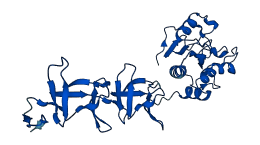
Descriptions
The autoinhibited protein was predicted that may have potential autoinhibitory elements via cis-regPred.
Autoinhibitory domains (AIDs)
Target domain |
|
Relief mechanism |
|
Assay |
cis-regPred |
Accessory elements
No accessory elements
Autoinhibited structure

Activated structure
8 structures for P06653
| Entry ID | Method | Resolution | Chain | Position | Source |
|---|---|---|---|---|---|
| 1GVM | X-ray | 280 A | A/B/C/D/E/F | 188-318 | PDB |
| 1H8G | X-ray | 240 A | A/B | 224-318 | PDB |
| 1HCX | X-ray | 260 A | A/B | 192-318 | PDB |
| 2BML | X-ray | 260 A | A/B | 193-318 | PDB |
| 4IVV | X-ray | 105 A | A | 1-180 | PDB |
| 4X36 | X-ray | 210 A | A | 1-318 | PDB |
| 5CTV | X-ray | 105 A | A | 1-180 | PDB |
| AF-P06653-F1 | Predicted | AlphaFoldDB |
No variants for P06653
| Variant ID(s) | Position | Change | Description | Diseaes Association | Provenance |
|---|---|---|---|---|---|
| No variants for P06653 | |||||
No associated diseases with P06653
4 regional properties for P06653
| Type | Name | Position | InterPro Accession |
|---|---|---|---|
| domain | N-acetylmuramoyl-L-alanine amidase domain | 10 - 153 | IPR002502 |
| repeat | Cell wall/choline-binding repeat | 196 - 215 | IPR018337-1 |
| repeat | Cell wall/choline-binding repeat | 217 - 237 | IPR018337-2 |
| repeat | Cell wall/choline-binding repeat | 238 - 283 | IPR018337-3 |
Functions
| Description | ||
|---|---|---|
| EC Number | 3.5.1.28 | In linear amides |
| Subcellular Localization |
|
|
| PANTHER Family | ||
| PANTHER Subfamily | ||
| PANTHER Protein Class | ||
| PANTHER Pathway Category | No pathway information available | |
1 GO annotations of cellular component
| Name | Definition |
|---|---|
| extracellular region | The space external to the outermost structure of a cell. For cells without external protective or external encapsulating structures this refers to space outside of the plasma membrane. This term covers the host cell environment outside an intracellular parasite. |
1 GO annotations of molecular function
| Name | Definition |
|---|---|
| N-acetylmuramoyl-L-alanine amidase activity | Catalysis of the hydrolysis of the link between N-acetylmuramoyl residues and L-amino acid residues in certain bacterial cell-wall glycopeptides. |
4 GO annotations of biological process
| Name | Definition |
|---|---|
| cell wall organization | A process that results in the assembly, arrangement of constituent parts, or disassembly of the cell wall, the rigid or semi-rigid envelope lying outside the cell membrane of plant, fungal and most prokaryotic cells, maintaining their shape and protecting them from osmotic lysis. |
| establishment of competence for transformation | The process in which a naturally transformable bacterium acquires the ability to take up exogenous DNA. This term should be applied only to naturally transformable bacteria, and should not be used in the context of artificially induced bacterial transformation. |
| peptidoglycan catabolic process | The chemical reactions and pathways resulting in the breakdown of peptidoglycans, any of a class of glycoconjugates found in bacterial cell walls. |
| sporulation resulting in formation of a cellular spore | The process in which a relatively unspecialized cell acquires the specialized features of a cellular spore, a cell form that can be used for dissemination, for survival of adverse conditions because of its heat and dessication resistance, and/or for reproduction. |
No homologous proteins in AiPD
| UniProt AC | Gene Name | Protein Name | Species | Evidence Code |
|---|---|---|---|---|
| No homologous proteins | ||||
| 10 | 20 | 30 | 40 | 50 | 60 |
| MEINVSKLRT | DLPQVGVQPY | RQVHAHSTGN | PHSTVQNEAD | YHWRKDPELG | FFSHIVGNGC |
| 70 | 80 | 90 | 100 | 110 | 120 |
| IMQVGPVDNG | AWDVGGGWNA | ETYAAVELIE | SHSTKEEFMT | DYRLYIELLR | NLADEAGLPK |
| 130 | 140 | 150 | 160 | 170 | 180 |
| TLDTGSLAGI | KTHEYCTNNQ | PNNHSDHVDP | YPYLAKWGIS | REQFKHDIEN | GLTIETGWQK |
| 190 | 200 | 210 | 220 | 230 | 240 |
| NDTGYWYVHS | DGSYPKDKFE | KINGTWYYFD | SSGYMLADRW | RKHTDGNWYW | FDNSGEMATG |
| 250 | 260 | 270 | 280 | 290 | 300 |
| WKKIADKWYY | FNEEGAMKTG | WVKYKDTWYY | LDAKEGAMVS | NAFIQSADGT | GWYYLKPDGT |
| 310 | |||||
| LADKPEFTVE | PDGLITVK |