P05772
Gene name |
PRKCB (PRKCB1) |
Protein name |
Protein kinase C beta type |
Names |
PKC-B, PKC-beta |
Species |
Oryctolagus cuniculus (Rabbit) |
KEGG Pathway |
ocu:100037719 |
EC number |
2.7.11.13: Protein-serine/threonine kinases |
Protein Class |
|
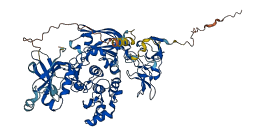
Descriptions
The autoinhibited protein was predicted that may have potential autoinhibitory elements via cis-regPred.
Autoinhibitory domains (AIDs)
Target domain |
|
Relief mechanism |
|
Assay |
cis-regPred |
Accessory elements
483-506 (Activation loop from InterPro)
Target domain |
341-664 (Catalytic domain of the Serine/Threonine Kinase, Classical Protein Kinase C beta) |
Relief mechanism |
|
Assay |
|
Autoinhibited structure

Activated structure
1 structures for P05772
| Entry ID | Method | Resolution | Chain | Position | Source |
|---|---|---|---|---|---|
| AF-P05772-F1 | Predicted | AlphaFoldDB |
No variants for P05772
| Variant ID(s) | Position | Change | Description | Diseaes Association | Provenance |
|---|---|---|---|---|---|
| No variants for P05772 | |||||
No associated diseases with P05772
13 regional properties for P05772
| Type | Name | Position | InterPro Accession |
|---|---|---|---|
| domain | C2 domain | 158 - 277 | IPR000008 |
| domain | Protein kinase domain | 342 - 600 | IPR000719 |
| domain | AGC-kinase, C-terminal | 601 - 671 | IPR000961 |
| domain | Protein kinase C-like, phorbol ester/diacylglycerol-binding domain | 36 - 87 | IPR002219-1 |
| domain | Protein kinase C-like, phorbol ester/diacylglycerol-binding domain | 101 - 153 | IPR002219-2 |
| active_site | Serine/threonine-protein kinase, active site | 462 - 474 | IPR008271 |
| binding_site | Protein kinase, ATP binding site | 348 - 371 | IPR017441 |
| domain | Protein kinase, C-terminal | 624 - 662 | IPR017892 |
| domain | Diacylglycerol/phorbol-ester binding | 34 - 48 | IPR020454-1 |
| domain | Diacylglycerol/phorbol-ester binding | 50 - 59 | IPR020454-2 |
| domain | Diacylglycerol/phorbol-ester binding | 63 - 74 | IPR020454-3 |
| domain | Diacylglycerol/phorbol-ester binding | 140 - 152 | IPR020454-4 |
| domain | Classical protein kinase C beta, catalytic domain | 341 - 664 | IPR034664 |
Functions
| Description | ||
|---|---|---|
| EC Number | 2.7.11.13 | Protein-serine/threonine kinases |
| Subcellular Localization |
|
|
| PANTHER Family | ||
| PANTHER Subfamily | ||
| PANTHER Protein Class | ||
| PANTHER Pathway Category | No pathway information available | |
3 GO annotations of cellular component
| Name | Definition |
|---|---|
| cytoplasm | The contents of a cell excluding the plasma membrane and nucleus, but including other subcellular structures. |
| membrane | A lipid bilayer along with all the proteins and protein complexes embedded in it an attached to it. |
| nucleus | A membrane-bounded organelle of eukaryotic cells in which chromosomes are housed and replicated. In most cells, the nucleus contains all of the cell's chromosomes except the organellar chromosomes, and is the site of RNA synthesis and processing. In some species, or in specialized cell types, RNA metabolism or DNA replication may be absent. |
10 GO annotations of molecular function
| Name | Definition |
|---|---|
| ATP binding | Binding to ATP, adenosine 5'-triphosphate, a universally important coenzyme and enzyme regulator. |
| calcium-dependent protein kinase C activity | Calcium-dependent catalysis of the reaction: ATP + a protein = ADP + a phosphoprotein. |
| chromatin binding | Binding to chromatin, the network of fibers of DNA, protein, and sometimes RNA, that make up the chromosomes of the eukaryotic nucleus during interphase. |
| histone binding | Binding to a histone, any of a group of water-soluble proteins found in association with the DNA of eukaryotic or archaeal chromosomes. They are involved in the condensation and coiling of chromosomes during cell division and have also been implicated in gene regulation and DNA replication. They may be chemically modified (methylated, acetlyated and others) to regulate gene transcription. |
| histone kinase activity (H3-T6 specific) | Catalysis of the transfer of a phosphate group to the threonine-6 residue of the N-terminal tail of histone H3. |
| nuclear androgen receptor binding | Binding to a nuclear androgen receptor. |
| nuclear receptor coactivator activity | A transcription coactivator activity that activates or increases the transcription of specific gene sets via binding to a DNA-bound nuclear receptor, either on its own or as part of a complex. Coactivators often act by altering chromatin structure and modifications. For example, one class of transcription coregulators modifies chromatin structure through covalent modification of histones. A second class remodels the conformation of chromatin in an ATP-dependent fashion. A third class modulates interactions of DNA-bound DNA-binding transcription factors with other transcription coregulators. A fourth class of coactivator activity is the bridging of a DNA-binding transcription factor to the general (basal) transcription machinery. The Mediator complex, which bridges sequence-specific DNA binding transcription factors and RNA polymerase, is also a transcription coactivator. |
| protein kinase C activity | Catalysis of the reaction: ATP + a protein = ADP + a phosphoprotein. This reaction requires diacylglycerol. |
| protein serine kinase activity | Catalysis of the reactions: ATP + protein serine = ADP + protein serine phosphate. |
| zinc ion binding | Binding to a zinc ion (Zn). |
16 GO annotations of biological process
| Name | Definition |
|---|---|
| adaptive immune response | An immune response mediated by cells expressing specific receptors for antigen produced through a somatic diversification process, and allowing for an enhanced secondary response to subsequent exposures to the same antigen (immunological memory). |
| apoptotic process | A programmed cell death process which begins when a cell receives an internal (e.g. DNA damage) or external signal (e.g. an extracellular death ligand), and proceeds through a series of biochemical events (signaling pathway phase) which trigger an execution phase. The execution phase is the last step of an apoptotic process, and is typically characterized by rounding-up of the cell, retraction of pseudopodes, reduction of cellular volume (pyknosis), chromatin condensation, nuclear fragmentation (karyorrhexis), plasma membrane blebbing and fragmentation of the cell into apoptotic bodies. When the execution phase is completed, the cell has died. |
| B cell activation | The change in morphology and behavior of a mature or immature B cell resulting from exposure to a mitogen, cytokine, chemokine, cellular ligand, or an antigen for which it is specific. |
| B cell receptor signaling pathway | The series of molecular signals initiated by the cross-linking of an antigen receptor on a B cell. |
| chromatin organization | The assembly or remodeling of chromatin composed of DNA complexed with histones, other associated proteins, and sometimes RNA. |
| negative regulation of glucose transmembrane transport | Any process that decreases the frequency, rate or extent of glucose transport across a membrane. Glucose transport is the directed movement of the hexose monosaccharide glucose into, out of or within a cell, or between cells, by means of some agent such as a transporter or pore. |
| negative regulation of insulin receptor signaling pathway | Any process that stops, prevents, or reduces the frequency, rate or extent of insulin receptor signaling. |
| positive regulation of angiogenesis | Any process that activates or increases angiogenesis. |
| positive regulation of B cell receptor signaling pathway | Any process that activates or increases the frequency, rate or extent of signaling pathways initiated by the cross-linking of an antigen receptor on a B cell. |
| positive regulation of I-kappaB kinase/NF-kappaB signaling | Any process that activates or increases the frequency, rate or extent of I-kappaB kinase/NF-kappaB signaling. |
| positive regulation of NF-kappaB transcription factor activity | Any process that activates or increases the frequency, rate or extent of activity of the transcription factor NF-kappaB. |
| positive regulation of vascular endothelial growth factor receptor signaling pathway | Any process that activates or increases the frequency, rate or extent of vascular endothelial growth factor receptor signaling pathway activity. |
| post-translational protein modification | The process of covalently altering one or more amino acids in a protein after the protein has been completely translated and released from the ribosome. |
| protein phosphorylation | The process of introducing a phosphate group on to a protein. |
| regulation of glucose transmembrane transport | Any process that modulates the frequency, rate or extent of glucose transport across a membrane. Glucose transport is the directed movement of the hexose monosaccharide glucose into, out of or within a cell, or between cells, by means of some agent such as a transporter or pore. |
| regulation of transcription by RNA polymerase II | Any process that modulates the frequency, rate or extent of transcription mediated by RNA polymerase II. |
No homologous proteins in AiPD
| UniProt AC | Gene Name | Protein Name | Species | Evidence Code |
|---|---|---|---|---|
| No homologous proteins | ||||
| 10 | 20 | 30 | 40 | 50 | 60 |
| MADPAAGQPP | SEGEESTVRF | ARKGALRQKN | VHEVKNHKFT | ARFFKQPTFC | SHCTDFIWGF |
| 70 | 80 | 90 | 100 | 110 | 120 |
| GKQGFQCQVC | CFVVHKRCHE | FVTFSCPGAD | KGPASDDPRS | KHKFKIHTYS | SPTFCDHCGS |
| 130 | 140 | 150 | 160 | 170 | 180 |
| LLYGLIHQGM | KCDTCMMNVH | KRCVMNVPSL | CGTDHTERRG | RIYIQAHIDR | EVLIVVVRDA |
| 190 | 200 | 210 | 220 | 230 | 240 |
| KNLVPMDPNG | LSDPYVKLKL | IPDPKSESKQ | KTKTIKCSLN | PEWNETFRFQ | LKESDKDRRL |
| 250 | 260 | 270 | 280 | 290 | 300 |
| SVEIWDWDLT | SRNDFMGSLS | FGISELQKAG | VDGWFKLLSQ | EEGEYFNVPV | PPEGSEGNEE |
| 310 | 320 | 330 | 340 | 350 | 360 |
| LRQKFERAKI | GQGTKTPEEK | TTNTISKFDN | NGNRDRMKLT | DFNFLMVLGK | GSFGKVMLSE |
| 370 | 380 | 390 | 400 | 410 | 420 |
| RKGTDELYAV | KILKKDVVIQ | DDDVECTMVE | KRVLALPGKP | PFLTQLHSCF | QTMDRLYFVM |
| 430 | 440 | 450 | 460 | 470 | 480 |
| EYVNGGDLMY | HIQQVGRFKE | PHAVFYAAEI | AIGLFFLQSK | GIIYRDLKLD | NVMLDSEGHI |
| 490 | 500 | 510 | 520 | 530 | 540 |
| KIADFGMCKE | NIWDGVTTKT | FCGTPDYIAP | EIIAYQPYGK | SVDWWAFGVL | LYEMLAGQAP |
| 550 | 560 | 570 | 580 | 590 | 600 |
| FEGEDEDELF | QSIMEHNVAY | PKSMSKEAVA | ICKGLMTKHP | GKRLGCGPEG | ERDIKDHAFF |
| 610 | 620 | 630 | 640 | 650 | 660 |
| RYIDWEKLER | KEIQPPYKPK | ARDKRDTSNF | DKEFTRQPVE | LTPTDKLFIM | NLDQNEFAGF |
| 670 | |||||
| SYTNPEFVIN | V |