P05059
Gene name |
CHGA |
Protein name |
Chromogranin-A |
Names |
CgA, Pituitary secretory protein I, SP-I |
Species |
Bos taurus (Bovine) |
KEGG Pathway |
bta:281070 |
EC number |
|
Protein Class |
|
Descriptions
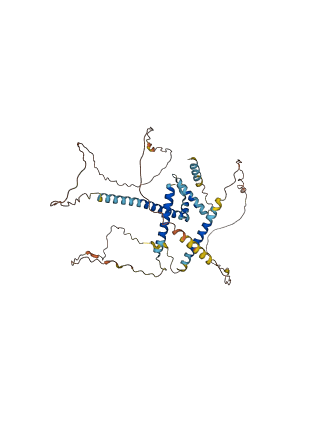
The autoinhibited protein was predicted that may have potential autoinhibitory elements via cis-regPred.
Autoinhibitory domains (AIDs)
Target domain |
|
Relief mechanism |
|
Assay |
cis-regPred |
Accessory elements
No accessory elements
Autoinhibited structure

Activated structure
2 structures for P05059
| Entry ID | Method | Resolution | Chain | Position | Source |
|---|---|---|---|---|---|
| 1N2Y | NMR | - | A | 368-380 | PDB |
| AF-P05059-F1 | Predicted | AlphaFoldDB |
No variants for P05059
| Variant ID(s) | Position | Change | Description | Diseaes Association | Provenance |
|---|---|---|---|---|---|
| No variants for P05059 | |||||
No associated diseases with P05059
2 regional properties for P05059
| Type | Name | Position | InterPro Accession |
|---|---|---|---|
| conserved_site | Chromogranin, conserved site | 35 - 56 | IPR018054-1 |
| conserved_site | Chromogranin, conserved site | 427 - 436 | IPR018054-2 |
6 GO annotations of cellular component
| Name | Definition |
|---|---|
| chromaffin granule | Specialized secretory vesicle found in the cells of adrenal glands and various other organs, which is concerned with the synthesis, storage, metabolism, and secretion of epinephrine and norepinephrine. |
| extracellular region | The space external to the outermost structure of a cell. For cells without external protective or external encapsulating structures this refers to space outside of the plasma membrane. This term covers the host cell environment outside an intracellular parasite. |
| extracellular space | That part of a multicellular organism outside the cells proper, usually taken to be outside the plasma membranes, and occupied by fluid. |
| neuronal dense core vesicle | A dense core vesicle (granule) that is part of a neuron. These vesicles typically contain neuropeptides. They can be found in all parts of neurons, including the soma, dendrites, axonal swellings (varicosities) and synaptic terminals. |
| secretory granule | A small subcellular vesicle, surrounded by a membrane, that is formed from the Golgi apparatus and contains a highly concentrated protein destined for secretion. Secretory granules move towards the periphery of the cell and upon stimulation, their membranes fuse with the cell membrane, and their protein load is exteriorized. Processing of the contained protein may take place in secretory granules. |
| transport vesicle | Any of the vesicles of the constitutive secretory pathway, which carry cargo from the endoplasmic reticulum to the Golgi, between Golgi cisternae, from the Golgi to the ER (retrograde transport) or to destinations within or outside the cell. |
2 GO annotations of molecular function
| Name | Definition |
|---|---|
| calcium ion binding | Binding to a calcium ion (Ca2+). |
| metal ion binding | Binding to a metal ion. |
20 GO annotations of biological process
| Name | Definition |
|---|---|
| adenylate cyclase-activating adrenergic receptor signaling pathway involved in cardiac muscle relaxation | An adrenergic receptor signaling pathway that contributes to a reduction in cardiac muscle contraction. Beta-adrenergic receptor-induced cardiac relaxation is achieved by a GPCR-activated adenylate cyclase generating cAMP; cAMP then activates the cAMP-dependent protein kinase A (PKA), which phosphorylates the sarcoplasmic reticulum (SR) membrane protein PLB. In its non-phosphorylated state, PLB acts as an inhibitor of the ATPase Ca(2+) pump of the cardiac SR (SERCA2a); inhibition of the pump is relieved upon phosphorylation. The pump removes Ca(2+) from the cytoplasm, thereby preventing cytosolic Ca(2+)-dependent activation of contractile proteins, leading to enhanced muscle relaxation. |
| antifungal humoral response | An immune response against a fungus mediated through a body fluid. An example of this process is the antifungal humoral response in Drosophila melanogaster. |
| antimicrobial humoral immune response mediated by antimicrobial peptide | An immune response against microbes mediated by anti-microbial peptides in body fluid. |
| defense response to bacterium | Reactions triggered in response to the presence of a bacterium that act to protect the cell or organism. |
| defense response to fungus | Reactions triggered in response to the presence of a fungus that act to protect the cell or organism. |
| defense response to Gram-negative bacterium | Reactions triggered in response to the presence of a Gram-negative bacterium that act to protect the cell or organism. |
| defense response to Gram-positive bacterium | Reactions triggered in response to the presence of a Gram-positive bacterium that act to protect the cell or organism. |
| disruption by host of symbiont cell wall | The chemical reactions and pathways performed by an organism resulting in the breakdown of the symbiont cell wall. The symbiont is defined as the smaller of the organisms involved in a symbiotic interaction. |
| innate immune response | Innate immune responses are defense responses mediated by germline encoded components that directly recognize components of potential pathogens. |
| killing of cells of another organism | Any process in an organism that results in the killing of cells of another organism, including in some cases the death of the other organism. Killing here refers to the induction of death in one cell by another cell, not cell-autonomous death due to internal or other environmental conditions. |
| mast cell activation | The change in morphology and behavior of a mast cell resulting from exposure to a cytokine, chemokine, soluble factor, or to (at least in mammals) an antigen which the mast cell has specifically bound via IgE bound to Fc-epsilonRI receptors. |
| mast cell chemotaxis | The movement of a mast cell in response to an external stimulus. |
| mast cell degranulation | The regulated exocytosis of secretory granules containing preformed mediators such as histamine, serotonin, and neutral proteases by a mast cell. |
| negative regulation of angiogenesis | Any process that stops, prevents, or reduces the frequency, rate or extent of angiogenesis. |
| negative regulation of catecholamine secretion | Any process that stops, prevents, or reduces the frequency, rate or extent of the regulated release of a catecholamine. |
| negative regulation of hormone secretion | Any process that stops, prevents, or reduces the frequency, rate or extent of the regulated release of a hormone from a cell. |
| negative regulation of insulin secretion | Any process that stops, prevents, or reduces the frequency, rate or extent of the regulated release of insulin. |
| negative regulation of protein serine/threonine phosphatase activity | Any process that stops, prevents or reduces the frequency, rate or extent of protein serine/threonine phosphatase activity. |
| positive regulation of dense core granule biogenesis | Any process that activates or increases the frequency, rate or extent of dense core granule biogenesis. |
| regulation of cell adhesion | Any process that modulates the frequency, rate or extent of attachment of a cell to another cell or to the extracellular matrix. |
No homologous proteins in AiPD
| UniProt AC | Gene Name | Protein Name | Species | Evidence Code |
|---|---|---|---|---|
| No homologous proteins | ||||
| 10 | 20 | 30 | 40 | 50 | 60 |
| MRSAAVLALL | LCAGQVIALP | VNSPMNKGDT | EVMKCIVEVI | SDTLSKPSPM | PVSKECFETL |
| 70 | 80 | 90 | 100 | 110 | 120 |
| RGDERILSIL | RHQNLLKELQ | DLALQGAKER | THQQKKHSSY | EDELSEVLEK | PNDQAEPKEV |
| 130 | 140 | 150 | 160 | 170 | 180 |
| TEEVSSKDAA | EKRDDFKEVE | KSDEDSDGDR | PQASPGLGPG | PKVEEDNQAP | GEEEEAPSNA |
| 190 | 200 | 210 | 220 | 230 | 240 |
| HPLASLPSPK | YPGPQAKEDS | EGPSQGPASR | EKGLSAEQGR | QTEREEEEEK | WEEAEAREKA |
| 250 | 260 | 270 | 280 | 290 | 300 |
| VPEEESPPTA | AFKPPPSLGN | KETQRAAPGW | PEDGAGKMGA | EEAKPPEGKG | EWAHSRQEEE |
| 310 | 320 | 330 | 340 | 350 | 360 |
| EMARAPQVLF | RGGKSGEPEQ | EEQLSKEWED | AKRWSKMDQL | AKELTAEKRL | EGEEEEEEDP |
| 370 | 380 | 390 | 400 | 410 | 420 |
| DRSMRLSFRA | RGYGFRGPGL | QLRRGWRPNS | REDSVEAGLP | LQVRGYPEEK | KEEEGSANRR |
| 430 | 440 | ||||
| PEDQELESLS | AIEAELEKVA | HQLEELRRG |