Descriptions
The autoinhibited protein was predicted that may have potential autoinhibitory elements via cis-regPred.
Autoinhibitory domains (AIDs)
Target domain |
|
Relief mechanism |
|
Assay |
cis-regPred |
Accessory elements
No accessory elements
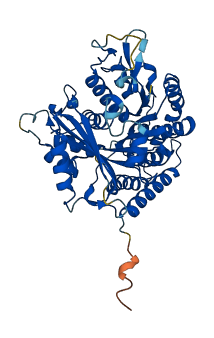
Autoinhibited structure

Activated structure
1 structures for P04105
| Entry ID | Method | Resolution | Chain | Position | Source |
|---|---|---|---|---|---|
| AF-P04105-F1 | Predicted | AlphaFoldDB |
No variants for P04105
| Variant ID(s) | Position | Change | Description | Diseaes Association | Provenance |
|---|---|---|---|---|---|
| No variants for P04105 | |||||
No associated diseases with P04105
Functions
4 GO annotations of cellular component
| Name | Definition |
|---|---|
| cytoplasm | The contents of a cell excluding the plasma membrane and nucleus, but including other subcellular structures. |
| microtubule | Any of the long, generally straight, hollow tubes of internal diameter 12-15 nm and external diameter 24 nm found in a wide variety of eukaryotic cells; each consists (usually) of 13 protofilaments of polymeric tubulin, staggered in such a manner that the tubulin monomers are arranged in a helical pattern on the microtubular surface, and with the alpha/beta axes of the tubulin subunits parallel to the long axis of the tubule; exist in equilibrium with pool of tubulin monomers and can be rapidly assembled or disassembled in response to physiological stimuli; concerned with force generation, e.g. in the spindle. |
| nucleus | A membrane-bounded organelle of eukaryotic cells in which chromosomes are housed and replicated. In most cells, the nucleus contains all of the cell's chromosomes except the organellar chromosomes, and is the site of RNA synthesis and processing. In some species, or in specialized cell types, RNA metabolism or DNA replication may be absent. |
| spindle | The array of microtubules and associated molecules that forms between opposite poles of a eukaryotic cell during mitosis or meiosis and serves to move the duplicated chromosomes apart. |
2 GO annotations of molecular function
| Name | Definition |
|---|---|
| GTP binding | Binding to GTP, guanosine triphosphate. |
| structural constituent of cytoskeleton | The action of a molecule that contributes to the structural integrity of a cytoskeletal structure. |
1 GO annotations of biological process
| Name | Definition |
|---|---|
| microtubule-based process | Any cellular process that depends upon or alters the microtubule cytoskeleton, that part of the cytoskeleton comprising microtubules and their associated proteins. |
No homologous proteins in AiPD
| UniProt AC | Gene Name | Protein Name | Species | Evidence Code |
|---|---|---|---|---|
| No homologous proteins | ||||
| 10 | 20 | 30 | 40 | 50 | 60 |
| MREIISIHIG | QAGAQVGNAC | WELYCLEHGI | NPDGQMPSDK | SVGGGDDAFN | TFFSETSSGK |
| 70 | 80 | 90 | 100 | 110 | 120 |
| HVPRAIYLDL | EPTVIDEIRT | GTYRQLFHPE | QLITGKEDAA | NNYARGHYTV | GKEIVDLCLD |
| 130 | 140 | 150 | 160 | 170 | 180 |
| RVRKLADQCS | GLQGFLVFHS | VGGGTGSGFG | SLLLERLSVD | YGKKSKLDFC | VYPSPQVSTA |
| 190 | 200 | 210 | 220 | 230 | 240 |
| VVEPYNSVLS | THGLLEHTDV | AFMLDNEAIY | DLCKKSLDID | RPSYANLNRL | VAQVISSLTT |
| 250 | 260 | 270 | 280 | 290 | 300 |
| SLRFDGALNV | DINEFQTNLV | PYPRIHFMLA | SYAPVISAEK | AFHEQLSVAE | LTNTVFEPSS |
| 310 | 320 | 330 | 340 | 350 | 360 |
| MMAKCDPRHG | KYMACCLMYR | GDVVPKDVTA | AVAVIKTKRT | IQFVDWCPTG | FKCGINYQAP |
| 370 | 380 | 390 | 400 | 410 | 420 |
| SVVPGGDLAK | VQRALCMISN | TTAIAEVFSR | IDHKFDLMYA | KRAFVHWYVG | EGMEEGEFSE |
| 430 | 440 | ||||
| AREDLAALEK | DYEEVGAETV | GDDEAEEEM |