P04068
Gene name |
EPHX1 |
Protein name |
Epoxide hydrolase 1 |
Names |
Epoxide hydratase, Microsomal epoxide hydrolase, mEH |
Species |
Oryctolagus cuniculus (Rabbit) |
KEGG Pathway |
ocu:100009104 |
EC number |
|
Protein Class |
|
Descriptions
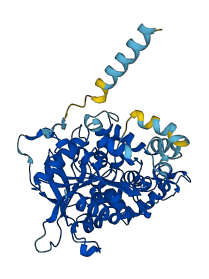
The autoinhibited protein was predicted that may have potential autoinhibitory elements via cis-regPred.
Autoinhibitory domains (AIDs)
Target domain |
|
Relief mechanism |
|
Assay |
cis-regPred |
Accessory elements
No accessory elements
Autoinhibited structure

Activated structure
1 structures for P04068
| Entry ID | Method | Resolution | Chain | Position | Source |
|---|---|---|---|---|---|
| AF-P04068-F1 | Predicted | AlphaFoldDB |
No variants for P04068
| Variant ID(s) | Position | Change | Description | Diseaes Association | Provenance |
|---|---|---|---|---|---|
| No variants for P04068 | |||||
No associated diseases with P04068
1 regional properties for P04068
| Type | Name | Position | InterPro Accession |
|---|---|---|---|
| domain | Epoxide hydrolase, N-terminal | 48 - 157 | IPR010497 |
2 GO annotations of cellular component
| Name | Definition |
|---|---|
| endoplasmic reticulum membrane | The lipid bilayer surrounding the endoplasmic reticulum. |
| integral component of membrane | The component of a membrane consisting of the gene products and protein complexes having at least some part of their peptide sequence embedded in the hydrophobic region of the membrane. |
2 GO annotations of molecular function
| Name | Definition |
|---|---|
| cis-stilbene-oxide hydrolase activity | Catalysis of the reaction: cis-stilbene oxide + H2O = (+)-(1R,2R)-1,2-diphenylethane-1,2-diol. |
| epoxide hydrolase activity | Catalysis of the reaction: an epoxide + H2O = a glycol. |
3 GO annotations of biological process
| Name | Definition |
|---|---|
| arachidonic acid metabolic process | The chemical reactions and pathways involving arachidonic acid, a straight chain fatty acid with 20 carbon atoms and four double bonds per molecule. Arachidonic acid is the all-Z-(5,8,11,14)-isomer. |
| aromatic compound catabolic process | The chemical reactions and pathways resulting in the breakdown of aromatic compounds, any substance containing an aromatic carbon ring. |
| response to toxic substance | Any process that results in a change in state or activity of a cell or an organism (in terms of movement, secretion, enzyme production, gene expression, etc.) as a result of a toxic stimulus. |
No homologous proteins in AiPD
| UniProt AC | Gene Name | Protein Name | Species | Evidence Code |
|---|---|---|---|---|
| No homologous proteins | ||||
| 10 | 20 | 30 | 40 | 50 | 60 |
| MLLELLLASV | LGFVIYWFVS | GDKEESLPLE | DGWWGPGSRP | VGLEDESIRP | FKVETSDEEI |
| 70 | 80 | 90 | 100 | 110 | 120 |
| NDLHQRIDRI | RLTPPLENSR | FHYGFNSNYL | KKILSYWRHE | FDWKKQVEIL | NSYPHFKTKI |
| 130 | 140 | 150 | 160 | 170 | 180 |
| EGLDIHFIHV | KPPQVPPGRT | PKPLLMVHGW | PGSFFEFYKI | IPLLTDPKSH | GLSDEHIFEV |
| 190 | 200 | 210 | 220 | 230 | 240 |
| ICPSIPGYGF | SQASSKKGFN | SVSTARIFYK | LMLRLGFQEF | YIQGGDWGAL | VCTNMAQLVP |
| 250 | 260 | 270 | 280 | 290 | 300 |
| SHVKGLHLNM | ALILRNHYTL | TLLLGRRIGG | LLGYTERDME | LLYPFKEKVF | YSLMRESGYM |
| 310 | 320 | 330 | 340 | 350 | 360 |
| HIRATKPDTV | GCALNDSPVG | LAAYILEKFS | TWTNSEFRDL | EDGGLERKFS | LQDLLTNIMI |
| 370 | 380 | 390 | 400 | 410 | 420 |
| YWTTGSIVSS | QRYYKENLGQ | GFMAHKHERL | KVHVPTGFAA | FPCEIMHVPE | KWVRTKYPQL |
| 430 | 440 | 450 | |||
| ISYSYMPRGG | HFAAFEEPEL | LARDICKFVG | LVERQ |