P03004
Gene name |
dnaA (b3702, JW3679) |
Protein name |
Chromosomal replication initiator protein DnaA |
Names |
|
Species |
Escherichia coli (strain K12) |
KEGG Pathway |
eco:b3702 |
EC number |
|
Protein Class |
|
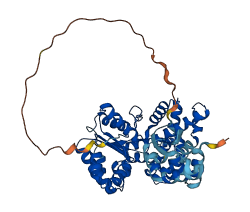
Descriptions
The autoinhibited protein was predicted that may have potential autoinhibitory elements via cis-regPred.
Autoinhibitory domains (AIDs)
Target domain |
|
Relief mechanism |
|
Assay |
cis-regPred |
Accessory elements
No accessory elements
Autoinhibited structure

Activated structure
3 structures for P03004
| Entry ID | Method | Resolution | Chain | Position | Source |
|---|---|---|---|---|---|
| 1J1V | X-ray | 210 A | A | 374-467 | PDB |
| 2E0G | NMR | - | A | 2-108 | PDB |
| AF-P03004-F1 | Predicted | AlphaFoldDB |
No variants for P03004
| Variant ID(s) | Position | Change | Description | Diseaes Association | Provenance |
|---|---|---|---|---|---|
| No variants for P03004 | |||||
No associated diseases with P03004
5 regional properties for P03004
| Type | Name | Position | InterPro Accession |
|---|---|---|---|
| domain | AAA+ ATPase domain | 163 - 365 | IPR003593 |
| domain | Chromosomal replication initiator, DnaA C-terminal | 374 - 464 | IPR013159 |
| domain | Chromosomal replication initiator protein DnaA | 132 - 348 | IPR013317 |
| conserved_site | Chromosomal replication control, initiator DnaA, conserved site | 424 - 443 | IPR018312 |
| domain | DnaA N-terminal domain | 4 - 64 | IPR024633 |
9 GO annotations of cellular component
| Name | Definition |
|---|---|
| cytoplasmic side of plasma membrane | The leaflet the plasma membrane that faces the cytoplasm and any proteins embedded or anchored in it or attached to its surface. |
| cytosol | The part of the cytoplasm that does not contain organelles but which does contain other particulate matter, such as protein complexes. |
| DnaA-DiaA complex | A protein-DNA complex containing a tetramer of DiaA attached to multiple DnaA molecule bound to oriC DNA. Regulates timely initiation of chromosomal replication during the cell cycle by stimulating assembly of DnaA-oriC complexes, conformational changes in ATP-DnaA initiation complexes, and unwinding of oriC duplex DNA. |
| DnaA-Dps complex | A protein complex that negatively regulates strand-opening at the origin of replication, thereby interfering with replication initiation. This complex is thought to be involved in the regulation of replication under oxidative stress conditions. In E. coli, this complex is composed of DnaA and Dps. |
| DnaA-HU complex | A protein-DNA complex containing DNA-bound DnaA attached to HU. HU is a dimer encoded by two closely related genes. Essential for the initiation of replication in bacteria; stimulates the DnaA-dependent unwinding of oriC. |
| DnaA-L2 complex | A protein complex that inhibits unwinding of DNA at the origin of replication and assembly of the pre-primosome. In E. coli, this complex is composed of DnaA and of the ribosomal protein L2. |
| DnaA-oriC complex | A protein-DNA complex containing the initiator protein DnaA bound to high-affinity recognition sites in the unique origin of replication, oriC. DnaA-oriC binding is the first step in assembly of a bacterial pre-replicative complex (pre-RC) and is responsible for the timely initiation of replication once per cell cycle. |
| plasma membrane | The membrane surrounding a cell that separates the cell from its external environment. It consists of a phospholipid bilayer and associated proteins. |
| replication inhibiting complex | A protein complex that inhibits multiple events of replication initiation during one replication cycle. |
5 GO annotations of molecular function
| Name | Definition |
|---|---|
| ATP binding | Binding to ATP, adenosine 5'-triphosphate, a universally important coenzyme and enzyme regulator. |
| DNA binding | Any molecular function by which a gene product interacts selectively and non-covalently with DNA (deoxyribonucleic acid). |
| DNA replication origin binding | Binding to a DNA replication origin, a unique DNA sequence of a replicon at which DNA replication is initiated and proceeds bidirectionally or unidirectionally. |
| identical protein binding | Binding to an identical protein or proteins. |
| sequence-specific DNA binding | Binding to DNA of a specific nucleotide composition, e.g. GC-rich DNA binding, or with a specific sequence motif or type of DNA e.g. promotor binding or rDNA binding. |
7 GO annotations of biological process
| Name | Definition |
|---|---|
| DNA replication | The cellular metabolic process in which a cell duplicates one or more molecules of DNA. DNA replication begins when specific sequences, known as origins of replication, are recognized and bound by initiation proteins, and ends when the original DNA molecule has been completely duplicated and the copies topologically separated. The unit of replication usually corresponds to the genome of the cell, an organelle, or a virus. The template for replication can either be an existing DNA molecule or RNA. |
| DNA replication initiation | The process in which DNA-dependent DNA replication is started; this begins with the ATP dependent loading of an initiator complex onto the DNA, this is followed by DNA melting and helicase activity. In bacteria, the gene products that enable the helicase activity are loaded after the initial melting and in archaea and eukaryotes, the gene products that enable the helicase activity are inactive when they are loaded and subsequently activate. |
| DNA unwinding involved in DNA replication | The process in which interchain hydrogen bonds between two strands of DNA are broken or 'melted', generating unpaired template strands for DNA replication. |
| negative regulation of DNA-templated DNA replication initiation | Any process that stops, prevents, or reduces the frequency, rate or extent of initiation of DNA-dependent DNA replication. |
| positive regulation of DNA-templated DNA replication initiation | Any process that activates or increases the frequency, rate or extent of initiation of DNA-dependent DNA replication. |
| regulation of DNA replication | Any process that modulates the frequency, rate or extent of DNA replication. |
| regulation of DNA-templated DNA replication initiation | Any process that modulates the frequency, rate or extent of initiation of DNA-dependent DNA replication; the process in which DNA becomes competent to replicate. In eukaryotes, replication competence is established in early G1 and lost during the ensuing S phase. |
No homologous proteins in AiPD
| UniProt AC | Gene Name | Protein Name | Species | Evidence Code |
|---|---|---|---|---|
| No homologous proteins | ||||
| 10 | 20 | 30 | 40 | 50 | 60 |
| MSLSLWQQCL | ARLQDELPAT | EFSMWIRPLQ | AELSDNTLAL | YAPNRFVLDW | VRDKYLNNIN |
| 70 | 80 | 90 | 100 | 110 | 120 |
| GLLTSFCGAD | APQLRFEVGT | KPVTQTPQAA | VTSNVAAPAQ | VAQTQPQRAA | PSTRSGWDNV |
| 130 | 140 | 150 | 160 | 170 | 180 |
| PAPAEPTYRS | NVNVKHTFDN | FVEGKSNQLA | RAAARQVADN | PGGAYNPLFL | YGGTGLGKTH |
| 190 | 200 | 210 | 220 | 230 | 240 |
| LLHAVGNGIM | ARKPNAKVVY | MHSERFVQDM | VKALQNNAIE | EFKRYYRSVD | ALLIDDIQFF |
| 250 | 260 | 270 | 280 | 290 | 300 |
| ANKERSQEEF | FHTFNALLEG | NQQIILTSDR | YPKEINGVED | RLKSRFGWGL | TVAIEPPELE |
| 310 | 320 | 330 | 340 | 350 | 360 |
| TRVAILMKKA | DENDIRLPGE | VAFFIAKRLR | SNVRELEGAL | NRVIANANFT | GRAITIDFVR |
| 370 | 380 | 390 | 400 | 410 | 420 |
| EALRDLLALQ | EKLVTIDNIQ | KTVAEYYKIK | VADLLSKRRS | RSVARPRQMA | MALAKELTNH |
| 430 | 440 | 450 | 460 | ||
| SLPEIGDAFG | GRDHTTVLHA | CRKIEQLREE | SHDIKEDFSN | LIRTLSS |