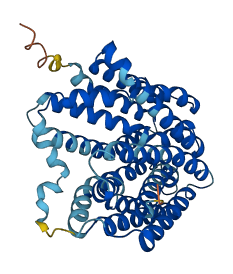
Descriptions
The autoinhibited protein was predicted that may have potential autoinhibitory elements via cis-regPred.
Autoinhibitory domains (AIDs)
Target domain |
|
Relief mechanism |
|
Assay |
cis-regPred |
Accessory elements
No accessory elements
Autoinhibited structure

Activated structure
1 structures for P02982
| Entry ID | Method | Resolution | Chain | Position | Source |
|---|---|---|---|---|---|
| AF-P02982-F1 | Predicted | AlphaFoldDB |
No variants for P02982
| Variant ID(s) | Position | Change | Description | Diseaes Association | Provenance |
|---|---|---|---|---|---|
| No variants for P02982 | |||||
No associated diseases with P02982
2 GO annotations of cellular component
| Name | Definition |
|---|---|
| integral component of membrane | The component of a membrane consisting of the gene products and protein complexes having at least some part of their peptide sequence embedded in the hydrophobic region of the membrane. |
| plasma membrane | The membrane surrounding a cell that separates the cell from its external environment. It consists of a phospholipid bilayer and associated proteins. |
2 GO annotations of molecular function
| Name | Definition |
|---|---|
| antiporter activity | Enables the active transport of a solute across a membrane by a mechanism whereby two or more species are transported in opposite directions in a tightly coupled process not directly linked to a form of energy other than chemiosmotic energy. The reaction is: solute A(out) + solute B(in) = solute A(in) + solute B(out). |
| xenobiotic transmembrane transporter activity | Enables the directed movement of a xenobiotic from one side of a membrane to the other. A xenobiotic is a compound foreign to the organim exposed to it. It may be synthesized by another organism (like ampicilin) or it can be a synthetic chemical. |
2 GO annotations of biological process
| Name | Definition |
|---|---|
| proton transmembrane transport | The directed movement of a proton across a membrane. |
| response to antibiotic | Any process that results in a change in state or activity of a cell or an organism (in terms of movement, secretion, enzyme production, gene expression, etc.) as a result of an antibiotic stimulus. An antibiotic is a chemical substance produced by a microorganism which has the capacity to inhibit the growth of or to kill other microorganisms. |
No homologous proteins in AiPD
| UniProt AC | Gene Name | Protein Name | Species | Evidence Code |
|---|---|---|---|---|
| No homologous proteins | ||||
| 10 | 20 | 30 | 40 | 50 | 60 |
| MKPNRPLIVI | LSTVALDAVG | IGLIMPVLPG | LLRDLVHSND | VTAHYGILLA | LYALMQFACA |
| 70 | 80 | 90 | 100 | 110 | 120 |
| PVLGALSDRF | GRRPVLLVSL | AGAAVDYAIM | ATAPFLWVLY | IGRIVAGITG | ATGAVAGAYI |
| 130 | 140 | 150 | 160 | 170 | 180 |
| ADITDGDERA | RHFGFMSACF | GFGMVAGPVL | GGLMGGFSPH | APFFAAAALN | GLNFLTGCFL |
| 190 | 200 | 210 | 220 | 230 | 240 |
| LPESHKGERR | PLRREALNPL | ASFRWARGMT | VVAALMAVFF | IMQLVGQVPA | ALWVIFGEDR |
| 250 | 260 | 270 | 280 | 290 | 300 |
| FHWDATTIGI | SLAAFGILHS | LAQAMITGPV | AARLGERRAL | MLGMIADGTG | YILLAFATRG |
| 310 | 320 | 330 | 340 | 350 | 360 |
| WMAFPIMVLL | ASGGIGMPAL | QAMLSRQVDE | ERQGQLQGSL | AALTSLTSIV | GPLLFTAIYA |
| 370 | 380 | 390 | |||
| ASITTWNGWA | WIAGAALYLL | CLPALRRGLW | SGAGQRADR |