P00502
Gene name |
Gsta1 |
Protein name |
Glutathione S-transferase alpha-1 |
Names |
13-hydroperoxyoctadecadienoate peroxidase, Androst-5-ene-3,17-dione isomerase, GST 1-1, GST 1a-1a, GST A1-1, GST B, Glutathione S-transferase Ya-1, GST Ya1, Ligandin |
Species |
Rattus norvegicus (Rat) |
KEGG Pathway |
rno:24422 |
EC number |
2.5.1.18: Transferring alkyl or aryl groups, other than methyl groups |
Protein Class |
|
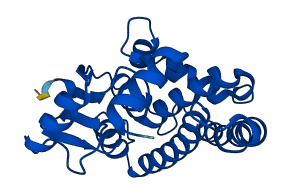
Descriptions
The autoinhibited protein was predicted that may have potential autoinhibitory elements via cis-regPred.
Autoinhibitory domains (AIDs)
Target domain |
|
Relief mechanism |
|
Assay |
cis-regPred |
Accessory elements
No accessory elements
Autoinhibited structure

Activated structure
3 structures for P00502
| Entry ID | Method | Resolution | Chain | Position | Source |
|---|---|---|---|---|---|
| 1EV4 | X-ray | 220 A | A/C/D | 2-222 | PDB |
| 1EV9 | X-ray | 220 A | A/C/D | 2-222 | PDB |
| AF-P00502-F1 | Predicted | AlphaFoldDB |
No variants for P00502
| Variant ID(s) | Position | Change | Description | Diseaes Association | Provenance |
|---|---|---|---|---|---|
| No variants for P00502 | |||||
No associated diseases with P00502
Functions
| Description | ||
|---|---|---|
| EC Number | 2.5.1.18 | Transferring alkyl or aryl groups, other than methyl groups |
| Subcellular Localization |
|
|
| PANTHER Family | ||
| PANTHER Subfamily | ||
| PANTHER Protein Class | ||
| PANTHER Pathway Category | No pathway information available | |
2 GO annotations of cellular component
| Name | Definition |
|---|---|
| cytosol | The part of the cytoplasm that does not contain organelles but which does contain other particulate matter, such as protein complexes. |
| organelle membrane | A membrane that is one of the two lipid bilayers of an organelle envelope or the outermost membrane of single membrane bound organelle. |
7 GO annotations of molecular function
| Name | Definition |
|---|---|
| dinitrosyl-iron complex binding | Binding to a dinitrosyl-iron complex. Nitric oxide (NO) is stored as dinitrosyl-iron complexes, which form spontaneously from Glutathione (GSH), S-nitrosoglutathione, and trace amounts of ferrous ions, or by reaction of iron-sulfur centers with NO. |
| fatty acid binding | Binding to a fatty acid, an aliphatic monocarboxylic acids liberated from naturally occurring fats and oils by hydrolysis. |
| glutathione binding | Binding to glutathione; a tripeptide composed of the three amino acids cysteine, glutamic acid and glycine. |
| glutathione peroxidase activity | Catalysis of the reaction: 2 glutathione + hydrogen peroxide = oxidized glutathione + 2 H2O. |
| glutathione transferase activity | Catalysis of the reaction: R-X + glutathione = H-X + R-S-glutathione. R may be an aliphatic, aromatic or heterocyclic group; X may be a sulfate, nitrile or halide group. |
| protein homodimerization activity | Binding to an identical protein to form a homodimer. |
| steroid delta-isomerase activity | Catalysis of the reaction: a 3-oxo-delta(5)-steroid = a 3-oxo-delta(4)-steroid. |
10 GO annotations of biological process
| Name | Definition |
|---|---|
| aging | A developmental process that is a deterioration and loss of function over time. Aging includes loss of functions such as resistance to disease, homeostasis, and fertility, as well as wear and tear. Aging includes cellular senescence, but is more inclusive. May precede death and may succeed developmental maturation (GO:0021700). |
| epithelial cell differentiation | The process in which a relatively unspecialized cell acquires specialized features of an epithelial cell, any of the cells making up an epithelium. |
| glutathione derivative biosynthetic process | The chemical reactions and pathways resulting in the formation of glutathione derivative. |
| glutathione metabolic process | The chemical reactions and pathways involving glutathione, the tripeptide glutamylcysteinylglycine, which acts as a coenzyme for some enzymes and as an antioxidant in the protection of sulfhydryl groups in enzymes and other proteins; it has a specific role in the reduction of hydrogen peroxide (H2O2) and oxidized ascorbate, and it participates in the gamma-glutamyl cycle. |
| linoleic acid metabolic process | The chemical reactions and pathways involving linoleic acid, an unsaturated omega-6 fatty acid that has the molecular formula C18H32O2. |
| prostaglandin metabolic process | The chemical reactions and pathways involving prostaglandins, any of a group of biologically active metabolites which contain a cyclopentane ring due to the formation of a bond between two carbons of a fatty acid. They have a wide range of biological activities. |
| response to nutrient levels | Any process that results in a change in state or activity of a cell or an organism (in terms of movement, secretion, enzyme production, gene expression, etc.) as a result of a stimulus reflecting the presence, absence, or concentration of nutrients. |
| response to xenobiotic stimulus | Any process that results in a change in state or activity of a cell or an organism (in terms of movement, secretion, enzyme production, gene expression, etc.) as a result of a stimulus from a xenobiotic, a compound foreign to the organim exposed to it. It may be synthesized by another organism (like ampicilin) or it can be a synthetic chemical. |
| xenobiotic catabolic process | The chemical reactions and pathways resulting in the breakdown of a xenobiotic compound, a compound foreign to the organim exposed to it. It may be synthesized by another organism (like ampicilin) or it can be a synthetic chemical. |
| xenobiotic metabolic process | The chemical reactions and pathways involving a xenobiotic compound, a compound foreign to the organim exposed to it. It may be synthesized by another organism (like ampicilin) or it can be a synthetic chemical. |
No homologous proteins in AiPD
| UniProt AC | Gene Name | Protein Name | Species | Evidence Code |
|---|---|---|---|---|
| No homologous proteins | ||||
| 10 | 20 | 30 | 40 | 50 | 60 |
| MSGKPVLHYF | NARGRMECIR | WLLAAAGVEF | DEKFIQSPED | LEKLKKDGNL | MFDQVPMVEI |
| 70 | 80 | 90 | 100 | 110 | 120 |
| DGMKLAQTRA | ILNYIATKYD | LYGKDMKERA | LIDMYTEGIL | DLTEMIMQLV | ICPPDQKEAK |
| 130 | 140 | 150 | 160 | 170 | 180 |
| TALAKDRTKN | RYLPAFEKVL | KSHGQDYLVG | NRLTRVDIHL | LELLLYVEEF | DASLLTSFPL |
| 190 | 200 | 210 | 220 | ||
| LKAFKSRISS | LPNVKKFLQP | GSQRKLPVDA | KQIEEARKIF | KF |