P00448
Gene name |
sodA (b3908, JW3879) |
Protein name |
Superoxide dismutase [Mn] |
Names |
MnSOD |
Species |
Escherichia coli (strain K12) |
KEGG Pathway |
eco:b3908 |
EC number |
1.15.1.1: Acting on superoxide as acceptor |
Protein Class |
|
Descriptions
The autoinhibited protein was predicted that may have potential autoinhibitory elements via cis-regPred.
Autoinhibitory domains (AIDs)
Target domain |
|
Relief mechanism |
|
Assay |
cis-regPred |
Accessory elements
No accessory elements
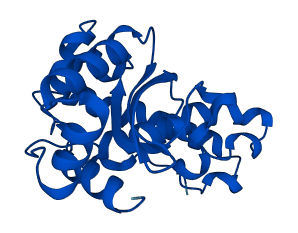
Autoinhibited structure

Activated structure
14 structures for P00448
| Entry ID | Method | Resolution | Chain | Position | Source |
|---|---|---|---|---|---|
| 1D5N | X-ray | 155 A | A/B/C/D | 2-206 | PDB |
| 1EN4 | X-ray | 200 A | A/B/C/D | 2-206 | PDB |
| 1EN5 | X-ray | 230 A | A/B/C/D | 2-206 | PDB |
| 1EN6 | X-ray | 200 A | A/B/C/D | 2-206 | PDB |
| 1I08 | X-ray | 220 A | A/B/C/D | 2-206 | PDB |
| 1I0H | X-ray | 135 A | A/B | 2-206 | PDB |
| 1IX9 | X-ray | 090 A | A/B | 2-206 | PDB |
| 1IXB | X-ray | 090 A | A/B | 2-206 | PDB |
| 1MMM | X-ray | 220 A | A/B | 2-206 | PDB |
| 1VEW | X-ray | 210 A | A/B/C/D | 2-206 | PDB |
| 1ZLZ | X-ray | 155 A | A/B | 2-206 | PDB |
| 3K9S | X-ray | 155 A | A/B/C/D | 2-206 | PDB |
| 3OT7 | X-ray | 190 A | A/B/C/D | 2-206 | PDB |
| AF-P00448-F1 | Predicted | AlphaFoldDB |
1 variants for P00448
| Variant ID(s) | Position | Change | Description | Diseaes Association | Provenance |
|---|---|---|---|---|---|
| 165 | M>L | strain: B [UniProt] | No |
No associated diseases with P00448
No regional properties for P00448
| Type | Name | Position | InterPro Accession |
|---|---|---|---|
| No domain, repeats, and functional sites for P00448 | |||
Functions
| Description | ||
|---|---|---|
| EC Number | 1.15.1.1 | Acting on superoxide as acceptor |
| Subcellular Localization |
|
|
| PANTHER Family | ||
| PANTHER Subfamily | ||
| PANTHER Protein Class | ||
| PANTHER Pathway Category | No pathway information available | |
2 GO annotations of cellular component
5 GO annotations of molecular function
| Name | Definition |
|---|---|
| antioxidant activity | Inhibition of the reactions brought about by dioxygen (O2) or peroxides. Usually the antioxidant is effective because it can itself be more easily oxidized than the substance protected. The term is often applied to components that can trap free radicals, thereby breaking the chain reaction that normally leads to extensive biological damage. |
| DNA binding | Any molecular function by which a gene product interacts selectively and non-covalently with DNA (deoxyribonucleic acid). |
| manganese ion binding | Binding to a manganese ion (Mn). |
| metal ion binding | Binding to a metal ion. |
| superoxide dismutase activity | Catalysis of the reaction: 2 superoxide + 2 H+ = O2 + hydrogen peroxide. |
6 GO annotations of biological process
| Name | Definition |
|---|---|
| cellular response to selenium ion | Any process that results in a change in state or activity of a cell (in terms of movement, secretion, enzyme production, gene expression, etc.) as a result of a stimulus from selenium ion. |
| removal of superoxide radicals | Any process, acting at the cellular level, involved in removing superoxide radicals (O2-) from a cell or organism, e.g. by conversion to dioxygen (O2) and hydrogen peroxide (H2O2). |
| response to acidic pH | Any process that results in a change in state or activity of a cell or an organism (in terms of movement, secretion, enzyme production, gene expression, etc.) as a result of a pH stimulus with pH < 7. pH is a measure of the acidity or basicity of an aqueous solution. |
| response to heat | Any process that results in a change in state or activity of a cell or an organism (in terms of movement, secretion, enzyme production, gene expression, etc.) as a result of a heat stimulus, a temperature stimulus above the optimal temperature for that organism. |
| response to oxidative stress | Any process that results in a change in state or activity of a cell or an organism (in terms of movement, secretion, enzyme production, gene expression, etc.) as a result of oxidative stress, a state often resulting from exposure to high levels of reactive oxygen species, e.g. superoxide anions, hydrogen peroxide (H2O2), and hydroxyl radicals. |
| superoxide metabolic process | The chemical reactions and pathways involving superoxide, the superoxide anion O2- (superoxide free radical), or any compound containing this species. |
No homologous proteins in AiPD
| UniProt AC | Gene Name | Protein Name | Species | Evidence Code |
|---|---|---|---|---|
| No homologous proteins | ||||
| 10 | 20 | 30 | 40 | 50 | 60 |
| MSYTLPSLPY | AYDALEPHFD | KQTMEIHHTK | HHQTYVNNAN | AALESLPEFA | NLPVEELITK |
| 70 | 80 | 90 | 100 | 110 | 120 |
| LDQLPADKKT | VLRNNAGGHA | NHSLFWKGLK | KGTTLQGDLK | AAIERDFGSV | DNFKAEFEKA |
| 130 | 140 | 150 | 160 | 170 | 180 |
| AASRFGSGWA | WLVLKGDKLA | VVSTANQDSP | LMGEAISGAS | GFPIMGLDVW | EHAYYLKFQN |
| 190 | 200 | ||||
| RRPDYIKEFW | NVVNWDEAAA | RFAAKK |