O97627
Gene name |
GRK2 |
Protein name |
Beta-adrenergic receptor kinase 1 |
Names |
CD40-L, Tumor necrosis factor ligand superfamily member 5, CD40-L, Tumor necrosis factor ligand superfamily member 5, Beta-ARK-1, G-protein coupled receptor kinase 2 |
Species |
Didelphis virginiana (North American opossum) (Didelphis marsupialis virginiana) |
KEGG Pathway |
|
EC number |
2.7.11.15: Protein-serine/threonine kinases |
Protein Class |
|
Descriptions
The autoinhibited protein was predicted that may have potential autoinhibitory elements via cis-regPred.
Autoinhibitory domains (AIDs)
Target domain |
|
Relief mechanism |
|
Assay |
cis-regPred |
Accessory elements
No accessory elements
Autoinhibited structure

Activated structure
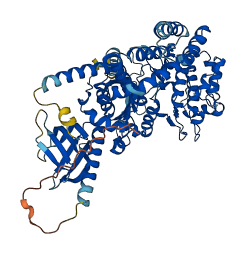
1 structures for O97627
| Entry ID | Method | Resolution | Chain | Position | Source |
|---|---|---|---|---|---|
| AF-O97627-F1 | Predicted | AlphaFoldDB |
No variants for O97627
| Variant ID(s) | Position | Change | Description | Diseaes Association | Provenance |
|---|---|---|---|---|---|
| No variants for O97627 | |||||
No associated diseases with O97627
4 regional properties for O97627
| Type | Name | Position | InterPro Accession |
|---|---|---|---|
| domain | Ionotropic glutamate receptor, C-terminal | 433 - 824 | IPR001320 |
| domain | Receptor, ligand binding region | 42 - 358 | IPR001828 |
| domain | Calmodulin-binding domain C0, NMDA receptor, NR1 subunit | 835 - 863 | IPR018882 |
| domain | Ionotropic glutamate receptor, L-glutamate and glycine-binding domain | 439 - 545 | IPR019594 |
Functions
| Description | ||
|---|---|---|
| EC Number | 2.7.11.15 | Protein-serine/threonine kinases |
| Subcellular Localization |
|
|
| PANTHER Family | ||
| PANTHER Subfamily | ||
| PANTHER Protein Class | ||
| PANTHER Pathway Category | No pathway information available | |
6 GO annotations of cellular component
| Name | Definition |
|---|---|
| anchoring junction | A cell junction that mechanically attaches a cell (and its cytoskeleton) to neighboring cells or to the extracellular matrix. |
| cell projection | A prolongation or process extending from a cell, e.g. a flagellum or axon. |
| cytoplasm | The contents of a cell excluding the plasma membrane and nucleus, but including other subcellular structures. |
| plasma membrane | The membrane surrounding a cell that separates the cell from its external environment. It consists of a phospholipid bilayer and associated proteins. |
| postsynapse | The part of a synapse that is part of the post-synaptic cell. |
| presynapse | The part of a synapse that is part of the presynaptic cell. |
4 GO annotations of molecular function
| Name | Definition |
|---|---|
| ATP binding | Binding to ATP, adenosine 5'-triphosphate, a universally important coenzyme and enzyme regulator. |
| beta-adrenergic receptor kinase activity | Catalysis of the reaction: ATP + beta-adrenergic receptor = ADP + phospho-beta-adrenergic receptor. |
| Edg-2 lysophosphatidic acid receptor binding | Binding to an Edg-2 lysophosphatidic acid receptor. |
| G protein-coupled receptor kinase activity | Catalysis of the reaction: ATP + G protein-coupled receptor = ADP + G protein-coupled receptor phosphate. |
3 GO annotations of biological process
| Name | Definition |
|---|---|
| negative regulation of relaxation of smooth muscle | Any process that stops, prevents or reduces the frequency, rate or extent of relaxation of smooth muscle. |
| protein phosphorylation | The process of introducing a phosphate group on to a protein. |
| signal transduction | The cellular process in which a signal is conveyed to trigger a change in the activity or state of a cell. Signal transduction begins with reception of a signal (e.g. a ligand binding to a receptor or receptor activation by a stimulus such as light), or for signal transduction in the absence of ligand, signal-withdrawal or the activity of a constitutively active receptor. Signal transduction ends with regulation of a downstream cellular process, e.g. regulation of transcription or regulation of a metabolic process. Signal transduction covers signaling from receptors located on the surface of the cell and signaling via molecules located within the cell. For signaling between cells, signal transduction is restricted to events at and within the receiving cell. |
No homologous proteins in AiPD
| UniProt AC | Gene Name | Protein Name | Species | Evidence Code |
|---|---|---|---|---|
| No homologous proteins | ||||
| 10 | 20 | 30 | 40 | 50 | 60 |
| MADLEAVLAD | VSYLMAMEKS | KATPAARASK | KILLPEPSIR | SVMQKYLEDR | GEVTFEKIFS |
| 70 | 80 | 90 | 100 | 110 | 120 |
| QKLGYLLFRE | FCLNHMEEAK | PLVEFYDEIK | KYEKLDSEEE | RTVKSREIFD | LYIMKELLSC |
| 130 | 140 | 150 | 160 | 170 | 180 |
| SHLFSKSATE | HVQSRLLKKQ | VPTDLFQPYI | EEICQRFRDD | VFQKFIESEK | FTRFCQWKNV |
| 190 | 200 | 210 | 220 | 230 | 240 |
| ELNIHLTMND | FSVHRIIGRG | GFGEVYGCRK | ADTGKMYAMK | CLDKKRIKMK | QGETLALNER |
| 250 | 260 | 270 | 280 | 290 | 300 |
| IMLSLVSTGD | CPFIVCMSYA | FHTPDKLSFI | LDLMNGGDLH | YHLSQHGVFS | ESDMRFYAAE |
| 310 | 320 | 330 | 340 | 350 | 360 |
| IILGLEHMHS | RFVVYRDLKP | ANILLDEFGH | VRISDLGLAC | DFSKKKPHAS | VGTHGYMAPE |
| 370 | 380 | 390 | 400 | 410 | 420 |
| VLQKGVAYDS | SADWFSLGCM | LFKLLRGHSP | FRQHKTKDKH | EIDRMTLTMA | VELPDSFSPE |
| 430 | 440 | 450 | 460 | 470 | 480 |
| LRSLLEGLLQ | RDVNRSLGCL | GRGAQEVKED | PFFKAVDWQM | VLLQKYPPPL | IPPRGEVNAA |
| 490 | 500 | 510 | 520 | 530 | 540 |
| DAFDIGSFDE | EDTKGIKLLD | SDQELYRNFP | LTISERWQQE | VAETVFDTVN | SETDRLEARK |
| 550 | 560 | 570 | 580 | 590 | 600 |
| KAKNKQLGHE | DDYALGKDCI | MHGYMSKMGN | PFLTQWQRRY | FYLFPNRLEW | RAEGEAPQSL |
| 610 | 620 | 630 | 640 | 650 | 660 |
| LTMEEIQSVE | ETQIKDRKCI | LLKIRGGKQF | ILQCDSDPEL | VQWKKELRDV | YREAQQLLQR |
| 670 | 680 | ||||
| VPKMKNKPRS | PVVELSKMPL | TQRGSANGL |