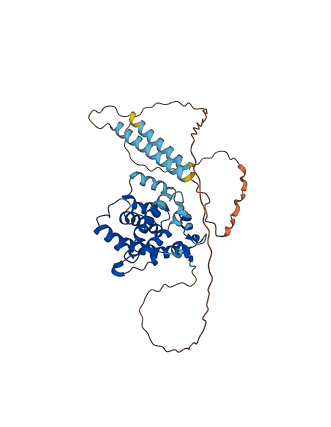
Descriptions
The autoinhibited protein was predicted that may have potential autoinhibitory elements via cis-regPred.
Autoinhibitory domains (AIDs)
Target domain |
|
Relief mechanism |
|
Assay |
cis-regPred |
Accessory elements
No accessory elements
Autoinhibited structure

Activated structure
1 structures for O95397
| Entry ID | Method | Resolution | Chain | Position | Source |
|---|---|---|---|---|---|
| AF-O95397-F1 | Predicted | AlphaFoldDB |
No variants for O95397
| Variant ID(s) | Position | Change | Description | Diseaes Association | Provenance |
|---|---|---|---|---|---|
| No variants for O95397 | |||||
No associated diseases with O95397
1 regional properties for O95397
| Type | Name | Position | InterPro Accession |
|---|---|---|---|
| domain | Glycolipid transfer protein domain | 189 - 390 | IPR014830 |
1 GO annotations of cellular component
| Name | Definition |
|---|---|
| cytosol | The part of the cytoplasm that does not contain organelles but which does contain other particulate matter, such as protein complexes. |
2 GO annotations of molecular function
| Name | Definition |
|---|---|
| ceramide 1-phosphate binding | Binding to ceramide 1-phosphate. |
| ceramide 1-phosphate transfer activity | Removes a ceramide 1-phosphate from a membrane or a monolayer lipid particle, transports it through the aqueous phase while protected in a hydrophobic pocket, and brings it to an acceptor membrane or lipid particle. |
3 GO annotations of biological process
| Name | Definition |
|---|---|
| ceramide transport | The directed movement of ceramides into, out of or within a cell, or between cells, by means of some agent such as a transporter or pore. Ceramides are a class of lipid composed of sphingosine linked to a fatty acid. |
| ER to Golgi ceramide transport | The directed movement of a ceramide from the endoplasmic reticulum (ER) to the Golgi. Ceramides are a class of lipid composed of sphingosine linked to a fatty acid. |
| intermembrane lipid transfer | The transport of lipids between membranes in which a lipid molecule is transported through an aqueous phase from the outer leaflet of a donor membrane to the outer leaflet of an acceptor membrane. This process does not require metabolic energy and can be either spontaneous or mediated by lipid transfer proteins (LTPs). |
No homologous proteins in AiPD
| UniProt AC | Gene Name | Protein Name | Species | Evidence Code |
|---|---|---|---|---|
| No homologous proteins | ||||
| 10 | 20 | 30 | 40 | 50 | 60 |
| MSELRLCCDL | LVQQVDKTKE | VTTTGVSNSE | EGIDVGTLLK | STCNTFLKTL | EECMQIANAA |
| 70 | 80 | 90 | 100 | 110 | 120 |
| FTSELLYHTP | PGSPQLAMLK | SSKMKHPIIP | IHNSLERQTE | LSTCENGSLN | MEINGEEEIL |
| 130 | 140 | 150 | 160 | 170 | 180 |
| MKNKNSLYLK | SAEIDCSISS | EENTDDNITV | QGEIMKEDRM | ENLKNHDNNL | SQSGSDSSCS |
| 190 | 200 | 210 | 220 | 230 | 240 |
| PECLWEEGKE | VIPTFFSTMN | TSFSDIELLE | DSGIPTEAFL | ASCCAVVPVL | DKLGPTVFAP |
| 250 | 260 | 270 | 280 | 290 | 300 |
| VKMDLVENIK | KVNQKYITNK | EEFTTLQKIV | LHEVEADVAQ | VRNSATEALL | WLKRGLKFLK |
| 310 | 320 | 330 | 340 | 350 | 360 |
| GFLTEVKNGE | KDIQTALNNA | YGKTLRQHHG | WVVRGVFALA | LRATPSYEDF | VAALTVKEGD |
| 370 | 380 | 390 | |||
| HRKEAFSIGM | QRDLSLYLPA | MKKQMAILDA | L |