O94652
Gene name |
gle1 (SPBC31E1.05) |
Protein name |
mRNA export factor gle1 |
Names |
Nuclear pore protein gle1, Nucleoporin gle1, RNA export factor gle1 |
Species |
Schizosaccharomyces pombe (strain 972 / ATCC 24843) (Fission yeast) |
KEGG Pathway |
spo:SPBC31E1.05 |
EC number |
|
Protein Class |
|
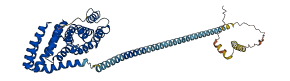
Descriptions
The autoinhibited protein was predicted that may have potential autoinhibitory elements via cis-regPred.
Autoinhibitory domains (AIDs)
Target domain |
|
Relief mechanism |
|
Assay |
cis-regPred |
Accessory elements
No accessory elements
Autoinhibited structure

Activated structure
1 structures for O94652
| Entry ID | Method | Resolution | Chain | Position | Source |
|---|---|---|---|---|---|
| AF-O94652-F1 | Predicted | AlphaFoldDB |
No variants for O94652
| Variant ID(s) | Position | Change | Description | Diseaes Association | Provenance |
|---|---|---|---|---|---|
| No variants for O94652 | |||||
No associated diseases with O94652
5 regional properties for O94652
| Type | Name | Position | InterPro Accession |
|---|---|---|---|
| domain | Alpha-D-phosphohexomutase, C-terminal | 365 - 440 | IPR005843 |
| domain | Alpha-D-phosphohexomutase, alpha/beta/alpha domain I | 7 - 137 | IPR005844 |
| domain | Alpha-D-phosphohexomutase, alpha/beta/alpha domain II | 156 - 252 | IPR005845 |
| domain | Alpha-D-phosphohexomutase, alpha/beta/alpha domain III | 258 - 357 | IPR005846 |
| conserved_site | Alpha-D-phosphohexomutase, conserved site | 95 - 104 | IPR016066 |
Functions
8 GO annotations of cellular component
| Name | Definition |
|---|---|
| cytoplasm | The contents of a cell excluding the plasma membrane and nucleus, but including other subcellular structures. |
| cytosol | The part of the cytoplasm that does not contain organelles but which does contain other particulate matter, such as protein complexes. |
| nuclear envelope | The double lipid bilayer enclosing the nucleus and separating its contents from the rest of the cytoplasm; includes the intermembrane space, a gap of width 20-40 nm (also called the perinuclear space). |
| nuclear membrane | Either of the lipid bilayers that surround the nucleus and form the nuclear envelope; excludes the intermembrane space. |
| nuclear periphery | The portion of the nuclear lumen proximal to the inner nuclear membrane. |
| nuclear pore | A protein complex providing a discrete opening in the nuclear envelope of a eukaryotic cell, where the inner and outer nuclear membranes are joined. |
| nuclear pore cytoplasmic filaments | Filamentous extensions on cytoplasmic face of the nuclear pore complex (NPC). In S. cerevisiae, Nup159p, Nup82p, and Nup42p contribute to the cytoplasmic filaments. In vertebrates, Nup358 is a major component. |
| nucleus | A membrane-bounded organelle of eukaryotic cells in which chromosomes are housed and replicated. In most cells, the nucleus contains all of the cell's chromosomes except the organellar chromosomes, and is the site of RNA synthesis and processing. In some species, or in specialized cell types, RNA metabolism or DNA replication may be absent. |
3 GO annotations of molecular function
| Name | Definition |
|---|---|
| inositol hexakisphosphate binding | Binding to inositol hexakisphosphate. |
| phospholipid binding | Binding to a phospholipid, a class of lipids containing phosphoric acid as a mono- or diester. |
| translation initiation factor binding | Binding to a translation initiation factor, any polypeptide factor involved in the initiation of ribosome-mediated translation. |
5 GO annotations of biological process
| Name | Definition |
|---|---|
| mRNA export from nucleus | The directed movement of mRNA from the nucleus to the cytoplasm. |
| poly(A)+ mRNA export from nucleus | The directed movement of poly(A)+ mRNA out of the nucleus into the cytoplasm. |
| protein transport | The directed movement of proteins into, out of or within a cell, or between cells, by means of some agent such as a transporter or pore. |
| regulation of translational initiation | Any process that modulates the frequency, rate or extent of translational initiation. |
| regulation of translational termination | Any process that modulates the frequency, rate or extent of translational termination. |
No homologous proteins in AiPD
| UniProt AC | Gene Name | Protein Name | Species | Evidence Code |
|---|---|---|---|---|
| No homologous proteins | ||||
| 10 | 20 | 30 | 40 | 50 | 60 |
| MDTKTTPLIH | AKLDEKIISS | YNDANGLDID | DLWDIYNEKT | RRMIHIISQR | YKPKKQSPFP |
| 70 | 80 | 90 | 100 | 110 | 120 |
| VIADENVRIF | PPLHKTIDWA | KKRNVEEQNL | IEQSITESQR | IFSEKQRLEQ | ERFNRELLEK |
| 130 | 140 | 150 | 160 | 170 | 180 |
| KRIEAERQRL | KDEEERRKKE | LMEKEKKEKE | RIRLIEEQKH | KENEQRRLKQ | EQIDAKRKEE |
| 190 | 200 | 210 | 220 | 230 | 240 |
| EAREKRMKET | FKDDPEEDSN | MAWSIIHKIK | TEVVAPISEK | KELKNYCFTQ | KRKITPRLGQ |
| 250 | 260 | 270 | 280 | 290 | 300 |
| ITKSNSQIMK | ITQLLQQTFQ | EARNTDPLVY | KWVLNFFCKS | VVKQAEAEVA | VNPISAYPLA |
| 310 | 320 | 330 | 340 | 350 | 360 |
| KVCLLLQTQN | ADLKDLLFAR | LQKNCPWVIP | FWYDHGTENG | KKKMGFKKLS | DGHWEQNTTY |
| 370 | 380 | 390 | 400 | 410 | 420 |
| NERQCGIFAV | YAAILSLDDS | LAPESWRTFS | RLLNLPSPSQ | LMKSDLELGQ | TLCSIVSTYL |
| 430 | 440 | 450 | 460 | 470 | |
| DIAGQSLLRI | YGRQAKKLIV | CSFSEAYLGA | NGGGSQYGRL | RIVGEDWMKG | QGGLKFSFEP |