O94374
Gene name |
imp1 (SPBC1604.08c) |
Protein name |
Importin subunit alpha-2 |
Names |
Importin-1, Karyopherin subunit alpha-2 |
Species |
Schizosaccharomyces pombe (strain 972 / ATCC 24843) (Fission yeast) |
KEGG Pathway |
spo:SPBC1604.08c |
EC number |
|
Protein Class |
|
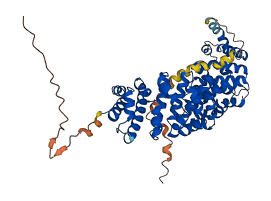
Descriptions
The autoinhibited protein was predicted that may have potential autoinhibitory elements via cis-regPred.
Autoinhibitory domains (AIDs)
Target domain |
|
Relief mechanism |
|
Assay |
cis-regPred |
Accessory elements
No accessory elements
Autoinhibited structure

Activated structure
1 structures for O94374
| Entry ID | Method | Resolution | Chain | Position | Source |
|---|---|---|---|---|---|
| AF-O94374-F1 | Predicted | AlphaFoldDB |
No variants for O94374
| Variant ID(s) | Position | Change | Description | Diseaes Association | Provenance |
|---|---|---|---|---|---|
| No variants for O94374 | |||||
No associated diseases with O94374
7 regional properties for O94374
| Type | Name | Position | InterPro Accession |
|---|---|---|---|
| repeat | Armadillo | 109 - 235 | IPR000225-1 |
| repeat | Armadillo | 238 - 277 | IPR000225-2 |
| repeat | Armadillo | 279 - 361 | IPR000225-3 |
| repeat | Armadillo | 363 - 403 | IPR000225-4 |
| repeat | Armadillo | 408 - 448 | IPR000225-5 |
| domain | Importin-alpha, importin-beta-binding domain | 1 - 99 | IPR002652 |
| repeat | Atypical Arm repeat | 462 - 511 | IPR032413 |
9 GO annotations of cellular component
| Name | Definition |
|---|---|
| cytoplasm | The contents of a cell excluding the plasma membrane and nucleus, but including other subcellular structures. |
| cytosol | The part of the cytoplasm that does not contain organelles but which does contain other particulate matter, such as protein complexes. |
| mitotic spindle midzone | The area in the center of the anaphase spindle consisting of microtubules, microtubule bundling factors and kinesin motors where the spindle microtubules from opposite poles overlap in an antiparallel manner. |
| nuclear envelope | The double lipid bilayer enclosing the nucleus and separating its contents from the rest of the cytoplasm; includes the intermembrane space, a gap of width 20-40 nm (also called the perinuclear space). |
| nuclear periphery | The portion of the nuclear lumen proximal to the inner nuclear membrane. |
| nuclear pore | A protein complex providing a discrete opening in the nuclear envelope of a eukaryotic cell, where the inner and outer nuclear membranes are joined. |
| nucleolus | A small, dense body one or more of which are present in the nucleus of eukaryotic cells. It is rich in RNA and protein, is not bounded by a limiting membrane, and is not seen during mitosis. Its prime function is the transcription of the nucleolar DNA into 45S ribosomal-precursor RNA, the processing of this RNA into 5.8S, 18S, and 28S components of ribosomal RNA, and the association of these components with 5S RNA and proteins synthesized outside the nucleolus. This association results in the formation of ribonucleoprotein precursors; these pass into the cytoplasm and mature into the 40S and 60S subunits of the ribosome. |
| nucleoplasm | That part of the nuclear content other than the chromosomes or the nucleolus. |
| nucleus | A membrane-bounded organelle of eukaryotic cells in which chromosomes are housed and replicated. In most cells, the nucleus contains all of the cell's chromosomes except the organellar chromosomes, and is the site of RNA synthesis and processing. In some species, or in specialized cell types, RNA metabolism or DNA replication may be absent. |
3 GO annotations of molecular function
| Name | Definition |
|---|---|
| GTP binding | Binding to GTP, guanosine triphosphate. |
| nuclear import signal receptor activity | Combining with a nuclear import signal (NIS) on a cargo to be transported, to mediate transport of the cargo through the nuclear pore, from the cytoplasm to the nuclear lumen. The cargo can be either a RNA or a protein. |
| nuclear localization sequence binding | Binding to a nuclear localization sequence, a specific peptide sequence that acts as a signal to localize the protein within the nucleus. |
5 GO annotations of biological process
| Name | Definition |
|---|---|
| cell division | The process resulting in division and partitioning of components of a cell to form more cells; may or may not be accompanied by the physical separation of a cell into distinct, individually membrane-bounded daughter cells. |
| mitotic nuclear pore complex disassembly | The mitotic cell cycle process in which the controlled breakdown of the nuclear pores occurs during open or closed mitosis. |
| NLS-bearing protein import into nucleus | The directed movement of a protein bearing a nuclear localization signal (NLS) from the cytoplasm into the nucleus, across the nuclear envelope. |
| protein import into nucleus | The directed movement of a protein from the cytoplasm to the nucleus. |
| regulation of mitotic nuclear envelope disassembly | Any process that modulates the frequency, rate or extent of mitotic nuclear envelope disassembly. |
No homologous proteins in AiPD
| UniProt AC | Gene Name | Protein Name | Species | Evidence Code |
|---|---|---|---|---|
| No homologous proteins | ||||
| 10 | 20 | 30 | 40 | 50 | 60 |
| MESRYLSDRR | SRFKSKGVFK | ADELRRQREE | QQIEIRKQKR | EESLNKRRNL | NAVLQNDIDV |
| 70 | 80 | 90 | 100 | 110 | 120 |
| EEEADQSQVQ | MEQQMKDEFP | KLTADVMSDD | IELQLGAVTK | FRKYLSKETH | PPIDQVIACG |
| 130 | 140 | 150 | 160 | 170 | 180 |
| VVDRFVQFLE | SEHHLLQFEA | AWALTNIASG | TTDQTRIVVD | SGAVPRFIQL | LSSPEKDVRE |
| 190 | 200 | 210 | 220 | 230 | 240 |
| QVVWALGNIA | GDSSACRDYV | LGNGVLQPLL | NILQSSASDV | SMLRNATWTL | SNLCRGKNPP |
| 250 | 260 | 270 | 280 | 290 | 300 |
| PNWSTISVAV | PILAKLLYSE | DVEIIVDACW | AISYLSDGPN | EKIGAILDVG | CAPRLVELLS |
| 310 | 320 | 330 | 340 | 350 | 360 |
| SPSVNIQTPA | LRSVGNIVTG | TDAQTQIIID | CGALNAFPSL | LSHQKENIRK | EACWTISNIT |
| 370 | 380 | 390 | 400 | 410 | 420 |
| AGNTQQIQAI | IESNLIPPLV | HLLSYADYKT | KKEACWAISN | ATSGGLGQPD | QIRYLVSQGV |
| 430 | 440 | 450 | 460 | 470 | 480 |
| IKPLCDMLNG | SDNKIIQVAL | DAIENILKVG | EMDRTMDLEN | INQYAVYVEE | AGGMDMIHDL |
| 490 | 500 | 510 | 520 | 530 | |
| QSSGNNDIYL | KAYSIIEKYF | SDEDAVEDLA | PETENGAFTF | GNGPQAQGEF | KFDSQDMAM |