O94335
Gene name |
stt3 (SPBC1271.02) |
Protein name |
Dolichyl-diphosphooligosaccharide--protein glycosyltransferase subunit stt3 |
Names |
Oligosaccharyl transferase subunit stt3 |
Species |
Schizosaccharomyces pombe (strain 972 / ATCC 24843) (Fission yeast) |
KEGG Pathway |
spo:SPBC1271.02 |
EC number |
2.4.99.18: Transferring other glycosyl groups |
Protein Class |
|
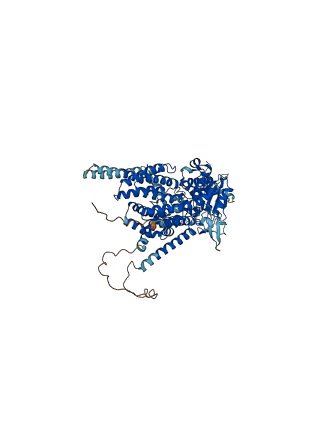
Descriptions
The autoinhibited protein was predicted that may have potential autoinhibitory elements via cis-regPred.
Autoinhibitory domains (AIDs)
Target domain |
|
Relief mechanism |
|
Assay |
cis-regPred |
Accessory elements
No accessory elements
Autoinhibited structure

Activated structure
1 structures for O94335
| Entry ID | Method | Resolution | Chain | Position | Source |
|---|---|---|---|---|---|
| AF-O94335-F1 | Predicted | AlphaFoldDB |
No variants for O94335
| Variant ID(s) | Position | Change | Description | Diseaes Association | Provenance |
|---|---|---|---|---|---|
| No variants for O94335 | |||||
No associated diseases with O94335
1 regional properties for O94335
| Type | Name | Position | InterPro Accession |
|---|---|---|---|
| domain | Luciferase-like domain | 1 - 332 | IPR011251 |
Functions
| Description | ||
|---|---|---|
| EC Number | 2.4.99.18 | Transferring other glycosyl groups |
| Subcellular Localization |
|
|
| PANTHER Family | ||
| PANTHER Subfamily | ||
| PANTHER Protein Class | ||
| PANTHER Pathway Category | No pathway information available | |
3 GO annotations of cellular component
| Name | Definition |
|---|---|
| endoplasmic reticulum | The irregular network of unit membranes, visible only by electron microscopy, that occurs in the cytoplasm of many eukaryotic cells. The membranes form a complex meshwork of tubular channels, which are often expanded into slitlike cavities called cisternae. The ER takes two forms, rough (or granular), with ribosomes adhering to the outer surface, and smooth (with no ribosomes attached). |
| integral component of membrane | The component of a membrane consisting of the gene products and protein complexes having at least some part of their peptide sequence embedded in the hydrophobic region of the membrane. |
| oligosaccharyltransferase complex | A protein complex that is found in the endoplasmic reticulum membrane of eukaryotes and transfers lipid-linked oligosaccharide precursor to asparagine residues on nascent proteins. In yeast, the complex includes at least nine different subunits, whereas in mammalian cells at least three different forms of the complex have been detected. |
2 GO annotations of molecular function
| Name | Definition |
|---|---|
| dolichyl-diphosphooligosaccharide-protein glycotransferase activity | Catalysis of the reaction: dolichyl diphosphooligosaccharide + protein L-asparagine = dolichyl diphosphate + a glycoprotein with the oligosaccharide chain attached by glycosylamine linkage to protein L-asparagine. |
| metal ion binding | Binding to a metal ion. |
3 GO annotations of biological process
| Name | Definition |
|---|---|
| post-translational protein modification | The process of covalently altering one or more amino acids in a protein after the protein has been completely translated and released from the ribosome. |
| protein N-linked glycosylation | A protein glycosylation process in which a carbohydrate or carbohydrate derivative unit is added to a protein via the N4 atom of peptidyl-asparagine, the omega-N of arginine, or the N1' atom peptidyl-tryptophan. |
| protein N-linked glycosylation via asparagine | The glycosylation of protein via the N4 atom of peptidyl-asparagine forming N4-glycosyl-L-asparagine; the most common form is N-acetylglucosaminyl asparagine; N-acetylgalactosaminyl asparagine and N4 glucosyl asparagine also occur. This modification typically occurs in extracellular peptides with an N-X-(ST) motif. Partial modification has been observed to occur with cysteine, rather than serine or threonine, in the third position; secondary structure features are important, and proline in the second or fourth positions inhibits modification. |
No homologous proteins in AiPD
| UniProt AC | Gene Name | Protein Name | Species | Evidence Code |
|---|---|---|---|---|
| No homologous proteins | ||||
| 10 | 20 | 30 | 40 | 50 | 60 |
| MANSATITSK | KGVKSHQKDW | KIPLKVLILI | CIAVASVSSR | LFSVIRYESI | IHEFDPWFNF |
| 70 | 80 | 90 | 100 | 110 | 120 |
| RASKILVEQG | FYNFLNWFDE | RSWYPLGRVA | GGTLYPGLMV | TSGIIFKVLH | LLRINVNIRD |
| 130 | 140 | 150 | 160 | 170 | 180 |
| VCVLLAPAFS | GITAIATYYL | ARELKSDACG | LLAAAFMGIA | PGYTSRSVAG | SYDNEAIAIT |
| 190 | 200 | 210 | 220 | 230 | 240 |
| LLMSTFALWI | KAVKSGSSFW | GACTGLLYFY | MVTAWGGYVF | ITNMIPLHVF | VLLLMGRYTS |
| 250 | 260 | 270 | 280 | 290 | 300 |
| KLYIAYTTYY | VIGTLASMQV | PFVGFQPVST | SEHMSALGVF | GLLQLFAFYN | YVKGLVSSKQ |
| 310 | 320 | 330 | 340 | 350 | 360 |
| FQILIRFALV | CLVGLATVVL | FALSSTGVIA | PWTGRFYSLW | DTNYAKIHIP | IIASVSEHQP |
| 370 | 380 | 390 | 400 | 410 | 420 |
| PTWSSLFFDL | QFLIWLLPVG | VYLCFKELRN | EHVFIIIYSV | LGTYFCGVMV | RLVLTLTPCV |
| 430 | 440 | 450 | 460 | 470 | 480 |
| CIAAAVAIST | LLDTYMGPEV | EEDKVSEEAA | SAKSKNKKGI | FSILSFFTSG | SKNIGIYSLL |
| 490 | 500 | 510 | 520 | 530 | 540 |
| SRVLVISSTA | YFLIMFVYHS | SWVTSNAYSS | PTVVLSTVLN | DGSLMYIDDF | REAYDWLRRN |
| 550 | 560 | 570 | 580 | 590 | 600 |
| TPYDTKVMSW | WDYGYQIAGM | ADRITLVDNN | TWNNTHIATV | GKAMSSPEEK | AYPILRKHDV |
| 610 | 620 | 630 | 640 | 650 | 660 |
| DYILIIYGGT | LGYSSDDMNK | FLWMIRISQG | LWPDEIVERN | FFTPNGEYRT | DDAATPTMRE |
| 670 | 680 | 690 | 700 | 710 | 720 |
| SLLYKMSYHG | AWKLFPPNQG | YDRARNQKLP | SKDPQLFTIE | EAFTTVHHLV | RLYKVKKPDT |
| 730 | 740 | 750 | |||
| LGRDLKQVTL | FEEGKRKKLR | RPAKTNEIPL | RV |