O94332
Gene name |
rrn11 (SPBC725.17c) |
Protein name |
RNA polymerase I-specific transcription initiation factor rrn11 |
Names |
|
Species |
Schizosaccharomyces pombe (strain 972 / ATCC 24843) (Fission yeast) |
KEGG Pathway |
spo:SPBC725.17c |
EC number |
|
Protein Class |
|
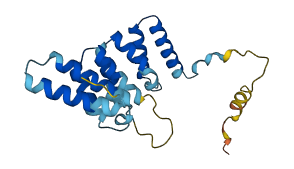
Descriptions
The autoinhibited protein was predicted that may have potential autoinhibitory elements via cis-regPred.
Autoinhibitory domains (AIDs)
Target domain |
|
Relief mechanism |
|
Assay |
cis-regPred |
Accessory elements
No accessory elements
Autoinhibited structure

Activated structure
1 structures for O94332
| Entry ID | Method | Resolution | Chain | Position | Source |
|---|---|---|---|---|---|
| AF-O94332-F1 | Predicted | AlphaFoldDB |
No variants for O94332
| Variant ID(s) | Position | Change | Description | Diseaes Association | Provenance |
|---|---|---|---|---|---|
| No variants for O94332 | |||||
No associated diseases with O94332
6 GO annotations of cellular component
| Name | Definition |
|---|---|
| cell division site | The eventual plane of cell division (also known as cell cleavage or cytokinesis) in a dividing cell. In Eukaryotes, the cleavage apparatus, composed of septin structures and the actomyosin contractile ring, forms along this plane, and the mitotic, or meiotic, spindle is aligned perpendicular to the division plane. In bacteria, the cell division site is generally located at mid-cell and is the site at which the cytoskeletal structure, the Z-ring, assembles. |
| cytosol | The part of the cytoplasm that does not contain organelles but which does contain other particulate matter, such as protein complexes. |
| mitotic spindle | A spindle that forms as part of mitosis. Mitotic and meiotic spindles contain distinctive complements of proteins associated with microtubules. |
| nucleus | A membrane-bounded organelle of eukaryotic cells in which chromosomes are housed and replicated. In most cells, the nucleus contains all of the cell's chromosomes except the organellar chromosomes, and is the site of RNA synthesis and processing. In some species, or in specialized cell types, RNA metabolism or DNA replication may be absent. |
| RNA polymerase I core factor complex | A RNA polymerase I-specific transcription factor complex that is required for the transcription of rDNA by RNA polymerase I. In yeast the complex consists of Rrn6p, Rrn7p, and Rrn11p. |
| RNA polymerase I transcription regulator complex | A transcription factor complex that acts at a regulatory region of a gene transcribed by RNA polymerase I. |
3 GO annotations of molecular function
| Name | Definition |
|---|---|
| RNA polymerase I core promoter sequence-specific DNA binding | Binding to a regulatory region composed of the transcription start site and binding sites for transcription factors of the RNA polymerase I transcription machinery. This site is often referred to as the CORE element. In mammalian cells, the CORE element functions in conjunction with the Upstream Control Element (UCE), while in fungi, protozoa, and plants, the CORE element functions without a UCE. |
| RNA polymerase I general transcription initiation factor activity | A general transcription initiation factor activity that contributes to transcription start site selection and transcription initiation of genes transcribed by RNA polymerase I. Factors required for RNA polymerase I transcription initiation include upstream activation factor (UAF), core factor (CF), TATA binding protein (TBP) and RRN3. In all species characterized, RNA polymerase I transcribes a large polycistronic transcript that is processed into several mature rRNAs (3 or 4 depending on the species), including the large subunit rRNA (28S in humans), the small subunit rRNA (18S in humans), as well as one or two additional smaller rRNAs (the 5.8S rRNA in humans). In most species, this large rRNA transcript is the sole product of RNA polymerase I. However there are rare exceptions, such as Trypanosoma brucei, where RNA polymerase I also transcribes certain mRNAs. |
| TBP-class protein binding | Binding to a member of the class of TATA-binding proteins (TBP), including any of the TBP-related factors (TRFs). |
2 GO annotations of biological process
| Name | Definition |
|---|---|
| nucleolar large rRNA transcription by RNA polymerase I | The synthesis of the large ribosomal RNA (rRNA) transcript which encodes several rRNAs, e.g. in mammals 28S, 18S and 5.8S, from a nuclear DNA template transcribed by RNA polymerase I. |
| transcription initiation at RNA polymerase I promoter | A transcription initiation process that takes place at a RNA polymerase I gene promoter. Ribosomal RNAs (rRNA) genes are transcribed by RNA polymerase I. |
No homologous proteins in AiPD
| UniProt AC | Gene Name | Protein Name | Species | Evidence Code |
|---|---|---|---|---|
| No homologous proteins | ||||
| 10 | 20 | 30 | 40 | 50 | 60 |
| MFSPCTVKEK | RSTLRSVAPN | PESSVIPPIP | LPSRRYKTRH | IDALCSLMHL | CLLRKDYPRA |
| 70 | 80 | 90 | 100 | 110 | 120 |
| SRAFSLLLRS | KSVDISKLWN | IGLEILNKVN | PEASSEYMER | LIARYPARPS | INNSYPNRNA |
| 130 | 140 | 150 | 160 | 170 | 180 |
| EHFFPAYIML | LIQRQEYNKA | MKLLDEYLLL | PPYNQNPALH | EYSGMLCFEL | AKEEASESER |
| 190 | |||||
| TKWIEKAKYN | FSNAGIDVEL |