Descriptions
The autoinhibited protein was predicted that may have potential autoinhibitory elements via cis-regPred.
Autoinhibitory domains (AIDs)
Target domain |
|
Relief mechanism |
|
Assay |
cis-regPred |
Accessory elements
No accessory elements
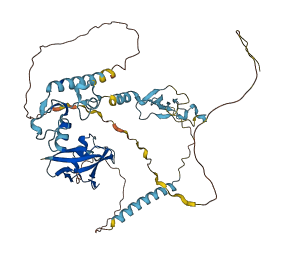
Autoinhibited structure

Activated structure
1 structures for O94264
| Entry ID | Method | Resolution | Chain | Position | Source |
|---|---|---|---|---|---|
| AF-O94264-F1 | Predicted | AlphaFoldDB |
No variants for O94264
| Variant ID(s) | Position | Change | Description | Diseaes Association | Provenance |
|---|---|---|---|---|---|
| No variants for O94264 | |||||
No associated diseases with O94264
No regional properties for O94264
| Type | Name | Position | InterPro Accession |
|---|---|---|---|
| No domain, repeats, and functional sites for O94264 | |||
2 GO annotations of cellular component
| Name | Definition |
|---|---|
| mRNA cleavage and polyadenylation specificity factor complex | A multisubunit complex that binds to the canonical AAUAAA hexamer and to U-rich upstream sequence elements on the pre-mRNA, thereby stimulating the otherwise weakly active and nonspecific polymerase to elongate efficiently RNAs containing a poly(A) signal. |
| nucleus | A membrane-bounded organelle of eukaryotic cells in which chromosomes are housed and replicated. In most cells, the nucleus contains all of the cell's chromosomes except the organellar chromosomes, and is the site of RNA synthesis and processing. In some species, or in specialized cell types, RNA metabolism or DNA replication may be absent. |
3 GO annotations of molecular function
| Name | Definition |
|---|---|
| nucleic acid binding | Binding to a nucleic acid. |
| ubiquitin protein ligase activity | Catalysis of the transfer of ubiquitin to a substrate protein via the reaction X-ubiquitin + S -> X + S-ubiquitin, where X is either an E2 or E3 enzyme, the X-ubiquitin linkage is a thioester bond, and the S-ubiquitin linkage is an amide bond: an isopeptide bond between the C-terminal glycine of ubiquitin and the epsilon-amino group of lysine residues in the substrate or, in the linear extension of ubiquitin chains, a peptide bond the between the C-terminal glycine and N-terminal methionine of ubiquitin residues. |
| zinc ion binding | Binding to a zinc ion (Zn). |
5 GO annotations of biological process
| Name | Definition |
|---|---|
| mRNA cleavage | Any process in which a pre-mRNA or mRNA molecule is cleaved at specific sites or in a regulated manner. |
| mRNA polyadenylation | The enzymatic addition of a sequence of 40-200 adenylyl residues at the 3' end of a eukaryotic mRNA primary transcript. |
| protein modification by small protein conjugation or removal | A protein modification process in which one or more groups of a small protein, such as ubiquitin or a ubiquitin-like protein, are covalently attached to or removed from a target protein. |
| protein ubiquitination | The process in which one or more ubiquitin groups are added to a protein. |
| ubiquitin-dependent protein catabolic process | The chemical reactions and pathways resulting in the breakdown of a protein or peptide by hydrolysis of its peptide bonds, initiated by the covalent attachment of a ubiquitin group, or multiple ubiquitin groups, to the protein. |
No homologous proteins in AiPD
| UniProt AC | Gene Name | Protein Name | Species | Evidence Code |
|---|---|---|---|---|
| No homologous proteins | ||||
| 10 | 20 | 30 | 40 | 50 | 60 |
| MSGVIYYKFK | SQKDPSRITF | DGTIGMSVFD | VKREIIMQKK | LGNGLDFDLL | LYNANSNEEY |
| 70 | 80 | 90 | 100 | 110 | 120 |
| DDDTFIIPRS | TSVIVRRVPA | QKSGKGTAAR | YVSGAPKTTG | ARSDSVKRPV | PMLQKKAPIT |
| 130 | 140 | 150 | 160 | 170 | 180 |
| SGESNINKSP | SSSEDAAIQQ | MFQVSSDQWR | ETQDKMASAT | PIYKPNQRRI | AASVPDKPPP |
| 190 | 200 | 210 | 220 | 230 | 240 |
| PGYICYRCGQ | KGHWIQACPT | NADPNYDGKP | RVKRTTGIPR | SFLKNVERPA | EGDAANIMIN |
| 250 | 260 | 270 | 280 | 290 | 300 |
| AEGDYVVVQP | DVASWETYQS | RKAALTANDV | YKMQPPNISL | ACTLCKKLAR | NACRTPCCDK |
| 310 | 320 | 330 | 340 | 350 | 360 |
| LFCEECIQTA | LLDSDFECPN | CHRKDVLLDT | LNPDYQKQRE | IEAVVKSVLG | SNSKNSDKVG |
| 370 | 380 | 390 | 400 | 410 | 420 |
| TSDDNNTPMS | EKRKREDDDA | NGPNKFAARS | SAVFSKATAE | PAFKSAMAIP | DMPSMPHVQG |
| 430 | 440 | 450 | 460 | 470 | 480 |
| FPAPFPPFMM | PGLPQMPPMM | MNAIAGQVYH | NNRNPPRTNS | RPSNASVPPP | SSLHKNPPTK |
| TN |