O89042
Gene name |
Pola1 (Pola) |
Protein name |
DNA polymerase alpha catalytic subunit |
Names |
DNA polymerase alpha catalytic subunit p180 |
Species |
Rattus norvegicus (Rat) |
KEGG Pathway |
rno:85241 |
EC number |
2.7.7.7: Nucleotidyltransferases |
Protein Class |
|
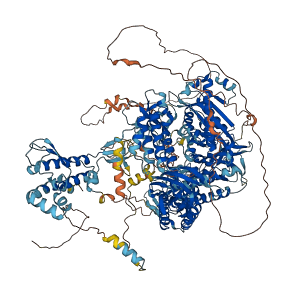
Descriptions
The autoinhibited protein was predicted that may have potential autoinhibitory elements via cis-regPred.
Autoinhibitory domains (AIDs)
Target domain |
|
Relief mechanism |
|
Assay |
cis-regPred |
Accessory elements
No accessory elements
Autoinhibited structure

Activated structure
1 structures for O89042
| Entry ID | Method | Resolution | Chain | Position | Source |
|---|---|---|---|---|---|
| AF-O89042-F1 | Predicted | AlphaFoldDB |
No variants for O89042
| Variant ID(s) | Position | Change | Description | Diseaes Association | Provenance |
|---|---|---|---|---|---|
| No variants for O89042 | |||||
No associated diseases with O89042
16 regional properties for O89042
| Type | Name | Position | InterPro Accession |
|---|---|---|---|
| repeat | HAT (Half-A-TPR) repeat | 289 - 321 | IPR003107-1 |
| repeat | HAT (Half-A-TPR) repeat | 323 - 355 | IPR003107-2 |
| repeat | HAT (Half-A-TPR) repeat | 384 - 416 | IPR003107-3 |
| repeat | HAT (Half-A-TPR) repeat | 417 - 446 | IPR003107-4 |
| repeat | HAT (Half-A-TPR) repeat | 447 - 476 | IPR003107-5 |
| repeat | HAT (Half-A-TPR) repeat | 554 - 586 | IPR003107-6 |
| repeat | HAT (Half-A-TPR) repeat | 588 - 620 | IPR003107-7 |
| repeat | HAT (Half-A-TPR) repeat | 622 - 654 | IPR003107-8 |
| repeat | HAT (Half-A-TPR) repeat | 656 - 687 | IPR003107-9 |
| repeat | HAT (Half-A-TPR) repeat | 689 - 721 | IPR003107-10 |
| repeat | HAT (Half-A-TPR) repeat | 723 - 755 | IPR003107-11 |
| repeat | HAT (Half-A-TPR) repeat | 757 - 789 | IPR003107-12 |
| repeat | HAT (Half-A-TPR) repeat | 791 - 823 | IPR003107-13 |
| domain | PRP1 splicing factor, N-terminal | 13 - 169 | IPR010491 |
| repeat | Tetratricopeptide repeat | 709 - 742 | IPR019734-1 |
| repeat | Tetratricopeptide repeat | 841 - 874 | IPR019734-2 |
Functions
| Description | ||
|---|---|---|
| EC Number | 2.7.7.7 | Nucleotidyltransferases |
| Subcellular Localization |
|
|
| PANTHER Family | ||
| PANTHER Subfamily | ||
| PANTHER Protein Class | ||
| PANTHER Pathway Category | No pathway information available | |
7 GO annotations of cellular component
| Name | Definition |
|---|---|
| alpha DNA polymerase:primase complex | A complex of four polypeptides, comprising large and small DNA polymerase alpha subunits and two primase subunits, which are capable of catalyzing the synthesis of an RNA primer on the lagging strand of replicating DNA and the subsequent synthesis of a smal stretch of DNA. The smaller of the two primase subunits alone can catalyze oligoribonucleotide synthesis. |
| cytosol | The part of the cytoplasm that does not contain organelles but which does contain other particulate matter, such as protein complexes. |
| nuclear envelope | The double lipid bilayer enclosing the nucleus and separating its contents from the rest of the cytoplasm; includes the intermembrane space, a gap of width 20-40 nm (also called the perinuclear space). |
| nuclear matrix | The dense fibrillar network lying on the inner side of the nuclear membrane. |
| nucleolus | A small, dense body one or more of which are present in the nucleus of eukaryotic cells. It is rich in RNA and protein, is not bounded by a limiting membrane, and is not seen during mitosis. Its prime function is the transcription of the nucleolar DNA into 45S ribosomal-precursor RNA, the processing of this RNA into 5.8S, 18S, and 28S components of ribosomal RNA, and the association of these components with 5S RNA and proteins synthesized outside the nucleolus. This association results in the formation of ribonucleoprotein precursors; these pass into the cytoplasm and mature into the 40S and 60S subunits of the ribosome. |
| nucleoplasm | That part of the nuclear content other than the chromosomes or the nucleolus. |
| nucleus | A membrane-bounded organelle of eukaryotic cells in which chromosomes are housed and replicated. In most cells, the nucleus contains all of the cell's chromosomes except the organellar chromosomes, and is the site of RNA synthesis and processing. In some species, or in specialized cell types, RNA metabolism or DNA replication may be absent. |
11 GO annotations of molecular function
| Name | Definition |
|---|---|
| chromatin binding | Binding to chromatin, the network of fibers of DNA, protein, and sometimes RNA, that make up the chromosomes of the eukaryotic nucleus during interphase. |
| DNA binding | Any molecular function by which a gene product interacts selectively and non-covalently with DNA (deoxyribonucleic acid). |
| DNA replication origin binding | Binding to a DNA replication origin, a unique DNA sequence of a replicon at which DNA replication is initiated and proceeds bidirectionally or unidirectionally. |
| DNA-directed DNA polymerase activity | Catalysis of the reaction: deoxynucleoside triphosphate + DNA(n) = diphosphate + DNA(n+1); the synthesis of DNA from deoxyribonucleotide triphosphates in the presence of a DNA template and a 3'hydroxyl group. |
| double-stranded DNA binding | Binding to double-stranded DNA. |
| nucleotide binding | Binding to a nucleotide, any compound consisting of a nucleoside that is esterified with (ortho)phosphate or an oligophosphate at any hydroxyl group on the ribose or deoxyribose. |
| protein kinase binding | Binding to a protein kinase, any enzyme that catalyzes the transfer of a phosphate group, usually from ATP, to a protein substrate. |
| purine nucleotide binding | Binding to a purine nucleotide, a compound consisting of a purine nucleoside esterified with (ortho)phosphate. |
| pyrimidine nucleotide binding | Binding to a pyrimidine nucleotide, a pyrimidine nucleoside esterified with (ortho)phosphate. |
| single-stranded DNA binding | Binding to single-stranded DNA. |
| zinc ion binding | Binding to a zinc ion (Zn). |
12 GO annotations of biological process
| Name | Definition |
|---|---|
| DNA biosynthetic process | The biosynthetic process resulting in the formation of DNA. |
| DNA repair | The process of restoring DNA after damage. Genomes are subject to damage by chemical and physical agents in the environment (e.g. UV and ionizing radiations, chemical mutagens, fungal and bacterial toxins, etc.) and by free radicals or alkylating agents endogenously generated in metabolism. DNA is also damaged because of errors during its replication. A variety of different DNA repair pathways have been reported that include direct reversal, base excision repair, nucleotide excision repair, photoreactivation, bypass, double-strand break repair pathway, and mismatch repair pathway. |
| DNA replication | The cellular metabolic process in which a cell duplicates one or more molecules of DNA. DNA replication begins when specific sequences, known as origins of replication, are recognized and bound by initiation proteins, and ends when the original DNA molecule has been completely duplicated and the copies topologically separated. The unit of replication usually corresponds to the genome of the cell, an organelle, or a virus. The template for replication can either be an existing DNA molecule or RNA. |
| DNA replication initiation | The process in which DNA-dependent DNA replication is started; this begins with the ATP dependent loading of an initiator complex onto the DNA, this is followed by DNA melting and helicase activity. In bacteria, the gene products that enable the helicase activity are loaded after the initial melting and in archaea and eukaryotes, the gene products that enable the helicase activity are inactive when they are loaded and subsequently activate. |
| DNA replication, synthesis of RNA primer | The synthesis of a short RNA polymer, usually 4-15 nucleotides long, using one strand of unwound DNA as a template; the RNA then serves as a primer from which DNA polymerases extend synthesis. |
| DNA strand elongation involved in DNA replication | The process in which an existing DNA strand is extended by activities including the addition of nucleotides to the 3' end of the strand, complementary to an existing template, as part of DNA replication. |
| DNA synthesis involved in DNA repair | Synthesis of DNA that proceeds from the broken 3' single-strand DNA end and uses the homologous intact duplex as the template. |
| double-strand break repair via nonhomologous end joining | The repair of a double-strand break in DNA in which the two broken ends are rejoined with little or no sequence complementarity. Information at the DNA ends may be lost due to the modification of broken DNA ends. This term covers instances of separate pathways, called classical (or canonical) and alternative nonhomologous end joining (C-NHEJ and A-NHEJ). These in turn may further branch into sub-pathways, but evidence is still unclear. |
| lagging strand elongation | The process in which an existing DNA strand is extended in a net 3' to 5' direction by activities including the addition of nucleotides to the 3' end of the strand, complementary to an existing template, as part of DNA replication. Lagging strand DNA elongation proceeds by discontinuous synthesis of short stretches of DNA, known as Okazaki fragments, from RNA primers; these fragments are then joined by DNA ligase. Although each segment of nascent DNA is synthesized in the 5' to 3' direction, the overall direction of lagging strand synthesis is 3' to 5', mirroring the progress of the replication fork. |
| leading strand elongation | The process in which an existing DNA strand is extended continuously in a 5' to 3' direction by activities including the addition of nucleotides to the 3' end of the strand, complementary to an existing template, as part of DNA replication. Leading strand elongation proceeds in the same direction as the replication fork. |
| mitotic DNA replication initiation | Any DNA replication initiation involved in mitotic cell cycle DNA replication. |
| regulation of type I interferon production | Any process that modulates the frequency, rate, or extent of interferon type I production. Type I interferons include the interferon-alpha, beta, delta, episilon, zeta, kappa, tau, and omega gene families. |
| 10 | 20 | 30 | 40 | 50 | 60 |
| MAPVHGDDCK | LETSAVSDSG | SFVASRARRE | KKSKKGRQEA | LERLKKAKAG | EKYKYEVEDL |
| 70 | 80 | 90 | 100 | 110 | 120 |
| TSVYEEVDEE | QYSKLVQARQ | DDDWIVDDDG | IGYVEDGREI | FDDDLEDDAL | DTCGEGSDGK |
| 130 | 140 | 150 | 160 | 170 | 180 |
| AHRKDRKDVK | KPSVTKPNNI | KAMFIASAGK | KTTDKTVDLS | KDDLLGDILQ | DLNTETPQIA |
| 190 | 200 | 210 | 220 | 230 | 240 |
| PPPVLIPKKK | RSTGASPNPF | SVHTATAVPS | GKIASPVSRK | EPPLTPVPLK | RAEFAGDLAQ |
| 250 | 260 | 270 | 280 | 290 | 300 |
| PECPEDEQES | GVIEFEDGDF | DEPMDTEEVD | EEEPVTAKIW | DQESEPVEGV | KHEADPETGT |
| 310 | 320 | 330 | 340 | 350 | 360 |
| TSFLDSFLPD | VSCWDIDQKD | ENSFLLQEVQ | VDSNHLPLVK | GADDEQVFQF | YWLDAYEDPY |
| 370 | 380 | 390 | 400 | 410 | 420 |
| NQPGVVFLFG | KVWVESAKTH | VSCCVMVKNI | ERTLYFLPRE | MKIDLNTGKE | TATPITMKDV |
| 430 | 440 | 450 | 460 | 470 | 480 |
| YEEFDSKISA | KYKIMKFKSK | IVEKNYAFEI | PDVPEKSEYL | EVRYSAEVPQ | LPQNLKGETF |
| 490 | 500 | 510 | 520 | 530 | 540 |
| SHVFGTNTSS | LELFLMNRKI | KGPCWLEVKN | PQLLNQPISW | CKFEAMALKP | DLVNVIKDVS |
| 550 | 560 | 570 | 580 | 590 | 600 |
| PPPLVVMSFS | MKTMQNVQNH | QHEIIAMAAL | VHHNFPLDKA | PPKPPFQTHF | CVVSKPKDCI |
| 610 | 620 | 630 | 640 | 650 | 660 |
| FPCAFKEVIK | KKNMEVEVAA | TERTLLGFFL | AKVHKLDPDI | LVGHNICGFE | LEVLLQRINE |
| 670 | 680 | 690 | 700 | 710 | 720 |
| CKVPFWSKIG | RLRRSNMPKL | GSRSGFGERN | ATCGRMICDV | EISVKELIHC | KSYHLSELVQ |
| 730 | 740 | 750 | 760 | 770 | 780 |
| QILKTERIVI | PTENIRNMYS | EPSHLLYLLE | HIWKDARFIL | QIMCELNVLP | LALQITNIAG |
| 790 | 800 | 810 | 820 | 830 | 840 |
| NIMSRTLMGG | RSERNEFLLL | HAFYENNYIV | PDKQIFRKPQ | QKPGDEDEEI | DGDTNKYKKG |
| 850 | 860 | 870 | 880 | 890 | 900 |
| RKKAAYAGGL | VLDPKVGFYD | KFILLLDFNS | LYPSIIQEFN | ICFTTVQRVA | SETLKATEDE |
| 910 | 920 | 930 | 940 | 950 | 960 |
| EQEQIPELPD | PNLDMGILPR | EIRKLVERRK | QVKQLMKQQD | LNPDLVLQYD | IRQKALKLTA |
| 970 | 980 | 990 | 1000 | 1010 | 1020 |
| NSMYGCLGFS | YSRFYAKPLA | ALVTYKGREI | LMHTKEMVQK | MNLEVIYGDT | DSIMINTNST |
| 1030 | 1040 | 1050 | 1060 | 1070 | 1080 |
| NLEEVFKLGN | KVKNEVNKLY | KLLEIDIDGV | FKSLLLLKKK | KYAALVVEPT | SDGNYITKQE |
| 1090 | 1100 | 1110 | 1120 | 1130 | 1140 |
| LKGLDIVRRD | WCDLAKDTGN | FVIGQILSDQ | SRDTIVENIQ | KRLIEIGENV | LNGSVPVSQF |
| 1150 | 1160 | 1170 | 1180 | 1190 | 1200 |
| EINKALTKDP | QDYPDKKSLP | HVHVALWINS | QGGRKVKAGD | TVSYVICQDG | SNLPATQRAY |
| 1210 | 1220 | 1230 | 1240 | 1250 | 1260 |
| APEQLQKQDN | LAIDTQYYLA | QQIHPVVARI | CEPIDGIDAV | LIALWLGLDS | TQFRVHQYHK |
| 1270 | 1280 | 1290 | 1300 | 1310 | 1320 |
| DEENDALLGG | PAQLTDEEKY | KDCEKFKCLC | PSCGTENIYD | NVFEGSGMDM | EPSLNRCSNI |
| 1330 | 1340 | 1350 | 1360 | 1370 | 1380 |
| DCKASPATFM | VQLSNKLIMD | IRRCIKKYYD | GWLICEEPTC | RNRIRRLPLH | FSRNGPLCPA |
| 1390 | 1400 | 1410 | 1420 | 1430 | 1440 |
| CMKAVLRPEY | SDKSLYTQLC | FYRYIFDADC | ALEKLPEHEK | DKLKKQFFTP | RVLQDYRKVK |
| 1450 | |||||
| NIAEHFLSWS | G |