O88700
Gene name |
Blm |
Protein name |
RecQ-like DNA helicase BLM |
Names |
Bloom syndrome protein homolog, mBLM, RecQ helicase homolog |
Species |
Mus musculus (Mouse) |
KEGG Pathway |
mmu:12144 |
EC number |
5.6.2.4: Enzymes altering nucleic acid conformation |
Protein Class |
|
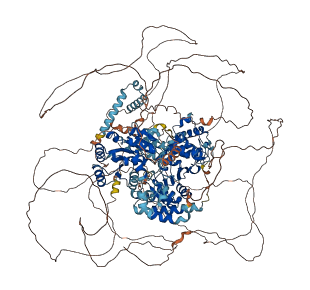
Descriptions
The autoinhibited protein was predicted that may have potential autoinhibitory elements via cis-regPred.
Autoinhibitory domains (AIDs)
Target domain |
|
Relief mechanism |
|
Assay |
cis-regPred |
Accessory elements
No accessory elements
Autoinhibited structure

Activated structure
1 structures for O88700
| Entry ID | Method | Resolution | Chain | Position | Source |
|---|---|---|---|---|---|
| AF-O88700-F1 | Predicted | AlphaFoldDB |
88 variants for O88700
| Variant ID(s) | Position | Change | Description | Diseaes Association | Provenance |
|---|---|---|---|---|---|
| rs3388917963 | 8 | N>K | No | EVA | |
| rs3388922480 | 27 | L>F | No | EVA | |
| rs3388920443 | 38 | K>N | No | EVA | |
| rs3412778536 | 39 | K>M | No | EVA | |
| rs3388880222 | 46 | V>E | No | EVA | |
| rs3388908920 | 56 | T>I | No | EVA | |
| rs3388918085 | 72 | F>I | No | EVA | |
| rs3388922985 | 72 | F>Y | No | EVA | |
| rs3388917900 | 82 | Q>* | No | EVA | |
| rs33214661 | 103 | C>R | No | EVA | |
| rs3388918145 | 126 | P>T | No | EVA | |
| rs252429562 | 128 | A>V | No | EVA | |
| rs32142074 | 131 | L>P | No | EVA | |
| rs32142074 | 131 | L>Q | No | EVA | |
| rs266198609 | 133 | V>M | No | EVA | |
| rs33214659 | 170 | K>E | No | EVA | |
| rs238407239 | 198 | N>S | No | EVA | |
| rs222661228 | 209 | P>S | No | EVA | |
| rs222661228 | 209 | P>T | No | EVA | |
| rs864278986 | 212 | L>Q | No | EVA | |
| rs3398001691 | 213 | Q>R | No | EVA | |
| rs3398318352 | 213 | Q>R* | No | EVA | |
| rs3398138606 | 218 | K>Q | No | EVA | |
| rs3398318341 | 218 | K>R | No | EVA | |
| rs584604272 | 233 | A>T | No | EVA | |
| rs33214658 | 239 | D>E | No | EVA | |
| rs33212681 | 338 | G>D | No | EVA | |
| rs3388920491 | 343 | S>L | No | EVA | |
| rs3388901749 | 356 | H>N | No | EVA | |
| rs3388901749 | 356 | H>Y | No | EVA | |
| rs33212680 | 363 | S>N | No | EVA | |
| rs33210872 | 391 | V>I | No | EVA | |
| rs248095622 | 397 | E>K | No | EVA | |
| rs256324812 | 431 | S>F | No | EVA | |
| rs259510230 | 488 | P>Q | No | EVA | |
| rs3388926132 | 496 | L>F | No | EVA | |
| rs8248433 | 535 | V>M | No | EVA | |
| rs8248436 | 546 | W>C | No | EVA | |
| rs8248435 | 546 | W>L | No | EVA | |
| rs8248434 | 546 | W>R | No | EVA | |
| rs8248437 | 547 | N>T | No | EVA | |
| rs1133105752 | 548 | V>L | No | EVA | |
| rs1134676396 | 549 | E>Q | No | EVA | |
| rs1132104204 | 554 | A>T | No | EVA | |
| rs1134554848 | 559 | D>N | No | EVA | |
| rs8248427 | 591 | T>A | No | EVA | |
| rs8248429 | 619 | V>I | No | EVA | |
| rs8248430 | 621 | T>N | No | EVA | |
| rs3388918154 | 683 | A>S | No | EVA | |
| rs3398218306 | 700 | G>V* | No | EVA | |
| rs3388908908 | 766 | P>T | No | EVA | |
| rs3388918147 | 813 | H>R | No | EVA | |
| rs3388926157 | 820 | K>E | No | EVA | |
| rs8248500 | 831 | S>F | No | EVA | |
| rs3388917950 | 832 | V>F | No | EVA | |
| rs3388922468 | 851 | T>S | No | EVA | |
| rs3388901778 | 862 | S>N | No | EVA | |
| rs3388893319 | 911 | T>I | No | EVA | |
| rs3388893319 | 911 | T>K | No | EVA | |
| rs8248517 | 912 | M>V | No | EVA | |
| rs3398317144 | 934 | A>G | No | EVA | |
| rs3388926159 | 934 | A>T | No | EVA | |
| rs3398217334 | 1019 | G>E | No | EVA | |
| rs3388893355 | 1050 | L>* | No | EVA | |
| rs3388893371 | 1055 | E>A | No | EVA | |
| rs260778671 | 1066 | Y>H | No | EVA | |
| rs33214617 | 1101 | S>L | No | EVA | |
| rs3388914961 | 1117 | N>K | No | EVA | |
| rs3388926144 | 1142 | Y>* | No | EVA | |
| rs3388903989 | 1157 | D>E | No | EVA | |
| rs3388922778 | 1194 | F>Y | No | EVA | |
| rs8248568 | 1221 | K>R | No | EVA | |
| rs3388917951 | 1223 | C>R | No | EVA | |
| rs3388901735 | 1240 | V>F | No | EVA | |
| rs3388903911 | 1252 | K>I | No | EVA | |
| rs3388924039 | 1261 | D>E | No | EVA | |
| rs3388893351 | 1271 | V>A | No | EVA | |
| rs8248583 | 1295 | V>L | No | EVA | |
| rs8248598 | 1309 | E>D | No | EVA | |
| rs3388880235 | 1311 | T>I | No | EVA | |
| rs8248603 | 1320 | V>I | No | EVA | |
| rs3388903927 | 1338 | M>L | No | EVA | |
| rs8248604 | 1342 | H>Q | No | EVA | |
| rs3388920437 | 1352 | G>A | No | EVA | |
| rs3388914983 | 1404 | V>I | No | EVA | |
| rs3388914321 | 1405 | N>D | No | EVA | |
| rs3388922805 | 1411 | P>L | No | EVA | |
| rs3412732082 | 1414 | A>V | No | EVA |
No associated diseases with O88700
Functions
| Description | ||
|---|---|---|
| EC Number | 5.6.2.4 | Enzymes altering nucleic acid conformation |
| Subcellular Localization |
|
|
| PANTHER Family | ||
| PANTHER Subfamily | ||
| PANTHER Protein Class | ||
| PANTHER Pathway Category | No pathway information available | |
16 GO annotations of cellular component
| Name | Definition |
|---|---|
| chromosome | A structure composed of a very long molecule of DNA and associated proteins (e.g. histones) that carries hereditary information. |
| chromosome, telomeric region | The end of a linear chromosome, required for the integrity and maintenance of the end. A chromosome telomere usually includes a region of telomerase-encoded repeats the length of which rarely exceeds 20 bp each and that permits the formation of a telomeric loop (T-loop). The telomeric repeat region is usually preceded by a sub-telomeric region that is gene-poor but rich in repetitive elements. Some telomeres only consist of the latter part (for eg. D. melanogaster telomeres). |
| cytoplasm | The contents of a cell excluding the plasma membrane and nucleus, but including other subcellular structures. |
| cytosol | The part of the cytoplasm that does not contain organelles but which does contain other particulate matter, such as protein complexes. |
| lateral element | A proteinaceous core found between sister chromatids during meiotic prophase. |
| male germ cell nucleus | The nucleus of a male germ cell, a reproductive cell in males. |
| nuclear chromosome | A chromosome that encodes the nuclear genome and is found in the nucleus of a eukaryotic cell during the cell cycle phases when the nucleus is intact. |
| nuclear matrix | The dense fibrillar network lying on the inner side of the nuclear membrane. |
| nucleolus | A small, dense body one or more of which are present in the nucleus of eukaryotic cells. It is rich in RNA and protein, is not bounded by a limiting membrane, and is not seen during mitosis. Its prime function is the transcription of the nucleolar DNA into 45S ribosomal-precursor RNA, the processing of this RNA into 5.8S, 18S, and 28S components of ribosomal RNA, and the association of these components with 5S RNA and proteins synthesized outside the nucleolus. This association results in the formation of ribonucleoprotein precursors; these pass into the cytoplasm and mature into the 40S and 60S subunits of the ribosome. |
| nucleoplasm | That part of the nuclear content other than the chromosomes or the nucleolus. |
| nucleus | A membrane-bounded organelle of eukaryotic cells in which chromosomes are housed and replicated. In most cells, the nucleus contains all of the cell's chromosomes except the organellar chromosomes, and is the site of RNA synthesis and processing. In some species, or in specialized cell types, RNA metabolism or DNA replication may be absent. |
| PML body | A class of nuclear body; they react against SP100 auto-antibodies (PML, promyelocytic leukemia); cells typically contain 10-30 PML bodies per nucleus; alterations in the localization of PML bodies occurs after viral infection. |
| pronucleus | The nucleus of either the ovum or the spermatozoon following fertilization. Thus, in the fertilized ovum, there are two pronuclei, one originating from the ovum, the other from the spermatozoon that brought about fertilization; they approach each other, but do not fuse until just before the first cleavage, when each pronucleus loses its membrane to release its contents. |
| protein-containing complex | A stable assembly of two or more macromolecules, i.e. proteins, nucleic acids, carbohydrates or lipids, in which at least one component is a protein and the constituent parts function together. |
| RecQ family helicase-topoisomerase III complex | A complex containing a RecQ family helicase and a topoisomerase III homologue (a member of the topoisomerase type IA subfamily); may also include one or more additional proteins; conserved from E. coli to human. |
| replication fork | The Y-shaped region of a replicating DNA molecule, resulting from the separation of the DNA strands and in which the synthesis of new strands takes place. Also includes associated protein complexes. |
21 GO annotations of molecular function
| Name | Definition |
|---|---|
| 3'-5' DNA helicase activity | Unwinding a DNA helix in the direction 5' to 3', driven by ATP hydrolysis. |
| 8-hydroxy-2'-deoxyguanosine DNA binding | Binding to 8-hydroxy-2'-deoxyguanosine an oxidized purine residue found in damaged DNA. |
| ATP binding | Binding to ATP, adenosine 5'-triphosphate, a universally important coenzyme and enzyme regulator. |
| ATP hydrolysis activity | Catalysis of the reaction: ATP + H2O = ADP + H+ phosphate. ATP hydrolysis is used in some reactions as an energy source, for example to catalyze a reaction or drive transport against a concentration gradient. |
| ATP-dependent activity, acting on DNA | Catalytic activity that acts to modify DNA, driven by ATP hydrolysis. |
| bubble DNA binding | Binding to DNA segment that contains a bubble. A bubble occurs when DNA contains a region of unpaired, single-stranded DNA flanked on both sides by regions of paired, double-stranded DNA. |
| DNA binding | Any molecular function by which a gene product interacts selectively and non-covalently with DNA (deoxyribonucleic acid). |
| DNA helicase activity | Unwinding of a DNA helix, driven by ATP hydrolysis. |
| DNA/DNA annealing activity | An activity that faciliates the formation of a complementary double-stranded DNA molecule. |
| forked DNA-dependent helicase activity | Unwinding a DNA helix containing forked DNA, driven by ATP hydrolysis. |
| four-way junction DNA binding | Binding to a DNA segment containing four-way junctions, also known as Holliday junctions, a structure where two DNA double strands are held together by reciprocal exchange of two of the four strands, one strand each from the two original helices. |
| four-way junction helicase activity | Unwinding a DNA helix of DNA containing four-way junctions, including Holliday junctions, driven by ATP hydrolysis. |
| G-quadruplex DNA binding | Binding to G-quadruplex DNA structures, in which groups of four guanines adopt a flat, cyclic Hoogsteen hydrogen-bonding arrangement known as a guanine tetrad. The stacking of guanine tetrads results in G-quadruplex DNA structures. G-quadruplex DNA can form under physiological conditions from some G-rich sequences, such as those found in telomeres, immunoglobulin switch regions, gene promoters, fragile X repeats, and the dimerization domain in the human immunodeficiency virus (HIV) genome. |
| helicase activity | Catalysis of the reaction: ATP + H2O = ADP + phosphate, to drive the unwinding of a DNA or RNA helix. |
| identical protein binding | Binding to an identical protein or proteins. |
| p53 binding | Binding to one of the p53 family of proteins. |
| protein homodimerization activity | Binding to an identical protein to form a homodimer. |
| single-stranded DNA binding | Binding to single-stranded DNA. |
| telomeric D-loop binding | Binding to a telomeric D-loop. A telomeric D-loop is a three-stranded DNA displacement loop that forms at the site where the telomeric 3' single-stranded DNA overhang (formed of the repeat sequence TTAGGG in mammals) is tucked back inside the double-stranded component of telomeric DNA molecule, thus forming a t-loop or telomeric-loop and protecting the chromosome terminus. |
| Y-form DNA binding | Binding to a DNA segment shaped like a Y. This shape occurs when DNA contains a region of paired double-stranded DNA on one end and a region of unpaired DNA strands on the opposite end. |
| zinc ion binding | Binding to a zinc ion (Zn). |
42 GO annotations of biological process
| Name | Definition |
|---|---|
| alpha-beta T cell differentiation | The process in which a precursor cell type acquires the specialized features of an alpha-beta T cell. An alpha-beta T cell is a T cell that expresses an alpha-beta T cell receptor complex. |
| alpha-beta T cell proliferation | The expansion of an alpha-beta T cell population by cell division. |
| cellular response to camptothecin | Any process that results in a change in state or activity of a cell (in terms of movement, secretion, enzyme production, gene expression, etc.) as a result of a camptothecin stimulus. |
| cellular response to DNA damage stimulus | Any process that results in a change in state or activity of a cell (in terms of movement, secretion, enzyme production, gene expression, etc.) as a result of a stimulus indicating damage to its DNA from environmental insults or errors during metabolism. |
| cellular response to hydroxyurea | Any process that results in a change in state or activity of a cell (in terms of movement, secretion, enzyme production, gene expression, etc.) as a result of a hydroxyurea stimulus. |
| cellular response to ionizing radiation | Any process that results in a change in state or activity of a cell (in terms of movement, secretion, enzyme production, gene expression, etc.) as a result of a ionizing radiation stimulus. Ionizing radiation is radiation with sufficient energy to remove electrons from atoms and may arise from spontaneous decay of unstable isotopes, resulting in alpha and beta particles and gamma rays. Ionizing radiation also includes X-rays. |
| cellular response to ketone | Any process that results in a change in state or activity of a cell (in terms of movement, secretion, enzyme production, gene expression, etc.) as a result of a ketone stimulus. |
| cellular response to organic cyclic compound | Any process that results in a change in state or activity of a cell (in terms of movement, secretion, enzyme production, gene expression, etc.) as a result of an organic cyclic compound stimulus. |
| cellular response to organonitrogen compound | Any process that results in a change in state or activity of a cell (in terms of movement, secretion, enzyme production, gene expression, etc.) as a result of an organonitrogen stimulus. An organonitrogen compound is formally a compound containing at least one carbon-nitrogen bond. |
| cellular response to xenobiotic stimulus | Any process that results in a change in state or activity of a cell (in terms of movement, secretion, enzyme production, gene expression, etc.) as a result of a stimulus from a xenobiotic, a compound foreign to the organism exposed to it. It may be synthesized by another organism (like ampicilin) or it can be a synthetic chemical. |
| chromosome organization | A process that is carried out at the cellular level that results in the assembly, arrangement of constituent parts, or disassembly of chromosomes, structures composed of a very long molecule of DNA and associated proteins that carries hereditary information. This term covers covalent modifications at the molecular level as well as spatial relationships among the major components of a chromosome. |
| DN4 thymocyte differentiation | The process in which a relatively unspecialized cell acquires the specialized features of a DN4 thymocyte. A DN4 thymocyte is a CD4-,CD8- thymocyte that is also CD44-,CD25-. |
| DNA double-strand break processing | The 5' to 3' exonucleolytic resection of the DNA at the site of the break to form a 3' single-strand DNA overhang. |
| DNA duplex unwinding | The process in which interchain hydrogen bonds between two strands of DNA are broken or 'melted', generating a region of unpaired single strands. |
| DNA recombination | Any process in which a new genotype is formed by reassortment of genes resulting in gene combinations different from those that were present in the parents. In eukaryotes genetic recombination can occur by chromosome assortment, intrachromosomal recombination, or nonreciprocal interchromosomal recombination. Interchromosomal recombination occurs by crossing over. In bacteria it may occur by genetic transformation, conjugation, transduction, or F-duction. |
| DNA repair | The process of restoring DNA after damage. Genomes are subject to damage by chemical and physical agents in the environment (e.g. UV and ionizing radiations, chemical mutagens, fungal and bacterial toxins, etc.) and by free radicals or alkylating agents endogenously generated in metabolism. DNA is also damaged because of errors during its replication. A variety of different DNA repair pathways have been reported that include direct reversal, base excision repair, nucleotide excision repair, photoreactivation, bypass, double-strand break repair pathway, and mismatch repair pathway. |
| DNA replication | The cellular metabolic process in which a cell duplicates one or more molecules of DNA. DNA replication begins when specific sequences, known as origins of replication, are recognized and bound by initiation proteins, and ends when the original DNA molecule has been completely duplicated and the copies topologically separated. The unit of replication usually corresponds to the genome of the cell, an organelle, or a virus. The template for replication can either be an existing DNA molecule or RNA. |
| DNA unwinding involved in DNA replication | The process in which interchain hydrogen bonds between two strands of DNA are broken or 'melted', generating unpaired template strands for DNA replication. |
| double-strand break repair via homologous recombination | The error-free repair of a double-strand break in DNA in which the broken DNA molecule is repaired using homologous sequences. A strand in the broken DNA searches for a homologous region in an intact chromosome to serve as the template for DNA synthesis. The restoration of two intact DNA molecules results in the exchange, reciprocal or nonreciprocal, of genetic material between the intact DNA molecule and the broken DNA molecule. |
| G-quadruplex DNA unwinding | The process by which G-quadruplex (also known as G4) DNA, which is a four-stranded DNA structure held together by guanine base pairing, is unwound or 'melted'. |
| immature T cell proliferation in thymus | The expansion of an immature T cell population by cell division in the thymus. |
| mitotic G2 DNA damage checkpoint signaling | A mitotic cell cycle checkpoint that detects and negatively regulates progression through the G2/M transition of the cell cycle in response to DNA damage. |
| mitotic recombination | The exchange, reciprocal or nonreciprocal, of genetic material between one DNA molecule and a homologous DNA region that occurs during mitotic cell cycles. |
| negative regulation of cell division | Any process that stops, prevents, or reduces the frequency, rate or extent of cell division. |
| negative regulation of DNA recombination | Any process that stops, prevents, or reduces the frequency, rate or extent of DNA recombination. |
| negative regulation of mitotic recombination | Any process that inhibits or decreases the rate of DNA recombination during mitosis. |
| negative regulation of thymocyte apoptotic process | Any process that stops, prevents, or reduces the frequency, rate or extent of thymocyte death by apoptotic process. |
| positive regulation of alpha-beta T cell proliferation | Any process that activates or increases the frequency, rate or extent of alpha-beta T cell proliferation. |
| positive regulation of DNA-templated transcription | Any process that activates or increases the frequency, rate or extent of cellular DNA-templated transcription. |
| positive regulation of double-strand break repair via homologous recombination | Any process that activates or increases the frequency, rate or extent of double-strand break repair via homologous recombination. |
| positive regulation of immature T cell proliferation in thymus | Any process that activates or increases the frequency, rate or extent of immature T cell proliferation in the thymus. |
| protein complex oligomerization | The process of creating protein oligomers, compounds composed of a small number, usually between three and ten, of component monomers; protein oligomers may be composed of different or identical monomers. Oligomers may be formed by the polymerization of a number of monomers or the depolymerization of a large protein polymer. |
| protein homooligomerization | The process of creating protein oligomers, compounds composed of a small number, usually between three and ten, of identical component monomers. Oligomers may be formed by the polymerization of a number of monomers or the depolymerization of a large protein polymer. |
| regulation of binding | Any process that modulates the frequency, rate or extent of binding, the selective interaction of a molecule with one or more specific sites on another molecule. |
| regulation of cyclin-dependent protein serine/threonine kinase activity | Any process that modulates the frequency, rate or extent of cyclin-dependent protein serine/threonine kinase activity. |
| regulation of DNA-templated DNA replication | Any process that modulates the rate, frequency, or extent of DNA-templated DNA replication, the process in which new strands of DNA are synthesized. |
| replication fork processing | The process in which a DNA replication fork that has stalled is restored to a functional state and replication is restarted. The stalling may be due to DNA damage, DNA secondary structure, bound proteins, dNTP shortage, or other causes. |
| replication-born double-strand break repair via sister chromatid exchange | The repair of a replication-born double-strand DNA break in which the DNA molecule is repaired using the homologous sequence of the sister chromatid which serves as a template to repair the breaks. |
| resolution of recombination intermediates | The cleavage and rejoining of intermediates, such as Holliday junctions, formed during DNA recombination to produce two intact molecules in which genetic material has been exchanged. |
| response to X-ray | Any process that results in a change in state or activity of a cell or an organism (in terms of movement, secretion, enzyme production, gene expression, etc.) as a result of X-ray radiation. An X-ray is a form of electromagnetic radiation with a wavelength in the range of 10 nanometers to 100 picometers (corresponding to frequencies in the range 30 PHz to 3 EHz). |
| telomere maintenance | Any process that contributes to the maintenance of proper telomeric length and structure by affecting and monitoring the activity of telomeric proteins, the length of telomeric DNA and the replication and repair of the DNA. These processes includes those that shorten, lengthen, replicate and repair the telomeric DNA sequences. |
| telomeric D-loop disassembly | A telomere loop disassembly process that results in the disassembly of telomeric D-loops. A telomeric D-loop is a three-stranded DNA displacement loop that forms at the site where the telomeric 3' single-stranded DNA overhang (formed of the repeat sequence TTAGGG in mammals) is tucked back inside the double-stranded component of telomeric DNA molecule, thus forming a t-loop or telomeric-loop and protecting the chromosome terminus. |
No homologous proteins in AiPD
| UniProt AC | Gene Name | Protein Name | Species | Evidence Code |
|---|---|---|---|---|
| No homologous proteins | ||||
| 10 | 20 | 30 | 40 | 50 | 60 |
| MAAVPLNNLQ | EQLQRHSARK | LNNQPSLSKP | KSLGFTFKKK | TSEGDVSVTS | VSVVKTPALS |
| 70 | 80 | 90 | 100 | 110 | 120 |
| DKDVNVSEAF | SFTESPLHKP | KQQAKIEGFF | KHFPGRQQSK | GTCSEPSLPA | TVQTAQDTLC |
| 130 | 140 | 150 | 160 | 170 | 180 |
| TTPKTPTAKK | LPVAVFKKLE | FSSSADSLSD | WADMDDFDMS | ASDAFASLAK | NPATRVSTAQ |
| 190 | 200 | 210 | 220 | 230 | 240 |
| KMKKTKRNFF | KPPPRKANAV | KTDLTPPSPE | CLQVDLTKES | EEEEEEEEEA | EGADCLSRDV |
| 250 | 260 | 270 | 280 | 290 | 300 |
| ICIDNDSASE | ELTEKDTQES | QSLKAHLGAE | RGDSEKKSHE | DEAVFHSVQN | TEYFEHNDND |
| 310 | 320 | 330 | 340 | 350 | 360 |
| YDIDFVPPSP | EEIISTASSS | LKCSSMLKDL | DDSDKEKGIL | STSEELLSKP | EEMTTHKSDA |
| 370 | 380 | 390 | 400 | 410 | 420 |
| GTSKDCDAQQ | IRIQQQLIHV | MEHICKLVDT | VPTDELEALN | CGTELLQQRN | IRRKLLAEAG |
| 430 | 440 | 450 | 460 | 470 | 480 |
| FNGNDVRLLG | SLWRHRPDSL | DNTVQGDSCP | VGHPNKELNS | PYLLSHSPST | EECLPTTTPG |
| 490 | 500 | 510 | 520 | 530 | 540 |
| KTGFSATPKN | LFERPLLNSH | LQKSFVSSNW | AETPRMENRN | ESTDFPGSVL | TSTTVKAQSK |
| 550 | 560 | 570 | 580 | 590 | 600 |
| QAASGWNVER | HGQASYDIDN | FNIDDFDDDD | DDDDWENIMH | NFPASKSSTA | TYPPIKEGGP |
| 610 | 620 | 630 | 640 | 650 | 660 |
| VKSLSERISS | AKAKFLPVVS | TAQNTNLSES | IQNCSDKLAQ | NLSSKNPKHE | HFQSLNFPHT |
| 670 | 680 | 690 | 700 | 710 | 720 |
| KEMMKIFHKK | FGLHNFRTNQ | LEAINAALLG | EDCFILMPTG | GGKSLCYQLP | ACVSPGVTIV |
| 730 | 740 | 750 | 760 | 770 | 780 |
| ISPLRSLIVD | QVQKLTSFDI | PATYLTGDKT | DSEAANIYLQ | LSKKDPIIKL | LYVTPEKVCA |
| 790 | 800 | 810 | 820 | 830 | 840 |
| SNRLISTLEN | LYERKLLARF | VIDEAHCVSQ | WGHDFRQDYK | RMNMLRQKFP | SVPVMALTAT |
| 850 | 860 | 870 | 880 | 890 | 900 |
| ANPRVQKDIL | TQLKILRPQV | FSMSFNRHNL | KYYVLPKKPK | KVAFDCLEWI | RKHHPYDSGI |
| 910 | 920 | 930 | 940 | 950 | 960 |
| IYCLSRRECD | TMADTLQREG | LAALAYHAGL | SDSARDEVQH | KWINQDNCQV | ICATIAFGMG |
| 970 | 980 | 990 | 1000 | 1010 | 1020 |
| IDKPDVRFVI | HASLPKSMEG | YYQESGRAGR | DGEISHCVLF | YTYHDVTRLK | RLIMMEKDGN |
| 1030 | 1040 | 1050 | 1060 | 1070 | 1080 |
| YHTKETHVNN | LYSMVHYCEN | ITECRRIQLL | AYFGEKGFNP | DFCKKYPDVS | CDNCCKTKDY |
| 1090 | 1100 | 1110 | 1120 | 1130 | 1140 |
| KTKDVTDDVK | NIIRFVQEHS | SSPGTRNIGP | AGRFTLNMLV | DIFLGSKSAK | VKSGIFGKGT |
| 1150 | 1160 | 1170 | 1180 | 1190 | 1200 |
| TYSRHNAERL | FKKLILDKIL | DEDLYINAND | QPIAYVMLGT | KAHSVLSGHL | KVDFMETENS |
| 1210 | 1220 | 1230 | 1240 | 1250 | 1260 |
| SSIKKQKALV | AKVSQREEVV | KKCLGELTEV | CKLLGKVFGV | HYFNIFNTAT | LKKLAESLSS |
| 1270 | 1280 | 1290 | 1300 | 1310 | 1320 |
| DPEVLLQIDG | VTEDKLEKYG | AEVIPVLQKY | SEWTVPAEDG | SPGARGAPED | TEEEEEEAPV |
| 1330 | 1340 | 1350 | 1360 | 1370 | 1380 |
| SSHYFANQTR | NERKRKKMSA | THKPKRRRTS | YGGFRAKGGS | TTCRKTTSKS | KFYGVTGSRS |
| 1390 | 1400 | 1410 | |||
| ASCASQATSS | ASRKLGIMAP | PKPVNRTFLR | PSYAFS |