O88693
Gene name |
Ugcg |
Protein name |
Ceramide glucosyltransferase |
Names |
GLCT-1, Glucosylceramide synthase, GCS, Glycosylceramide synthase, UDP-glucose ceramide glucosyltransferase, UDP-glucose:N-acylsphingosine D-glucosyltransferase |
Species |
Mus musculus (Mouse) |
KEGG Pathway |
mmu:22234 |
EC number |
2.4.1.80: Hexosyltransferases |
Protein Class |
|
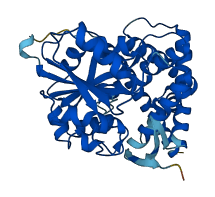
Descriptions
The autoinhibited protein was predicted that may have potential autoinhibitory elements via cis-regPred.
Autoinhibitory domains (AIDs)
Target domain |
|
Relief mechanism |
|
Assay |
cis-regPred |
Accessory elements
No accessory elements
Autoinhibited structure

Activated structure
1 structures for O88693
| Entry ID | Method | Resolution | Chain | Position | Source |
|---|---|---|---|---|---|
| AF-O88693-F1 | Predicted | AlphaFoldDB |
9 variants for O88693
| Variant ID(s) | Position | Change | Description | Diseaes Association | Provenance |
|---|---|---|---|---|---|
| rs3388688296 | 59 | L>Q | No | EVA | |
| rs3388681816 | 76 | L>M | No | EVA | |
| rs3388678813 | 77 | D>E | No | EVA | |
| rs3394298230 | 91 | D>H | No | EVA | |
| rs3388688492 | 155 | T>S | No | EVA | |
| rs3394313111 | 160 | Q>R | No | EVA | |
| rs3388687970 | 352 | A>V | No | EVA | |
| rs6211008 | 370 | D>G | No | EVA | |
| rs3388681870 | 373 | I>L | No | EVA |
No associated diseases with O88693
No regional properties for O88693
| Type | Name | Position | InterPro Accession |
|---|---|---|---|
| No domain, repeats, and functional sites for O88693 | |||
Functions
| Description | ||
|---|---|---|
| EC Number | 2.4.1.80 | Hexosyltransferases |
| Subcellular Localization |
|
|
| PANTHER Family | ||
| PANTHER Subfamily | ||
| PANTHER Protein Class | ||
| PANTHER Pathway Category | No pathway information available | |
3 GO annotations of cellular component
| Name | Definition |
|---|---|
| Golgi membrane | The lipid bilayer surrounding any of the compartments of the Golgi apparatus. |
| integral component of membrane | The component of a membrane consisting of the gene products and protein complexes having at least some part of their peptide sequence embedded in the hydrophobic region of the membrane. |
| membrane | A lipid bilayer along with all the proteins and protein complexes embedded in it an attached to it. |
2 GO annotations of molecular function
| Name | Definition |
|---|---|
| ceramide glucosyltransferase activity | Catalysis of the reaction: UDP-glucose + N-acylsphingosine = UDP + D-glucosyl-N-acylsphingosine. |
| dihydroceramide glucosyltransferase activity | Catalysis of the reaction: UDP-alpha-D-glucose + a dihydroceramide = UDP + H+ + a D-glucosyl-N-acylsphinganine. |
10 GO annotations of biological process
| Name | Definition |
|---|---|
| cell differentiation | The process in which relatively unspecialized cells, e.g. embryonic or regenerative cells, acquire specialized structural and/or functional features that characterize the cells, tissues, or organs of the mature organism or some other relatively stable phase of the organism's life history. Differentiation includes the processes involved in commitment of a cell to a specific fate and its subsequent development to the mature state. |
| cornified envelope assembly | The aggregation, arrangement and bonding together of a set of components to form a cornified envelope. |
| establishment of skin barrier | Establishment of the epithelial barrier, the functional barrier in the skin that limits its permeability. |
| glucosylceramide biosynthetic process | The chemical reactions and pathways resulting in the formation of glucosylceramides, any compound formed by the replacement of the glycosidic hydroxyl group of a cyclic form of glucose by a ceramide group. |
| intestinal lipid absorption | Any process in which lipids are taken up from the contents of the intestine. |
| keratinocyte differentiation | The process in which a relatively unspecialized cell acquires specialized features of a keratinocyte. |
| leptin-mediated signaling pathway | The series of molecular signals initiated by leptin binding to its receptor on the surface of a cell, and ending with the regulation of a downstream cellular process, e.g. transcription. Leptin is a hormone manufactured primarily in the adipocytes of white adipose tissue, and the level of circulating leptin is directly proportional to the total amount of fat in the body. |
| neuron development | The process whose specific outcome is the progression of a neuron over time, from initial commitment of the cell to a specific fate, to the fully functional differentiated cell. |
| protein lipidation | The covalent attachment of lipid groups to an amino acid in a protein. |
| regulation of signal transduction | Any process that modulates the frequency, rate or extent of signal transduction. |
1 homologous proteins in AiPD
| UniProt AC | Gene Name | Protein Name | Species | Evidence Code |
|---|---|---|---|---|
| Q9R0E0 | Ugcg | Ceramide glucosyltransferase | Rattus norvegicus (Rat) | PR |
| 10 | 20 | 30 | 40 | 50 | 60 |
| MALLDLAQEG | MALFGFVLFV | VLWLMHFMSI | IYTRLHLNKK | ATDKQPYSKL | PGVSLLKPLK |
| 70 | 80 | 90 | 100 | 110 | 120 |
| GVDPNLINNL | ETFFELDYPK | YEVLLCVQDH | DDPAIDVCKK | LLGKYPNVDA | RLFIGGKKVG |
| 130 | 140 | 150 | 160 | 170 | 180 |
| INPKINNLMP | AYEVAKYDLI | WICDSGIRVI | PDTLTDMVNQ | MTEKVGLVHG | LPYVADRQGF |
| 190 | 200 | 210 | 220 | 230 | 240 |
| AATLEQVYFG | TSHPRSYISA | NVTGFKCVTG | MSCLMRKDVL | DQAGGLIAFA | QYIAEDYFMA |
| 250 | 260 | 270 | 280 | 290 | 300 |
| KAIADRGWRF | SMSTQVAMQN | SGSYSISQFQ | SRMIRWTKLR | INMLPATIIC | EPISECFVAS |
| 310 | 320 | 330 | 340 | 350 | 360 |
| LIIGWAAHHV | FRWDIMVFFM | CHCLAWFIFD | YIQLRGVQGG | TLCFSKLDYA | VAWFIRESMT |
| 370 | 380 | 390 | |||
| IYIFLSALWD | PTISWRTGRY | RLRCGGTAEE | ILDV |