O88382
Gene name |
Magi2 (Acvrinp1, Aip1, Sscam) |
Protein name |
Membrane-associated guanylate kinase, WW and PDZ domain-containing protein 2 |
Names |
Atrophin-1-interacting protein 1, AIP-1, Membrane-associated guanylate kinase inverted 2, MAGI-2, Synaptic-scaffolding molecule, S-SCAM |
Species |
Rattus norvegicus (Rat) |
KEGG Pathway |
rno:113970 |
EC number |
|
Protein Class |
|
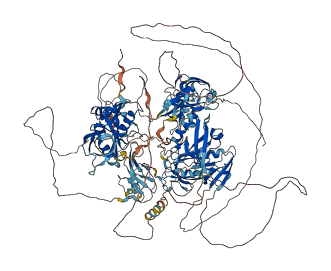
Descriptions
The autoinhibited protein was predicted that may have potential autoinhibitory elements via cis-regPred.
Autoinhibitory domains (AIDs)
Target domain |
|
Relief mechanism |
|
Assay |
cis-regPred |
Accessory elements
No accessory elements
Autoinhibited structure

Activated structure
1 structures for O88382
| Entry ID | Method | Resolution | Chain | Position | Source |
|---|---|---|---|---|---|
| AF-O88382-F1 | Predicted | AlphaFoldDB |
No variants for O88382
| Variant ID(s) | Position | Change | Description | Diseaes Association | Provenance |
|---|---|---|---|---|---|
| No variants for O88382 | |||||
No associated diseases with O88382
11 regional properties for O88382
| Type | Name | Position | InterPro Accession |
|---|---|---|---|
| domain | WW domain | 302 - 335 | IPR001202-1 |
| domain | WW domain | 348 - 381 | IPR001202-2 |
| domain | PDZ domain | 17 - 101 | IPR001478-1 |
| domain | PDZ domain | 426 - 510 | IPR001478-2 |
| domain | PDZ domain | 605 - 683 | IPR001478-3 |
| domain | PDZ domain | 778 - 862 | IPR001478-4 |
| domain | PDZ domain | 920 - 1010 | IPR001478-5 |
| domain | PDZ domain | 1141 - 1223 | IPR001478-6 |
| domain | Guanylate kinase-like domain | 109 - 185 | IPR008144 |
| domain | Guanylate kinase/L-type calcium channel beta subunit | 107 - 291 | IPR008145 |
| conserved_site | Guanylate kinase, conserved site | 141 - 158 | IPR020590 |
Functions
19 GO annotations of cellular component
| Name | Definition |
|---|---|
| bicellular tight junction | An occluding cell-cell junction that is composed of a branching network of sealing strands that completely encircles the apical end of each cell in an epithelial sheet; the outer leaflets of the two interacting plasma membranes are seen to be tightly apposed where sealing strands are present. Each sealing strand is composed of a long row of transmembrane adhesion proteins embedded in each of the two interacting plasma membranes. |
| cell-cell junction | A cell junction that forms a connection between two or more cells of an organism; excludes direct cytoplasmic intercellular bridges, such as ring canals in insects. |
| centriole | A cellular organelle, found close to the nucleus in many eukaryotic cells, consisting of a small cylinder with microtubular walls, 300-500 nm long and 150-250 nm in diameter. It contains nine short, parallel, peripheral microtubular fibrils, each fibril consisting of one complete microtubule fused to two incomplete microtubules. Cells usually have two centrioles, lying at right angles to each other. At division, each pair of centrioles generates another pair and the twin pairs form the pole of the mitotic spindle. |
| ciliary base | Area of the cilium (also called flagellum) where the basal body and the axoneme are anchored to the plasma membrane. The ciliary base encompasses the distal part of the basal body, transition fibers and transition zone and is structurally and functionally very distinct from the rest of the cilium. In this area proteins are sorted and filtered before entering the cilium, and many ciliary proteins localize specifically to this area. |
| cytoplasm | The contents of a cell excluding the plasma membrane and nucleus, but including other subcellular structures. |
| dendrite | A neuron projection that has a short, tapering, morphology. Dendrites receive and integrate signals from other neurons or from sensory stimuli, and conduct nerve impulses towards the axon or the cell body. In most neurons, the impulse is conveyed from dendrites to axon via the cell body, but in some types of unipolar neuron, the impulse does not travel via the cell body. |
| extrinsic component of postsynaptic membrane | The component of the postsynaptic membrane consisting of gene products and protein complexes that are loosely bound to one of its surfaces, but not integrated into the hydrophobic region. |
| GABA-ergic synapse | A synapse that uses GABA as a neurotransmitter. These synapses are typically inhibitory. |
| glutamatergic synapse | A synapse that uses glutamate as a neurotransmitter. |
| late endosome | A prelysosomal endocytic organelle differentiated from early endosomes by lower lumenal pH and different protein composition. Late endosomes are more spherical than early endosomes and are mostly juxtanuclear, being concentrated near the microtubule organizing center. |
| nucleus | A membrane-bounded organelle of eukaryotic cells in which chromosomes are housed and replicated. In most cells, the nucleus contains all of the cell's chromosomes except the organellar chromosomes, and is the site of RNA synthesis and processing. In some species, or in specialized cell types, RNA metabolism or DNA replication may be absent. |
| perinuclear region of cytoplasm | Cytoplasm situated near, or occurring around, the nucleus. |
| photoreceptor inner segment | The inner segment of a vertebrate photoreceptor containing mitochondria, ribosomes and membranes where opsin molecules are assembled and passed to be part of the outer segment discs. |
| photoreceptor outer segment | The outer segment of a vertebrate photoreceptor that contains a stack of membrane discs embedded with photoreceptor proteins. |
| plasma membrane | The membrane surrounding a cell that separates the cell from its external environment. It consists of a phospholipid bilayer and associated proteins. |
| postsynaptic density | An electron dense network of proteins within and adjacent to the postsynaptic membrane of an asymmetric, neuron-neuron synapse. Its major components include neurotransmitter receptors and the proteins that spatially and functionally organize them such as anchoring and scaffolding molecules, signaling enzymes and cytoskeletal components. |
| protein-containing complex | A stable assembly of two or more macromolecules, i.e. proteins, nucleic acids, carbohydrates or lipids, in which at least one component is a protein and the constituent parts function together. |
| slit diaphragm | A specialized cell-cell junction found between the interdigitating foot processes of the glomerular epithelium (the podocytes) in the vertebrate kidney, which is adapted for facilitating glomerular filtration. |
| synapse | The junction between an axon of one neuron and a dendrite of another neuron, a muscle fiber or a glial cell. As the axon approaches the synapse it enlarges into a specialized structure, the presynaptic terminal bouton, which contains mitochondria and synaptic vesicles. At the tip of the terminal bouton is the presynaptic membrane; facing it, and separated from it by a minute cleft (the synaptic cleft) is a specialized area of membrane on the receiving cell, known as the postsynaptic membrane. In response to the arrival of nerve impulses, the presynaptic terminal bouton secretes molecules of neurotransmitters into the synaptic cleft. These diffuse across the cleft and transmit the signal to the postsynaptic membrane. |
10 GO annotations of molecular function
| Name | Definition |
|---|---|
| activin receptor binding | Binding to an activin receptor. |
| beta-1 adrenergic receptor binding | Binding to a beta-1 adrenergic receptor. |
| kinesin binding | Interacting selectively and non-covalently and stoichiometrically with kinesin, a member of a superfamily of microtubule-based motor proteins that perform force-generating tasks such as organelle transport and chromosome segregation. |
| phosphatase binding | Binding to a phosphatase. |
| protein-containing complex binding | Binding to a macromolecular complex. |
| signaling receptor complex adaptor activity | The binding activity of a molecule that provides a physical support for the assembly of a multiprotein receptor signaling complex. |
| SMAD binding | Binding to a SMAD signaling protein. |
| structural constituent of postsynaptic density | The action of a molecule that contributes to the structural integrity of a postsynaptic density. |
| structural constituent of postsynaptic specialization | The action of a molecule that contributes to the structural integrity of a postsynaptic specialization. |
| type II activin receptor binding | Binding to a type II activin receptor. |
19 GO annotations of biological process
| Name | Definition |
|---|---|
| cellular response to nerve growth factor stimulus | A process that results in a change in state or activity of a cell (in terms of movement, secretion, enzyme production, gene expression, etc.) as a result of a nerve growth factor stimulus. |
| clathrin-dependent endocytosis | An endocytosis process that begins when material is taken up into clathrin-coated pits, which then pinch off to form clathrin-coated endocytic vesicles. |
| glomerular filtration | The process in which plasma is filtered through the glomerular membrane which consists of capillary endothelial cells, the basement membrane, and epithelial cells. The glomerular filtrate is the same as plasma except it has no significant amount of protein. |
| negative regulation of activin receptor signaling pathway | Any process that stops, prevents, or reduces the frequency, rate or extent of the activity of any activin receptor signaling pathway. |
| negative regulation of cell migration | Any process that stops, prevents, or reduces the frequency, rate or extent of cell migration. |
| negative regulation of cell population proliferation | Any process that stops, prevents or reduces the rate or extent of cell proliferation. |
| negative regulation of protein kinase B signaling | Any process that stops, prevents, or reduces the frequency, rate or extent of protein kinase B signaling, a series of reactions mediated by the intracellular serine/threonine kinase protein kinase B. |
| nerve growth factor signaling pathway | The series of molecular signals initiated by nerve growth factor (NGF) binding to its receptor on the surface of a target cell, and ending with the regulation of a downstream cellular process, e.g. transcription. |
| neuroligin clustering involved in postsynaptic membrane assembly | The receptor clustering process involved in assembly of the postsynaptic membrane in which neuroligins are localized to distinct domains in the cell membrane. Neuroligins are neuronal cell surface proteins on the postsynaptic membrane that mediate synapse formation between neurons. |
| podocyte development | The process whose specific outcome is the progression of a glomerular visceral epithelial cell over time, from its formation to the mature structure. A glomerular visceral epithelial cell is a specialized epithelial cell that contains 'feet' that interdigitate with the 'feet' of other glomerular epithelial cells. |
| positive regulation of neuron projection development | Any process that increases the rate, frequency or extent of neuron projection development. Neuron projection development is the process whose specific outcome is the progression of a neuron projection over time, from its formation to the mature structure. A neuron projection is any process extending from a neural cell, such as axons or dendrites (collectively called neurites). |
| positive regulation of phosphoprotein phosphatase activity | Any process that activates or increases the activity of a phosphoprotein phosphatase. |
| positive regulation of receptor internalization | Any process that activates or increases the frequency, rate or extent of receptor internalization. |
| positive regulation of synaptic vesicle clustering | Any process that activates or increases the frequency, rate or extent of synaptic vesicle clustering. |
| receptor clustering | The receptor metabolic process that results in grouping of a set of receptors at a cellular location, often to amplify the sensitivity of a signaling response. |
| regulation of neurotransmitter receptor localization to postsynaptic specialization membrane | Any process that modulates the frequency, rate or extent of neurotransmitter receptor localization to postsynaptic specialization membrane. |
| regulation of synaptic membrane adhesion | Any process that modulates the frequency, rate or extent of adhesion between pre- and post-synaptic membranes. |
| signal transduction | The cellular process in which a signal is conveyed to trigger a change in the activity or state of a cell. Signal transduction begins with reception of a signal (e.g. a ligand binding to a receptor or receptor activation by a stimulus such as light), or for signal transduction in the absence of ligand, signal-withdrawal or the activity of a constitutively active receptor. Signal transduction ends with regulation of a downstream cellular process, e.g. regulation of transcription or regulation of a metabolic process. Signal transduction covers signaling from receptors located on the surface of the cell and signaling via molecules located within the cell. For signaling between cells, signal transduction is restricted to events at and within the receiving cell. |
| SMAD protein signal transduction | The cascade of processes by which a signal interacts with a receptor, causing a change in the activity of a SMAD protein, and ultimately effecting a change in the functioning of the cell. |
1 homologous proteins in AiPD
| UniProt AC | Gene Name | Protein Name | Species | Evidence Code |
|---|---|---|---|---|
| Q9WVQ1 | Magi2 | Membrane-associated guanylate kinase, WW and PDZ domain-containing protein 2 | Mus musculus (Mouse) | PR |
| 10 | 20 | 30 | 40 | 50 | 60 |
| MSKSLKKKSH | WTSKVHESVI | GRNPEGQLGF | ELKGGAENGQ | FPYLGEVKPG | KVAYESGSKL |
| 70 | 80 | 90 | 100 | 110 | 120 |
| VSEELLLEVN | ETPVAGLTIR | DVLAVIKHCK | DPLRLKCVKQ | GGIVDKDLRH | YLNLRFQKGS |
| 130 | 140 | 150 | 160 | 170 | 180 |
| VDHELQQIIR | DNLYLRTVPC | TTRPHKEGEV | PGVDYIFITV | EDFMELEKSG | ALLESGTYED |
| 190 | 200 | 210 | 220 | 230 | 240 |
| NYYGTPKPPA | EPAPLLLNVT | DQILPGATPS | AEGKRKRNKS | VTNMEKASIE | PPEEEEEERP |
| 250 | 260 | 270 | 280 | 290 | 300 |
| VVNGNGVVIT | PESSEHEDKS | AGASGETPSQ | PYPAPVYSQP | EELKDQMDDT | KSTKPEENED |
| 310 | 320 | 330 | 340 | 350 | 360 |
| SDPLPDNWEM | AYTEKGEVYF | IDHNTKTTSW | LDPRLAKKAK | PAEECKENEL | PYGWEKIDDP |
| 370 | 380 | 390 | 400 | 410 | 420 |
| IYGTYYVDHI | NRRTQFENPV | LEAKRKLQQH | NMPHTELGTK | PLQAPGFREK | PLFTRDASQL |
| 430 | 440 | 450 | 460 | 470 | 480 |
| KGTFLSTTLK | KSNMGFGFTI | IGGDEPDEFL | QVKSVIPDGP | AAQDGKMETG | DVIVYINEVC |
| 490 | 500 | 510 | 520 | 530 | 540 |
| VLGHTHADVV | KLFQSVPIGQ | SVNLVLCRGY | PLPFDPEDPA | NSMVPPLAIM | ERPPPVMVNG |
| 550 | 560 | 570 | 580 | 590 | 600 |
| RHNYETYLEY | ISRTSQSVPD | ITDRPPHSLH | SMPADGQLDG | TYPPPVHDDN | VSVASSGATQ |
| 610 | 620 | 630 | 640 | 650 | 660 |
| AELMTLTIVK | GAKGFGFTIA | DSPTGQRVKQ | ILDIQGCPGL | CEGDLIVEIN | QQNVQNLSHT |
| 670 | 680 | 690 | 700 | 710 | 720 |
| EVVDILKDCP | VGSETSLIIH | RGGFFSPWKT | PKPMVDRWEN | QGSPQTSLSA | PAVPQSLPFP |
| 730 | 740 | 750 | 760 | 770 | 780 |
| PALHRSSFPD | STEAFDPRKP | DPYELYEKSR | AIYESRQQVP | PRTSFRMDSS | GPDYKELDVH |
| 790 | 800 | 810 | 820 | 830 | 840 |
| LRRMESGFGF | RILGGDEPGQ | PILIGAVIAM | GSADRDGRLH | PGDELVYVDG | IPVAGKTHRY |
| 850 | 860 | 870 | 880 | 890 | 900 |
| VIDLMHHAAR | NGQVNLTVRR | KVLCGGEPCP | ENGRSPGSVS | THHSSPRSDY | ATYANSNHAA |
| 910 | 920 | 930 | 940 | 950 | 960 |
| PSNNASPPEG | FASHSLQTSD | VIIHRKENEG | FGFVIISSLN | RPESGATITV | PHKIGRIIDG |
| 970 | 980 | 990 | 1000 | 1010 | 1020 |
| SPADRCAKLK | VGDRILAVNG | QSIINMPHAD | IVKLIKDAGL | SVTLRIIPQE | ELNNPTSAPS |
| 1030 | 1040 | 1050 | 1060 | 1070 | 1080 |
| SEKQSPMAQQ | HSPLAQQHSP | LAQPSPATPN | SPVAQPAPPQ | PLQLQGHENS | YRSEVKARQD |
| 1090 | 1100 | 1110 | 1120 | 1130 | 1140 |
| VKPDIRQPPF | TDYRQPPLDY | RQPPGGDYSQ | PSPLDYRQHS | PDTRQYPLSD | YRQPQDFDYF |
| 1150 | 1160 | 1170 | 1180 | 1190 | 1200 |
| TVDMEKGAKG | FGFSIRGGRE | YKMDLYVLRL | AEDGPAIRNG | RMRVGDQIIE | INGESTRDMT |
| 1210 | 1220 | 1230 | 1240 | 1250 | 1260 |
| HARAIELIKS | GGRRVRLLLK | RGTGQVPEYG | MVPSSLSMCM | KSDKHGSPYF | YLLGHPKDTT |
| 1270 | |||||
| NPTPGALPLP | PPQACRK |