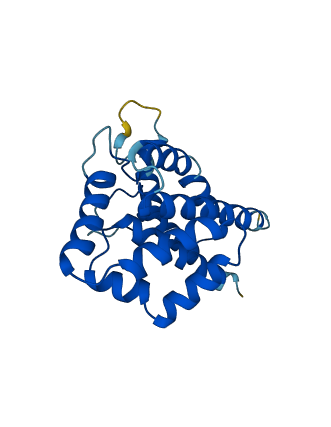
Descriptions
The autoinhibited protein was predicted that may have potential autoinhibitory elements via cis-regPred.
Autoinhibitory domains (AIDs)
Target domain |
|
Relief mechanism |
|
Assay |
cis-regPred |
Accessory elements
No accessory elements
Autoinhibited structure

Activated structure
2 structures for O87949
| Entry ID | Method | Resolution | Chain | Position | Source |
|---|---|---|---|---|---|
| 1N1C | X-ray | 240 A | A/B | 1-209 | PDB |
| AF-O87949-F1 | Predicted | AlphaFoldDB |
No variants for O87949
| Variant ID(s) | Position | Change | Description | Diseaes Association | Provenance |
|---|---|---|---|---|---|
| No variants for O87949 | |||||
No associated diseases with O87949
No regional properties for O87949
| Type | Name | Position | InterPro Accession |
|---|---|---|---|
| No domain, repeats, and functional sites for O87949 | |||
1 GO annotations of cellular component
| Name | Definition |
|---|---|
| cytoplasm | The contents of a cell excluding the plasma membrane and nucleus, but including other subcellular structures. |
No GO annotations of molecular function
| Name | Definition |
|---|---|
| No GO annotations for molecular function |
3 GO annotations of biological process
| Name | Definition |
|---|---|
| metabolic process | The chemical reactions and pathways, including anabolism and catabolism, by which living organisms transform chemical substances. Metabolic processes typically transform small molecules, but also include macromolecular processes such as DNA repair and replication, and protein synthesis and degradation. |
| protein complex oligomerization | The process of creating protein oligomers, compounds composed of a small number, usually between three and ten, of component monomers; protein oligomers may be composed of different or identical monomers. Oligomers may be formed by the polymerization of a number of monomers or the depolymerization of a large protein polymer. |
| protein folding | The process of assisting in the covalent and noncovalent assembly of single chain polypeptides or multisubunit complexes into the correct tertiary structure. |
No homologous proteins in AiPD
| UniProt AC | Gene Name | Protein Name | Species | Evidence Code |
|---|---|---|---|---|
| No homologous proteins | ||||
| 10 | 20 | 30 | 40 | 50 | 60 |
| MSQVDINHAR | ALVYQLLSSL | FAREVDEQRL | KELTSEAAQQ | FWEQLSLEAN | FTQSVDKIRS |
| 70 | 80 | 90 | 100 | 110 | 120 |
| TLNGIKDDEA | LLELAADYCG | LFLVGTKHSA | SPYASLYLSG | EDEPLLFGEQ | HQQMSEFLHQ |
| 130 | 140 | 150 | 160 | 170 | 180 |
| SKLQVQSHFP | EPADHLAVML | AYMAHLFCHS | ENSVQLSFLQ | TCFNSWLAKF | INHLTQCNKN |
| 190 | 200 | ||||
| GFYSAVATLT | LAWVKQDIAQ | LEPAVAIIS |