O84799
Gene name |
dnaG |
Protein name |
DNA primase |
Names |
|
Species |
Chlamydia trachomatis (strain D/UW-3/Cx) |
KEGG Pathway |
ctr:CT_794 |
EC number |
2.7.7.101: Nucleotidyltransferases |
Protein Class |
|
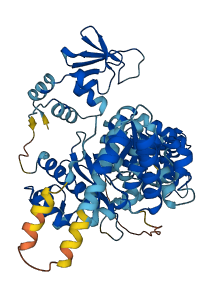
Descriptions
The autoinhibited protein was predicted that may have potential autoinhibitory elements via cis-regPred.
Autoinhibitory domains (AIDs)
Target domain |
|
Relief mechanism |
|
Assay |
cis-regPred |
Accessory elements
No accessory elements
Autoinhibited structure

Activated structure
1 structures for O84799
| Entry ID | Method | Resolution | Chain | Position | Source |
|---|---|---|---|---|---|
| AF-O84799-F1 | Predicted | AlphaFoldDB |
No variants for O84799
| Variant ID(s) | Position | Change | Description | Diseaes Association | Provenance |
|---|---|---|---|---|---|
| No variants for O84799 | |||||
No associated diseases with O84799
5 regional properties for O84799
| Type | Name | Position | InterPro Accession |
|---|---|---|---|
| domain | Zinc finger, CHC2-type | 4 - 97 | IPR002694 |
| domain | TOPRIM domain | 251 - 331 | IPR006171 |
| domain | DNA primase, DnaG | 3 - 408 | IPR006295 |
| domain | DNA primase, catalytic core, N-terminal | 125 - 241 | IPR013264 |
| domain | Bacterial DnaG primase, TOPRIM domain | 251 - 330 | IPR034151 |
Functions
| Description | ||
|---|---|---|
| EC Number | 2.7.7.101 | Nucleotidyltransferases |
| Subcellular Localization |
|
|
| PANTHER Family | ||
| PANTHER Subfamily | ||
| PANTHER Protein Class | ||
| PANTHER Pathway Category | No pathway information available | |
3 GO annotations of cellular component
| Name | Definition |
|---|---|
| cytoplasm | The contents of a cell excluding the plasma membrane and nucleus, but including other subcellular structures. |
| DNA-directed RNA polymerase complex | A protein complex that possesses DNA-directed RNA polymerase activity. |
| primosome complex | Any of a family of protein complexes that form at the origin of replication or stalled replication forks and function in replication primer synthesis in all organisms. Early complexes initiate double-stranded DNA unwinding. The core unit consists of a replicative helicase and a primase. The helicase further unwinds the DNA and recruits the polymerase machinery. The primase synthesizes RNA primers that act as templates for complementary stand replication by the polymerase machinery. The primosome contains a number of associated proteins and protein complexes and contributes to the processes of replication initiation, lagging strand elongation, and replication restart. |
3 GO annotations of molecular function
| Name | Definition |
|---|---|
| DNA binding | Any molecular function by which a gene product interacts selectively and non-covalently with DNA (deoxyribonucleic acid). |
| DNA primase activity | Catalysis of the synthesis of a short RNA primer on a DNA template, providing a free 3'-OH that can be extended by DNA-directed DNA polymerases. |
| zinc ion binding | Binding to a zinc ion (Zn). |
1 GO annotations of biological process
| Name | Definition |
|---|---|
| DNA replication, synthesis of RNA primer | The synthesis of a short RNA polymer, usually 4-15 nucleotides long, using one strand of unwound DNA as a template; the RNA then serves as a primer from which DNA polymerases extend synthesis. |
No homologous proteins in AiPD
| UniProt AC | Gene Name | Protein Name | Species | Evidence Code |
|---|---|---|---|---|
| No homologous proteins | ||||
| 10 | 20 | 30 | 40 | 50 | 60 |
| MYYTEESLET | LKHSIDIVSV | LGEYVHLKRS | GADYKACCPF | HDEKTPSFIV | YPTRGHYHCY |
| 70 | 80 | 90 | 100 | 110 | 120 |
| GCGEHGDAIN | FLMKQQGYSF | SEAVLFLAKK | FHVDLVVRTK | ETSGQDSKDS | LRRINREAER |
| 130 | 140 | 150 | 160 | 170 | 180 |
| FFQYCLLHLP | EGEEALAYLY | KRGFSPDTID | RFQIGYAPEQ | RLFIQAMEER | NISVKQLEWA |
| 190 | 200 | 210 | 220 | 230 | 240 |
| GYLAKDWFLF | AQRIMFPIQD | ALGYTIGFSS | RRFKEGGRGG | KYINSPETIL | FKKSRVLYGL |
| 250 | 260 | 270 | 280 | 290 | 300 |
| QFSRKRIAKE | RRVILVEGQA | DCLQMIDFGF | NCTLAAQGTS | FTETHVHELV | KLGVSKAYLL |
| 310 | 320 | 330 | 340 | 350 | 360 |
| FDGDAAGEKA | SLRVGDLCQA | AGITAIVCRL | PSGQDPDSFL | MQRGPEELRE | LLDRGEDYLS |
| 370 | 380 | 390 | 400 | 410 | 420 |
| FLVWHKIHSY | EQFTPREKAR | VIEEVIQQVR | CWGSPITIHE | YLRQLASLVK | VPEPAVLSYL |
| 430 | 440 | 450 | 460 | 470 | 480 |
| SSITSAAEDK | GKKVSAKEPS | SESKQTSTEG | KISKKISPRM | ILEADVIRCL | LFAKPEDEFV |
| 490 | 500 | 510 | 520 | 530 | 540 |
| PATVKQYLSP | EEFHCAEYRA | IFVMAMNHYN | DRQTLPSMDE | MMSLVVGTEA | MTLLVARRMN |
| 550 | 560 | 570 | 580 | 590 | |
| TELMRDIVVQ | SIQKLLDKHW | RDKKRKLCHQ | TGKGLDSLQE | YVRLSGERVK | VSLVS |