O82796
Gene name |
PSP (PSP1, At1g18640, F26I16.2) |
Protein name |
Phosphoserine phosphatase, chloroplastic |
Names |
PSP, PSPase, O-phosphoserine phosphohydrolase |
Species |
Arabidopsis thaliana (Mouse-ear cress) |
KEGG Pathway |
ath:AT1G18640 |
EC number |
3.1.3.3: Phosphoric monoester hydrolases |
Protein Class |
|
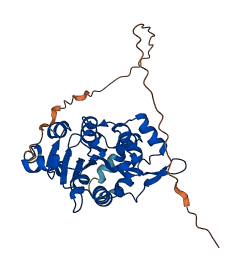
Descriptions
The autoinhibited protein was predicted that may have potential autoinhibitory elements via cis-regPred.
Autoinhibitory domains (AIDs)
Target domain |
|
Relief mechanism |
|
Assay |
cis-regPred |
Accessory elements
No accessory elements
Autoinhibited structure

Activated structure
1 structures for O82796
| Entry ID | Method | Resolution | Chain | Position | Source |
|---|---|---|---|---|---|
| AF-O82796-F1 | Predicted | AlphaFoldDB |
12 variants for O82796
| Variant ID(s) | Position | Change | Description | Diseaes Association | Provenance |
|---|---|---|---|---|---|
| ENSVATH04597707 | 8 | R>M | No | 1000Genomes | |
| ENSVATH11474936 | 20 | S>T | No | 1000Genomes | |
| ENSVATH04597706 | 37 | R>S | No | 1000Genomes | |
| ENSVATH04597704 | 63 | T>A | No | 1000Genomes | |
| tmp_1_6418037_A_C | 70 | I>S | No | 1000Genomes | |
| tmp_1_6417717_G_A | 114 | A>V | No | 1000Genomes | |
| tmp_1_6417563_G_T | 135 | L>I | No | 1000Genomes | |
| tmp_1_6417179_C_T | 174 | V>I | No | 1000Genomes | |
| ENSVATH04597691 | 259 | G>S | No | 1000Genomes | |
| ENSVATH11474821 | 268 | A>T | No | 1000Genomes | |
| ENSVATH04597690 | 278 | A>T | No | 1000Genomes | |
| ENSVATH11474820 | 292 | N>K | No | 1000Genomes |
No associated diseases with O82796
No regional properties for O82796
| Type | Name | Position | InterPro Accession |
|---|---|---|---|
| No domain, repeats, and functional sites for O82796 | |||
Functions
| Description | ||
|---|---|---|
| EC Number | 3.1.3.3 | Phosphoric monoester hydrolases |
| Subcellular Localization |
|
|
| PANTHER Family | ||
| PANTHER Subfamily | ||
| PANTHER Protein Class | ||
| PANTHER Pathway Category | No pathway information available | |
3 GO annotations of cellular component
| Name | Definition |
|---|---|
| chloroplast | A chlorophyll-containing plastid with thylakoids organized into grana and frets, or stroma thylakoids, and embedded in a stroma. |
| cytoplasm | The contents of a cell excluding the plasma membrane and nucleus, but including other subcellular structures. |
| plastid | Any member of a family of organelles found in the cytoplasm of plants and some protists, which are membrane-bounded and contain DNA. Plant plastids develop from a common type, the proplastid. |
2 GO annotations of molecular function
| Name | Definition |
|---|---|
| L-phosphoserine phosphatase activity | Catalysis of the reaction: O-phospho-L-serine + H2O = L-serine + phosphate, on a free amino acid. |
| magnesium ion binding | Binding to a magnesium (Mg) ion. |
7 GO annotations of biological process
| Name | Definition |
|---|---|
| dephosphorylation | The process of removing one or more phosphoric (ester or anhydride) residues from a molecule. |
| embryo development ending in seed dormancy | The process whose specific outcome is the progression of the embryo over time, from zygote formation to the end of seed dormancy. An example of this process is found in Arabidopsis thaliana. |
| L-serine biosynthetic process | The chemical reactions and pathways resulting in the formation of L-serine, the L-enantiomer of serine, i.e. (2S)-2-amino-3-hydroxypropanoic acid. |
| L-serine metabolic process | The chemical reactions and pathways involving L-serine, the L-enantiomer of serine, i.e. (2S)-2-amino-3-hydroxypropanoic acid. |
| pollen development | The process whose specific outcome is the progression of the pollen grain over time, from its formation to the mature structure. The process begins with the meiosis of the microsporocyte to form four haploid microspores. The nucleus of each microspore then divides by mitosis to form a two-celled organism, the pollen grain, that contains a tube cell as well as a smaller generative cell. The pollen grain is surrounded by an elaborate cell wall. In some species, the generative cell immediately divides again to give a pair of sperm cells. In most flowering plants, however this division takes place later, in the tube that develops when a pollen grain germinates. |
| root development | The process whose specific outcome is the progression of the root over time, from its formation to the mature structure. The root is the water- and mineral-absorbing part of a plant which is usually underground, does not bear leaves, tends to grow downwards and is typically derived from the radicle of the embryo. |
| sulfur amino acid metabolic process | The chemical reactions and pathways involving amino acids containing sulfur, comprising cysteine, homocysteine, methionine and selenocysteine. |
No homologous proteins in AiPD
| UniProt AC | Gene Name | Protein Name | Species | Evidence Code |
|---|---|---|---|---|
| No homologous proteins | ||||
| 10 | 20 | 30 | 40 | 50 | 60 |
| MEALTTSRVV | PVQVPCRKLS | SLFANFSCLE | LRRYPCRGLV | SIMNHPKLLR | PVTASVQPHE |
| 70 | 80 | 90 | 100 | 110 | 120 |
| LSTLGHEGNI | VPSKEILDLW | RSVEAVCFDV | DSTVCVDEGI | DELAEFCGAG | KAVAEWTARA |
| 130 | 140 | 150 | 160 | 170 | 180 |
| MGGSVPFEEA | LAARLSLFKP | SLSKVEEYLD | KRPPRLSPGI | EELVKKLRAN | NIDVYLISGG |
| 190 | 200 | 210 | 220 | 230 | 240 |
| FRQMINPVAS | ILGIPRENIF | ANNLLFGNSG | EFLGFDENEP | TSRSGGKAKA | VQQIRKGRLY |
| 250 | 260 | 270 | 280 | 290 | |
| KTMAMIGDGA | TDLEARKPGG | ADLFICYAGV | QLREAVAANA | DWLIFKFESL | INSLD |