O82171
Gene name |
AGD10 (MEE28, RPA, At2g35210, T4C15.12) |
Protein name |
ADP-ribosylation factor GTPase-activating protein AGD10 |
Names |
ARF GAP AGD10, Protein ARF-GAP DOMAIN 10, AtAGD10, Protein MATERNAL EFFECT EMBRYO ARREST 28, Protein ROOT AND POLLEN ARFGAP |
Species |
Arabidopsis thaliana (Mouse-ear cress) |
KEGG Pathway |
ath:AT2G35210 |
EC number |
|
Protein Class |
|
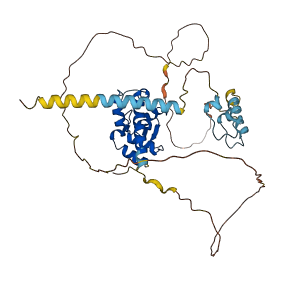
Descriptions
The autoinhibited protein was predicted that may have potential autoinhibitory elements via cis-regPred.
Autoinhibitory domains (AIDs)
Target domain |
|
Relief mechanism |
|
Assay |
cis-regPred |
Accessory elements
No accessory elements
Autoinhibited structure

Activated structure
1 structures for O82171
| Entry ID | Method | Resolution | Chain | Position | Source |
|---|---|---|---|---|---|
| AF-O82171-F1 | Predicted | AlphaFoldDB |
42 variants for O82171
| Variant ID(s) | Position | Change | Description | Diseaes Association | Provenance |
|---|---|---|---|---|---|
| tmp_2_14836264_C_T | 20 | S>L | No | 1000Genomes | |
| tmp_2_14836398_G_A | 30 | A>T | No | 1000Genomes | |
| tmp_2_14836413_T_A | 35 | W>R | No | 1000Genomes | |
| tmp_2_14836458_G_A | 50 | A>T | No | 1000Genomes | |
| ENSVATH14586717 | 53 | R>Q | No | 1000Genomes | |
| ENSVATH00260718 | 55 | L>F | No | 1000Genomes | |
| tmp_2_14836640_A_G | 68 | D>G | No | 1000Genomes | |
| ENSVATH00260720 | 72 | S>P | Number of days following stratification to opening of first flower. the experiment was stopped at 200 d and accessions that had not flowered at that point were assigned a value of 200 [18c with 16 hrs daylight and vernalized (5 wks at 4c)] Plants were checked bi-weekly for presence of first buds and the average flowering time of 4 plants of the same accession were collected [10c and 16 hrs daylight] Number of days following stratification to opening of first flower. the experiment was stopped at 200 d and accessions that had not flowered at that point were assigned a value of 200 [18c and 16 hrs daylight] Plants were checked bi-weekly for presence of first buds and the average flowering time of 4 plants of the same accession were collected [22c and 16 hrs daylight] Plants were checked bi-weekly for presence of first buds and the average flowering time of 4 plants of the same accession were collected [16c and 16 hrs daylight] Longest diameter of the plant measured on the day the first flower was observed [growth in field with natural light and started in october] Number of days required for the bolt height to reach 5cm [23c and 16hrs daylight. vernalized for 2 wks at 5c and 8hrs daylight] [EnsemblGenome] | No | 1000Genomes |
| ENSVATH00260721 | 144 | N>K | No | 1000Genomes | |
| ENSVATH05658878 | 155 | L>P | No | 1000Genomes | |
| tmp_2_14836921_A_C | 162 | K>Q | No | 1000Genomes | |
| tmp_2_14836996_A_T | 187 | K>* | No | 1000Genomes | |
| ENSVATH00260722 | 190 | G>C | No | 1000Genomes | |
| tmp_2_14837011_A_C | 192 | T>P | No | 1000Genomes | |
| ENSVATH13536651 | 194 | G>R | No | 1000Genomes | |
| tmp_2_14837038_A_G | 201 | T>A | No | 1000Genomes | |
| tmp_2_14837046_G_C | 203 | K>N | No | 1000Genomes | |
| tmp_2_14837203_T_G | 234 | F>L | No | 1000Genomes | |
| tmp_2_14837208_C_T | 236 | S>F | No | 1000Genomes | |
| ENSVATH00260724 | 242 | D>V | Number of days following stratification to opening of first flower. the experiment was stopped at 200 d and accessions that had not flowered at that point were assigned a value of 200 [18c and 16 hrs daylight] Plants were checked bi-weekly for presence of first buds and the average flowering time of 4 plants of the same accession were collected [16c and 16 hrs daylight] Plants were checked bi-weekly for presence of first buds and the average flowering time of 4 plants of the same accession were collected [22c and 16 hrs daylight] Number of days required for the bolt height to reach 5cm [23c and 16hrs daylight. vernalized for 2 wks at 5c and 8hrs daylight] Plants were checked bi-weekly for presence of first buds and the average leaf number at flowering time of 4 plants of the same accession were collected [22c and 16 hrs daylight] [EnsemblGenome] | No | 1000Genomes |
| ENSVATH14586718 | 243 | N>S | No | 1000Genomes | |
| tmp_2_14837231_G_A | 244 | V>I | No | 1000Genomes | |
| ENSVATH05658884 | 251 | M>I | No | 1000Genomes | |
| ENSVATH05658886 | 256 | V>G | No | 1000Genomes | |
| ENSVATH14586720 | 277 | G>D | No | 1000Genomes | |
| ENSVATH14586719 | 277 | G>S | No | 1000Genomes | |
| ENSVATH13536653 | 279 | F>Y | No | 1000Genomes | |
| ENSVATH14586721 | 281 | K>M | No | 1000Genomes | |
| ENSVATH14586722 | 285 | T>I | No | 1000Genomes | |
| tmp_2_14837354_A_T | 285 | T>S | No | 1000Genomes | |
| tmp_2_14837361_C_T | 287 | S>F | No | 1000Genomes | |
| ENSVATH14586723 | 290 | L>V | No | 1000Genomes | |
| ENSVATH05658889 | 295 | T>S | No | 1000Genomes | |
| ENSVATH13536675 | 303 | T>A | No | 1000Genomes | |
| tmp_2_14837564_C_G | 325 | A>G | No | 1000Genomes | |
| ENSVATH05658890 | 330 | K>N | No | 1000Genomes | |
| tmp_2_14837718_T_C | 351 | F>L | No | 1000Genomes | |
| tmp_2_14837863_C_A | 369 | Q>K | No | 1000Genomes | |
| ENSVATH13536681 | 369 | Q>L | No | 1000Genomes | |
| tmp_2_14837897_A_T | 380 | E>V | No | 1000Genomes | |
| tmp_2_14837934_C_A | 392 | S>R | No | 1000Genomes | |
| ENSVATH01950728 | 396 | V>L | No | 1000Genomes |
No associated diseases with O82171
1 GO annotations of cellular component
| Name | Definition |
|---|---|
| Golgi membrane | The lipid bilayer surrounding any of the compartments of the Golgi apparatus. |
2 GO annotations of molecular function
| Name | Definition |
|---|---|
| GTPase activator activity | Binds to and increases the activity of a GTPase, an enzyme that catalyzes the hydrolysis of GTP. |
| metal ion binding | Binding to a metal ion. |
3 GO annotations of biological process
| Name | Definition |
|---|---|
| COPI coating of Golgi vesicle | The addition of COPI proteins and adaptor proteins to Golgi membranes during the formation of transport vesicles, forming a vesicle coat. |
| embryo development ending in seed dormancy | The process whose specific outcome is the progression of the embryo over time, from zygote formation to the end of seed dormancy. An example of this process is found in Arabidopsis thaliana. |
| pollen development | The process whose specific outcome is the progression of the pollen grain over time, from its formation to the mature structure. The process begins with the meiosis of the microsporocyte to form four haploid microspores. The nucleus of each microspore then divides by mitosis to form a two-celled organism, the pollen grain, that contains a tube cell as well as a smaller generative cell. The pollen grain is surrounded by an elaborate cell wall. In some species, the generative cell immediately divides again to give a pair of sperm cells. In most flowering plants, however this division takes place later, in the tube that develops when a pollen grain germinates. |
1 homologous proteins in AiPD
| UniProt AC | Gene Name | Protein Name | Species | Evidence Code |
|---|---|---|---|---|
| Q9NP61 | ARFGAP3 | ADP-ribosylation factor GTPase-activating protein 3 | Homo sapiens (Human) | PR |
| 10 | 20 | 30 | 40 | 50 | 60 |
| MASENLNDKI | SVFKKLKAKS | DNKICFDCNA | KNPTWASVTY | GIFLCIDCSA | VHRSLGVHIS |
| 70 | 80 | 90 | 100 | 110 | 120 |
| FVRSTNLDSW | SSEQLKMMIY | GGNNRAQVFF | KQYGWSDGGK | TEAKYTSRAA | DLYKQILAKE |
| 130 | 140 | 150 | 160 | 170 | 180 |
| VAKSKAEEEL | DLPPSPPDST | QVPNGLSSIK | TSEALKESNT | LKQQEKPDVV | PVSPRISRSV |
| 190 | 200 | 210 | 220 | 230 | 240 |
| KKPLGAKKTG | KTGGLGARKL | TTKSSGTLYD | QKPEESVIIQ | ATSPVSAKSA | RSSFSSRFDY |
| 250 | 260 | 270 | 280 | 290 | 300 |
| ADNVQNREDY | MSPQVVSHVA | PPKSSGFFEE | ELEMNGGRFQ | KKPITSSSKL | QIQETDEARK |
| 310 | 320 | 330 | 340 | 350 | 360 |
| KFTNAKSISS | AQYFGNDNNS | ADLEAKSSLK | KFSGSSAISS | ADLFGDGDGD | FPLDLTAGDL |
| 370 | 380 | 390 | |||
| LNRLSLQAQQ | DISSLKNMAE | ETKKKLGSVA | SSLWV |