O80358
Gene name |
FPG1 (FPG2, At1g52500, F6D8.28) |
Protein name |
Formamidopyrimidine-DNA glycosylase |
Names |
Fapy-DNA glycosylase, DNA-(apurinic or apyrimidinic site) lyase FPG1, Formamidopyrimidine-DNA glycosylase 1, AtFPG-1, Formamidopyrimidine-DNA glycosylase 2, AtFPG-2, Protein MutM homolog 1, AtMMH-1, Protein MutM homolog 2, AtMMH-2 |
Species |
Arabidopsis thaliana (Mouse-ear cress) |
KEGG Pathway |
ath:AT1G52500 |
EC number |
3.2.2.23: Hydrolyzing N-glycosyl compounds |
Protein Class |
|
Descriptions
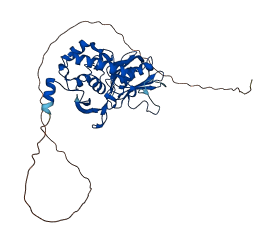
The autoinhibited protein was predicted that may have potential autoinhibitory elements via cis-regPred.
Autoinhibitory domains (AIDs)
Target domain |
|
Relief mechanism |
|
Assay |
cis-regPred |
Accessory elements
No accessory elements
Autoinhibited structure

Activated structure
4 structures for O80358
| Entry ID | Method | Resolution | Chain | Position | Source |
|---|---|---|---|---|---|
| 3TWK | X-ray | 230 A | A/B | 1-281 | PDB |
| 3TWL | X-ray | 170 A | A | 1-304 | PDB |
| 3TWM | X-ray | 280 A | A/B | 1-304 | PDB |
| AF-O80358-F1 | Predicted | AlphaFoldDB |
38 variants for O80358
| Variant ID(s) | Position | Change | Description | Diseaes Association | Provenance |
|---|---|---|---|---|---|
| ENSVATH13533785 | 13 | A>V | No | 1000Genomes | |
| tmp_1_19560169_T_C | 43 | F>L | No | 1000Genomes | |
| tmp_1_19560224_A_C | 61 | N>T | No | 1000Genomes | |
| tmp_1_19560707_T_C | 82 | I>T | No | 1000Genomes | |
| tmp_1_19560743_G_C | 94 | R>T | No | 1000Genomes | |
| ENSVATH04945220 | 162 | E>K | No | 1000Genomes | |
| ENSVATH13533823 | 164 | L>F | No | 1000Genomes | |
| ENSVATH13533824 | 165 | A>T | No | 1000Genomes | |
| tmp_1_19561248_C_T | 173 | P>S | No | 1000Genomes | |
| tmp_1_19561708_A_C | 203 | T>P | No | 1000Genomes | |
| tmp_1_19561734_A_C | 211 | Q>H | No | 1000Genomes | |
| ENSVATH00094502 | 216 | H>Y | No | 1000Genomes | |
| tmp_1_19561751_C_A | 217 | T>K | No | 1000Genomes | |
| ENSVATH04945226 | 219 | I>V | No | 1000Genomes | |
| tmp_1_19561759_A_G | 220 | K>E | No | 1000Genomes | |
| tmp_1_19561760_A_T | 220 | K>I | No | 1000Genomes | |
| ENSVATH01356803 | 239 | Y>N | No | 1000Genomes | |
| tmp_1_19562108_G_A | 240 | W>* | No | 1000Genomes | |
| tmp_1_19562528_C_G | 282 | D>E | No | 1000Genomes | |
| tmp_1_19562526_G_A | 282 | D>N | No | 1000Genomes | |
| tmp_1_19562530_C_T | 283 | A>V | No | 1000Genomes | |
| ENSVATH04945239 | 291 | P>L | No | 1000Genomes | |
| ENSVATH04945241 | 309 | E>A | No | 1000Genomes | |
| ENSVATH04945242 | 315 | E>K | No | 1000Genomes | |
| ENSVATH01356805 | 321 | S>L | No | 1000Genomes | |
| ENSVATH04945243 | 323 | K>N | No | 1000Genomes | |
| tmp_1_19562685_C_T | 335 | P>S | No | 1000Genomes | |
| tmp_1_19562689_C_G | 336 | A>G | No | 1000Genomes | |
| tmp_1_19562692_C_T | 337 | S>L | No | 1000Genomes | |
| ENSVATH13533897 | 341 | T>I | No | 1000Genomes | |
| tmp_1_19562706_G_C | 342 | E>Q | No | 1000Genomes | |
| ENSVATH14298791 | 346 | D>H | No | 1000Genomes | |
| tmp_1_19562731_A_G | 350 | D>G | No | 1000Genomes | |
| tmp_1_19562736_G_A | 352 | E>K | No | 1000Genomes | |
| ENSVATH13533898 | 369 | I>M | No | 1000Genomes | |
| ENSVATH04945244 | 372 | K>M | No | 1000Genomes | |
| ENSVATH01356806 | 385 | P>L | No | 1000Genomes | |
| tmp_1_19562847_A_G | 389 | K>E | No | 1000Genomes |
No associated diseases with O80358
No regional properties for O80358
| Type | Name | Position | InterPro Accession |
|---|---|---|---|
| No domain, repeats, and functional sites for O80358 | |||
Functions
| Description | ||
|---|---|---|
| EC Number | 3.2.2.23 | Hydrolyzing N-glycosyl compounds |
| Subcellular Localization |
|
|
| PANTHER Family | ||
| PANTHER Subfamily | ||
| PANTHER Protein Class | ||
| PANTHER Pathway Category | No pathway information available | |
1 GO annotations of cellular component
| Name | Definition |
|---|---|
| nucleus | A membrane-bounded organelle of eukaryotic cells in which chromosomes are housed and replicated. In most cells, the nucleus contains all of the cell's chromosomes except the organellar chromosomes, and is the site of RNA synthesis and processing. In some species, or in specialized cell types, RNA metabolism or DNA replication may be absent. |
6 GO annotations of molecular function
| Name | Definition |
|---|---|
| class I DNA-(apurinic or apyrimidinic site) endonuclease activity | Catalysis of the cleavage of an AP site 3' of the baseless site by a beta-lyase mechanism, leaving an unsaturated aldehyde, termed a 3'-(4-hydroxy-5-phospho-2-pentenal) residue, and a 5'-phosphate. |
| damaged DNA binding | Binding to damaged DNA. |
| DNA N-glycosylase activity | Catalysis of the removal of damaged bases by cleaving the N-C1' glycosidic bond between the target damaged DNA base and the deoxyribose sugar. The reaction releases a free base and leaves an apurinic/apyrimidinic (AP) site. |
| DNA-(apurinic or apyrimidinic site) endonuclease activity | Catalysis of the cleavage of the C-O-P bond in the AP site created when DNA glycosylase removes a damaged base, involved in the DNA base excision repair pathway (BER). |
| oxidized purine nucleobase lesion DNA N-glycosylase activity | Catalysis of the removal of oxidized purine bases by cleaving the N-C1' glycosidic bond between the oxidized purine and the deoxyribose sugar. The reaction involves the formation of a covalent enzyme-substrate intermediate. Release of the enzyme and free base by a beta-elimination or a beta, gamma-elimination mechanism results in the cleavage of the DNA backbone 3' of the apurinic (AP) site. |
| zinc ion binding | Binding to a zinc ion (Zn). |
3 GO annotations of biological process
| Name | Definition |
|---|---|
| base-excision repair | In base excision repair, an altered base is removed by a DNA glycosylase enzyme, followed by excision of the resulting sugar phosphate. The small gap left in the DNA helix is filled in by the sequential action of DNA polymerase and DNA ligase. |
| DNA repair | The process of restoring DNA after damage. Genomes are subject to damage by chemical and physical agents in the environment (e.g. UV and ionizing radiations, chemical mutagens, fungal and bacterial toxins, etc.) and by free radicals or alkylating agents endogenously generated in metabolism. DNA is also damaged because of errors during its replication. A variety of different DNA repair pathways have been reported that include direct reversal, base excision repair, nucleotide excision repair, photoreactivation, bypass, double-strand break repair pathway, and mismatch repair pathway. |
| response to oxidative stress | Any process that results in a change in state or activity of a cell or an organism (in terms of movement, secretion, enzyme production, gene expression, etc.) as a result of oxidative stress, a state often resulting from exposure to high levels of reactive oxygen species, e.g. superoxide anions, hydrogen peroxide (H2O2), and hydroxyl radicals. |
No homologous proteins in AiPD
| UniProt AC | Gene Name | Protein Name | Species | Evidence Code |
|---|---|---|---|---|
| No homologous proteins | ||||
| 10 | 20 | 30 | 40 | 50 | 60 |
| MPELPEVEAA | RRAIEENCLG | KKIKRVIIAD | DNKVIHGISP | SDFQTSILGK | TIISARRKGK |
| 70 | 80 | 90 | 100 | 110 | 120 |
| NLWLELDSPP | FPSFQFGMAG | AIYIKGVAVT | KYKRSAVKDS | EEWPSKYSKF | FVELDDGLEL |
| 130 | 140 | 150 | 160 | 170 | 180 |
| SFTDKRRFAK | VRLLANPTSV | SPISELGPDA | LLEPMTVDEF | AESLAKKKIT | IKPLLLDQGY |
| 190 | 200 | 210 | 220 | 230 | 240 |
| ISGIGNWIAD | EVLYQARIHP | LQTASSLSKE | QCEALHTSIK | EVIEKAVEVD | ADSSQFPSYW |
| 250 | 260 | 270 | 280 | 290 | 300 |
| IFHNREKKPG | KAFVDGKKID | FITAGGRTTA | YVPELQKLYG | KDAEKAAKVR | PAKRGVKPKE |
| 310 | 320 | 330 | 340 | 350 | 360 |
| DDGDGEEDEQ | ETEKEDESAK | SKKGQKPRGG | RGKKPASKTK | TEESDDDGDD | SEAEEEVVKP |
| 370 | 380 | ||||
| KGRGTKPAIK | RKSEEKATSQ | AGKKPKGRKS |