O77457
Gene name |
AGAP002721 |
Protein name |
Tryptophan 2,3-dioxygenase |
Names |
TDO, Tryptamin 2,3-dioxygenase, Tryptophan oxygenase, TO, TRPO, Tryptophan pyrrolase, Tryptophanase |
Species |
Anopheles gambiae (African malaria mosquito) |
KEGG Pathway |
aga:AgaP_AGAP002721 |
EC number |
1.13.11.11: With incorporation of two atoms of oxygen |
Protein Class |
|
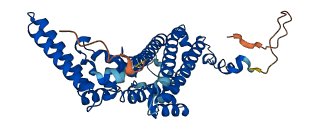
Descriptions
The autoinhibited protein was predicted that may have potential autoinhibitory elements via cis-regPred.
Autoinhibitory domains (AIDs)
Target domain |
|
Relief mechanism |
|
Assay |
cis-regPred |
Accessory elements
No accessory elements
Autoinhibited structure

Activated structure
1 structures for O77457
| Entry ID | Method | Resolution | Chain | Position | Source |
|---|---|---|---|---|---|
| AF-O77457-F1 | Predicted | AlphaFoldDB |
No variants for O77457
| Variant ID(s) | Position | Change | Description | Diseaes Association | Provenance |
|---|---|---|---|---|---|
| No variants for O77457 | |||||
No associated diseases with O77457
No regional properties for O77457
| Type | Name | Position | InterPro Accession |
|---|---|---|---|
| No domain, repeats, and functional sites for O77457 | |||
Functions
| Description | ||
|---|---|---|
| EC Number | 1.13.11.11 | With incorporation of two atoms of oxygen |
| Subcellular Localization |
|
|
| PANTHER Family | ||
| PANTHER Subfamily | ||
| PANTHER Protein Class | ||
| PANTHER Pathway Category | No pathway information available | |
No GO annotations of cellular component
| Name | Definition |
|---|---|
| No GO annotations for cellular component |
3 GO annotations of molecular function
| Name | Definition |
|---|---|
| heme binding | Binding to a heme, a compound composed of iron complexed in a porphyrin (tetrapyrrole) ring. |
| metal ion binding | Binding to a metal ion. |
| tryptophan 2,3-dioxygenase activity | Catalysis of the reaction: L-tryptophan + O2 = N-formyl-L-kynurenine. |
3 GO annotations of biological process
| Name | Definition |
|---|---|
| ommochrome biosynthetic process | The chemical reactions and pathways resulting in the formation of ommochromes, any of a large group of natural polycyclic pigments commonly found in the Arthropoda, particularly in the ommatidia of the compound eye. |
| tryptophan catabolic process to acetyl-CoA | The chemical reactions and pathways resulting in the breakdown of tryptophan into other compounds, including acetyl-CoA. |
| tryptophan catabolic process to kynurenine | The chemical reactions and pathways resulting in the breakdown of tryptophan into other compounds, including kynurenine. |
No homologous proteins in AiPD
| UniProt AC | Gene Name | Protein Name | Species | Evidence Code |
|---|---|---|---|---|
| No homologous proteins | ||||
| 10 | 20 | 30 | 40 | 50 | 60 |
| MSCPMRSGFV | DSVQGGHHLG | SEAGMLYGEY | LMLDKVLSAQ | RMLSVEGKKP | VHDEHLFIVT |
| 70 | 80 | 90 | 100 | 110 | 120 |
| HQAYELWFKQ | IIFELDSIRD | LFSTEHIEES | RTLEILKRLN | RIVMILKLLV | DQVPILETMT |
| 130 | 140 | 150 | 160 | 170 | 180 |
| PLDFMDFRDY | LSPASGFQSL | QFRLLENKLG | VKSEHRVKYN | QKYTEVFASD | PGAIERIGTT |
| 190 | 200 | 210 | 220 | 230 | 240 |
| ETEPSLADLV | QKWLERTPGL | EQDGFNFWGK | FQESVEQLLA | EQEASAMSEE | HENVREYRLM |
| 250 | 260 | 270 | 280 | 290 | 300 |
| DIDKRREVYK | SIFDAQVHDA | LVARGERRFT | HKALQGAIMI | TFYRDEPRFS | QPHQLLMLLM |
| 310 | 320 | 330 | 340 | 350 | 360 |
| DIDSLITKWR | YNHVIMVQRM | IGSQQLGTGG | SSGYQYLRST | LSDRYKVFLD | LFNLSTFLIP |
| 370 | 380 | 390 | |||
| RQSIPPLTNE | MQKALNLAWG | SPAHFARNGS | LH |