O75011
Gene name |
nak1 (SPBC17F3.02) |
Protein name |
Serine/threonine-protein kinase nak1 |
Names |
N-rich kinase 1 |
Species |
Schizosaccharomyces pombe (strain 972 / ATCC 24843) (Fission yeast) |
KEGG Pathway |
spo:SPBC17F3.02 |
EC number |
2.7.11.1: Protein-serine/threonine kinases |
Protein Class |
|
Descriptions
The autoinhibited protein was predicted that may have potential autoinhibitory elements via cis-regPred.
Autoinhibitory domains (AIDs)
Target domain |
|
Relief mechanism |
|
Assay |
cis-regPred |
Accessory elements
No accessory elements
Autoinhibited structure

Activated structure
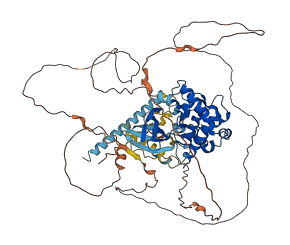
1 structures for O75011
| Entry ID | Method | Resolution | Chain | Position | Source |
|---|---|---|---|---|---|
| AF-O75011-F1 | Predicted | AlphaFoldDB |
No variants for O75011
| Variant ID(s) | Position | Change | Description | Diseaes Association | Provenance |
|---|---|---|---|---|---|
| No variants for O75011 | |||||
No associated diseases with O75011
6 regional properties for O75011
| Type | Name | Position | InterPro Accession |
|---|---|---|---|
| conserved_site | Twin-arginine translocation pathway, signal sequence | 1 - 34 | IPR006311 |
| domain | Molybdopterin oxidoreductase | 103 - 575 | IPR006656 |
| domain | Molybdopterin dinucleotide-binding domain | 725 - 833 | IPR006657 |
| domain | Molybdopterin oxidoreductase, 4Fe-4S domain | 46 - 102 | IPR006963 |
| conserved_site | Twin-arginine translocation pathway, signal sequence, bacterial/archaeal | 3 - 31 | IPR019546 |
| domain | Nitrate reductase NapA-like, molybdopterin-binding domain | 721 - 839 | IPR041957 |
Functions
| Description | ||
|---|---|---|
| EC Number | 2.7.11.1 | Protein-serine/threonine kinases |
| Subcellular Localization |
|
|
| PANTHER Family | ||
| PANTHER Subfamily | ||
| PANTHER Protein Class | ||
| PANTHER Pathway Category | No pathway information available | |
7 GO annotations of cellular component
| Name | Definition |
|---|---|
| actin cortical patch | An endocytic patch that consists of an actin-containing structure found at the plasma membrane in cells; formed of networks of branched actin filaments that lie just beneath the plasma membrane and assemble, move, and disassemble rapidly. An example of this is the actin cortical patch found in Saccharomyces cerevisiae. |
| cell division site | The eventual plane of cell division (also known as cell cleavage or cytokinesis) in a dividing cell. In Eukaryotes, the cleavage apparatus, composed of septin structures and the actomyosin contractile ring, forms along this plane, and the mitotic, or meiotic, spindle is aligned perpendicular to the division plane. In bacteria, the cell division site is generally located at mid-cell and is the site at which the cytoskeletal structure, the Z-ring, assembles. |
| cytoplasm | The contents of a cell excluding the plasma membrane and nucleus, but including other subcellular structures. |
| cytosol | The part of the cytoplasm that does not contain organelles but which does contain other particulate matter, such as protein complexes. |
| mitotic actomyosin contractile ring | A cytoskeletal structure composed of actin filaments, myosin, and myosin-associated proteins that forms beneath the plasma membrane of many cells, including animal cells and yeast cells, in a plane perpendicular to the axis of the mitotic spindle, i.e. the cell division plane. Ring contraction is associated with centripetal growth of the membrane that divides the cytoplasm of the two future daughter cells. In animal cells, the mitotic contractile ring is located inside the plasma membrane at the location of the cleavage furrow. In budding fungal cells, e.g. mitotic S. cerevisiae cells, the mitotic contractile ring forms beneath the plasma membrane at the mother-bud neck before mitosis. |
| mitotic spindle pole body | The microtubule organizing center that forms as part of the mitotic cell cycle; functionally homologous to the animal cell centrosome. |
| new mitotic spindle pole body | The spindle pole body that is formed by spindle pole body duplication, and to which proteins involved in mitotic exit signaling (for example, the septation initiation network in fission yeast) localize. |
4 GO annotations of molecular function
| Name | Definition |
|---|---|
| ATP binding | Binding to ATP, adenosine 5'-triphosphate, a universally important coenzyme and enzyme regulator. |
| protein kinase activity | Catalysis of the phosphorylation of an amino acid residue in a protein, usually according to the reaction: a protein + ATP = a phosphoprotein + ADP. |
| protein serine kinase activity | Catalysis of the reactions: ATP + protein serine = ADP + protein serine phosphate. |
| protein serine/threonine kinase activity | Catalysis of the reactions: ATP + protein serine = ADP + protein serine phosphate, and ATP + protein threonine = ADP + protein threonine phosphate. |
7 GO annotations of biological process
| Name | Definition |
|---|---|
| establishment or maintenance of actin cytoskeleton polarity | Any cellular process that results in the specification, formation or maintenance of polarized actin-based cytoskeletal structures. |
| establishment or maintenance of cell polarity regulating cell shape | Any cellular process that results in the specification, formation or maintenance of a polarized intracellular organization or cell growth patterns that regulate the shape of a cell. |
| positive regulation of establishment or maintenance of bipolar cell polarity regulating cell shape | Any process that activates or increases the frequency, rate or extent of establishment or maintenance of bipolar cell polarity regulating cell shape. |
| protein localization to medial cortex | A process in which a protein is transported to, or maintained in, the medial cortex. |
| protein phosphorylation | The process of introducing a phosphate group on to a protein. |
| RAM/MOR signaling pathway | An intracellular signaling pathway that regulates interphase polarized growth and cell separation at the end of cytokinesis through activation of the NDR1/2-related kinase. |
| regulation of establishment or maintenance of bipolar cell polarity regulating cell shape | Any process that modulates the frequency, rate or extent of establishment or maintenance of bipolar cell polarity regulating cell shape. |
No homologous proteins in AiPD
| UniProt AC | Gene Name | Protein Name | Species | Evidence Code |
|---|---|---|---|---|
| No homologous proteins | ||||
| 10 | 20 | 30 | 40 | 50 | 60 |
| MENNTASSPY | TKLELVGRGS | YGAVYRGICN | LTKETVAIKI | LNLDTDEDEV | SDIQKEVAVL |
| 70 | 80 | 90 | 100 | 110 | 120 |
| SELKQSDVEN | IIKYHGSYLV | GTNLWIIMDY | CHGGSVRTLM | EAGPISEPCI | SLILRETLQA |
| 130 | 140 | 150 | 160 | 170 | 180 |
| LKFIHHAGII | HRDIKAANIL | VSMSGNVKLC | DFGVAAELNI | NRRKRITFIG | TPYWMAPEVI |
| 190 | 200 | 210 | 220 | 230 | 240 |
| RDGQEYNVMA | DIWSLGITAY | EIATGSPPHA | KEDPFRAVYL | IAHTAPPRLN | GNFSALLKEF |
| 250 | 260 | 270 | 280 | 290 | 300 |
| IASCLQDVPQ | RRLDSSELLK | SKFIKQYSRM | SISELTNVVK | RYDTWQAAGG | IPQTLLLGEE |
| 310 | 320 | 330 | 340 | 350 | 360 |
| ADDGSDPDQE | TSDTAASDDG | WEFGTIKQGQ | SNVSSITGTS | TSTTTAATSS | TTVTGTVIPK |
| 370 | 380 | 390 | 400 | 410 | 420 |
| SSTVHEPPSS | NDSHPLLQLF | KDSKISDDDS | PSNAEGASTE | DSKGEVSYSQ | IELPSLDSSN |
| 430 | 440 | 450 | 460 | 470 | 480 |
| LSSKKSTIQS | KHTKQAEDYD | LFVGRTRSNS | KTSSDQSIKR | PLPRVVQRQK | TSLGKRGISM |
| 490 | 500 | 510 | 520 | 530 | 540 |
| SPMKPGLRMP | SSFDLQSRSI | SMGAFEQLST | PLEAPAHKHS | AVLQPLEVNR | SISIPPPKSI |
| 550 | 560 | 570 | 580 | 590 | 600 |
| SPSILHKPSL | ESASSTPKIS | SCSSTPKPFN | SKLRAHLPPL | SIGSPAVQPL | ANDNYDSLGV |
| 610 | 620 | 630 | 640 | 650 | |
| RGLNMELFND | YPGNMHNIKS | VLSLEIDIVL | GEMDACLKSL | ECNLLNRKAY | NE |