O74958
Gene name |
mmi1 (SPCC736.12c) |
Protein name |
RNA binding exosome specificity factor Mmi1 |
Names |
Meiotic mRNA interception protein 1, YTH domain-containing protein mmi1 |
Species |
Schizosaccharomyces pombe (strain 972 / ATCC 24843) (Fission yeast) |
KEGG Pathway |
spo:SPCC736.12c |
EC number |
|
Protein Class |
|
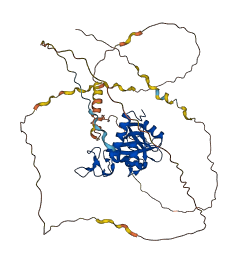
Descriptions
The autoinhibited protein was predicted that may have potential autoinhibitory elements via cis-regPred.
Autoinhibitory domains (AIDs)
Target domain |
|
Relief mechanism |
|
Assay |
cis-regPred |
Accessory elements
No accessory elements
Autoinhibited structure

Activated structure
12 structures for O74958
| Entry ID | Method | Resolution | Chain | Position | Source |
|---|---|---|---|---|---|
| 5DNO | X-ray | 180 A | A | 322-488 | PDB |
| 5DNP | X-ray | 230 A | A/B | 322-488 | PDB |
| 5EIM | X-ray | 154 A | A/B | 326-488 | PDB |
| 5EIP | X-ray | 149 A | A/B | 349-477 | PDB |
| 5H8A | X-ray | 175 A | A/B/C/D | 311-488 | PDB |
| 5HFZ | X-ray | 196 A | A/B/C/D | 319-488 | PDB |
| 5O8M | X-ray | 145 A | A/B/C/D | 347-488 | PDB |
| 6AKJ | X-ray | 270 A | A/B | 96-122 | PDB |
| 6FPP | X-ray | 193 A | A/B | 327-488 | PDB |
| 6FPQ | X-ray | 142 A | A | 299-488 | PDB |
| 6FPX | X-ray | 197 A | A/C/E | 299-488 | PDB |
| AF-O74958-F1 | Predicted | AlphaFoldDB |
No variants for O74958
| Variant ID(s) | Position | Change | Description | Diseaes Association | Provenance |
|---|---|---|---|---|---|
| No variants for O74958 | |||||
No associated diseases with O74958
1 regional properties for O74958
| Type | Name | Position | InterPro Accession |
|---|---|---|---|
| domain | YTH domain | 350 - 477 | IPR007275 |
6 GO annotations of cellular component
| Name | Definition |
|---|---|
| chromatin | The ordered and organized complex of DNA, protein, and sometimes RNA, that forms the chromosome. |
| cytoplasm | The contents of a cell excluding the plasma membrane and nucleus, but including other subcellular structures. |
| heterochromatin island | A region of facultative heterochromatin formed dynamically at specific loci in response to environmental signals, independently of RNAi. |
| Mei2 nuclear dot complex | A ribonucleoprotein complex that forms during meiotic prophase in a fixed position in the horsetail nucleus; contains Mei2 and meiRNA. May play a role in the progression of meiosis I. |
| nuclear exosome focus | An nuclear body involved in nuclear mRNA surveilllance. Contains at least Mmi1, or an ortholog of it, and the nuclear exosome. |
| nucleus | A membrane-bounded organelle of eukaryotic cells in which chromosomes are housed and replicated. In most cells, the nucleus contains all of the cell's chromosomes except the organellar chromosomes, and is the site of RNA synthesis and processing. In some species, or in specialized cell types, RNA metabolism or DNA replication may be absent. |
7 GO annotations of molecular function
| Name | Definition |
|---|---|
| CCR4-NOT complex binding | Binding to a CCR4-NOT complex. |
| DNA binding | Any molecular function by which a gene product interacts selectively and non-covalently with DNA (deoxyribonucleic acid). |
| mRNA binding | Binding to messenger RNA (mRNA), an intermediate molecule between DNA and protein. mRNA includes UTR and coding sequences, but does not contain introns. |
| N6-methyladenosine-containing RNA binding | Binding to an RNA molecule modified by N6-methyladenosine (m6A), a modification present at internal sites of mRNAs and some non-coding RNAs. |
| pre-mRNA intronic binding | Binding to an intronic sequence of a pre-messenger RNA (pre-mRNA). |
| protein-RNA adaptor activity | The binding activity of a protein that brings together another protein and an RNA, permitting those molecules to function in a coordinated way. |
| RNA binding | Binding to an RNA molecule or a portion thereof. |
14 GO annotations of biological process
| Name | Definition |
|---|---|
| lncRNA catabolic process | The chemical reactions and pathways resulting in the breakdown of lncRNAs, non-coding RNAs over 200 nucleotides in length. |
| mRNA destabilization | Any process that decreases the stability of an mRNA molecule, making it more vulnerable to degradative processes. Messenger RNA is the intermediate molecule between DNA and protein. It includes UTR and coding sequences. It does not contain introns. |
| negative regulation of meiotic cell cycle | Any process that stops, prevents or reduces the rate or extent of progression through the meiotic cell cycle. |
| negative regulation of nuclear-transcribed mRNA catabolic process, nonsense-mediated decay | Any process that stops, prevents or reduces the frequency, rate or extent of nuclear-transcribed mRNA catabolic process, nonsense-mediated decay. |
| nuclear mRNA surveillance of mRNA 3'-end processing | The set of processes involved in identifying and degrading mRNAs with incorrectly formed 3'-ends within the nucleus. |
| nuclear mRNA surveillance of spliceosomal pre-mRNA splicing | The set of processes involved in identifying and degrading incorrectly spliced pre-mRNAs within the nucleus. |
| nuclear ncRNA surveillance | The set of processes involved in identifying and degrading defective or aberrant ncRNAs within the nucleus. |
| nuclear-transcribed mRNA catabolic process, meiosis-specific transcripts | The chemical reactions and pathways resulting in the selective degradation of meiosis-specific transcripts during vegetative growth, by a mechanism that requires determinant of selective removal (DSR) sequences in the targeted mRNAs and involves a YTH family protein. |
| nuclear-transcribed mRNA poly(A) tail shortening | Shortening of the poly(A) tail of a nuclear-transcribed mRNA from full length to an oligo(A) length. |
| positive regulation of pericentric heterochromatin assembly | Any process that increases the frequency, rate or extent of pericentric heterochromatin formation. |
| positive regulation of termination of RNA polymerase II transcription | Any process that activates or increases the frequency, rate or extent of termination of RNA polymerase II transcription. |
| positive regulation of transcription by RNA polymerase II | Any process that activates or increases the frequency, rate or extent of transcription from an RNA polymerase II promoter. |
| regulation of termination of RNA polymerase II transcription, poly(A)-coupled | Any process that modulates the frequency, rate or extent of termination of RNA polymerase II transcription, poly(A)-coupled. |
| siRNA-independent facultative heterochromatin assembly | The formation of facultative heterochromatin into a heterochromatin domain, enriched in histone H3 methylated on lysine 9 (H3K9me), by a process independent of small interfering RNAs. |
No homologous proteins in AiPD
| UniProt AC | Gene Name | Protein Name | Species | Evidence Code |
|---|---|---|---|---|
| No homologous proteins | ||||
| 10 | 20 | 30 | 40 | 50 | 60 |
| MSNTNFSTSR | SSKSIPELPN | LEALRSLWPP | PSLNESGDTR | SVWTTHTGEP | VASSVLSTSG |
| 70 | 80 | 90 | 100 | 110 | 120 |
| SNNFSSPLKR | PAPESHDAPI | GRRLMVDDPR | LIKHGKYDFS | RHCTDYGHSY | EWPYFRSLRR |
| 130 | 140 | 150 | 160 | 170 | 180 |
| ESMLYHTSGS | YPESQPPYSS | YSTDAPHYYH | AGSESSAYYD | SRSRLHGIQP | PPKRRTLSPP |
| 190 | 200 | 210 | 220 | 230 | 240 |
| PRRLADPVVV | GSSRYVEEEV | YRRPPYTLAS | EVPSSASAYQ | AGYSSYPVRS | SPQLSHEDTR |
| 250 | 260 | 270 | 280 | 290 | 300 |
| HGIASSGSTR | YPFVPANTRA | SHSPSLLEPY | AHSLPSSVAP | VGAYPEKSSY | LLSNSSNDSA |
| 310 | 320 | 330 | 340 | 350 | 360 |
| SRKEKPKARA | STPPPLNFSR | ASEHRNEKGE | RISMINPRVV | LDENGISHRS | RYFIMLCDNE |
| 370 | 380 | 390 | 400 | 410 | 420 |
| TAIAHAKKTS | IWAVKKDSSK | RISDAYKKAS | VYFIFVAQQT | YNALGYAQVV | SDLNSTELPF |
| 430 | 440 | 450 | 460 | 470 | 480 |
| WSDSSHAGGV | RIKWIKTCNL | FSAEISEIVS | HMDHGSEARD | GMEMMYDEGS | RLCTLINYAI |
| MKRIGRDR |