O74856
Gene name |
caf1 (pop2, SPCC18.06c) |
Protein name |
Poly(A) ribonuclease pop2 |
Names |
CCR4-associated factor 1 |
Species |
Schizosaccharomyces pombe (strain 972 / ATCC 24843) (Fission yeast) |
KEGG Pathway |
spo:SPCC18.06c |
EC number |
3.1.13.4: Exoribonucleases producing 5'-phosphomonoesters |
Protein Class |
|
Descriptions
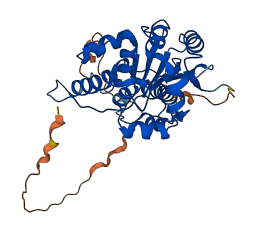
The autoinhibited protein was predicted that may have potential autoinhibitory elements via cis-regPred.
Autoinhibitory domains (AIDs)
Target domain |
|
Relief mechanism |
|
Assay |
cis-regPred |
Accessory elements
No accessory elements
Autoinhibited structure

Activated structure
4 structures for O74856
| Entry ID | Method | Resolution | Chain | Position | Source |
|---|---|---|---|---|---|
| 2P51 | X-ray | 140 A | A | 4-335 | PDB |
| 3G0Z | X-ray | 200 A | A | 4-335 | PDB |
| 3G10 | X-ray | 260 A | A | 4-335 | PDB |
| AF-O74856-F1 | Predicted | AlphaFoldDB |
No variants for O74856
| Variant ID(s) | Position | Change | Description | Diseaes Association | Provenance |
|---|---|---|---|---|---|
| No variants for O74856 | |||||
No associated diseases with O74856
No regional properties for O74856
| Type | Name | Position | InterPro Accession |
|---|---|---|---|
| No domain, repeats, and functional sites for O74856 | |||
Functions
| Description | ||
|---|---|---|
| EC Number | 3.1.13.4 | Exoribonucleases producing 5'-phosphomonoesters |
| Subcellular Localization |
|
|
| PANTHER Family | ||
| PANTHER Subfamily | ||
| PANTHER Protein Class | ||
| PANTHER Pathway Category | No pathway information available | |
5 GO annotations of cellular component
| Name | Definition |
|---|---|
| CCR4-NOT complex | The Ccr4-Not complex is an eukaryotically conserved deadenylase that can initiate cytoplasmic mRNA decay, and reduce translation by releasing poly(A)-binding protein (Pab1/PABPC1). Ccr4-Not contains seven core subunits, including two poly(A)-specific exonucleases, Ccr4/CNOT6/CNOT6L and Caf1/Pop2/CNOT7/CNOT8. |
| CCR4-NOT core complex | The core of the CCR4-NOT complex. In Saccharomyces the CCR4-NOT core complex comprises Ccr4p, Caf1p, Caf40p, Caf130p, Not1p, Not2p, Not3p, Not4p, and Not5p. |
| cytosol | The part of the cytoplasm that does not contain organelles but which does contain other particulate matter, such as protein complexes. |
| nucleus | A membrane-bounded organelle of eukaryotic cells in which chromosomes are housed and replicated. In most cells, the nucleus contains all of the cell's chromosomes except the organellar chromosomes, and is the site of RNA synthesis and processing. In some species, or in specialized cell types, RNA metabolism or DNA replication may be absent. |
| P-body | A focus in the cytoplasm where mRNAs may become inactivated by decapping or some other mechanism. Protein and RNA localized to these foci are involved in mRNA degradation, nonsense-mediated mRNA decay (NMD), translational repression, and RNA-mediated gene silencing. |
4 GO annotations of molecular function
| Name | Definition |
|---|---|
| chromatin binding | Binding to chromatin, the network of fibers of DNA, protein, and sometimes RNA, that make up the chromosomes of the eukaryotic nucleus during interphase. |
| metal ion binding | Binding to a metal ion. |
| mRNA binding | Binding to messenger RNA (mRNA), an intermediate molecule between DNA and protein. mRNA includes UTR and coding sequences, but does not contain introns. |
| poly(A)-specific ribonuclease activity | Catalysis of the exonucleolytic cleavage of poly(A) to 5'-AMP. |
2 GO annotations of biological process
| Name | Definition |
|---|---|
| exonucleolytic catabolism of deadenylated mRNA | The chemical reactions and pathways resulting in the breakdown of the transcript body of a nuclear-transcribed mRNA that occurs when the ends are not protected by the 3'-poly(A) tail. |
| nuclear-transcribed mRNA poly(A) tail shortening | Shortening of the poly(A) tail of a nuclear-transcribed mRNA from full length to an oligo(A) length. |
No homologous proteins in AiPD
| UniProt AC | Gene Name | Protein Name | Species | Evidence Code |
|---|---|---|---|---|
| No homologous proteins | ||||
| 10 | 20 | 30 | 40 | 50 | 60 |
| MTAMNSNFSY | PALGVDGISS | QISPIRDVWS | TNLQQEMNLI | MSLIERYPVV | SMDTEFPGVV |
| 70 | 80 | 90 | 100 | 110 | 120 |
| ARPLGVFKSS | DDYHYQTLRA | NVDSLKIIQI | GLALSDEEGN | APVEACTWQF | NFTFNLQDDM |
| 130 | 140 | 150 | 160 | 170 | 180 |
| YAPESIELLT | KSGIDFKKHQ | EVGIEPADFA | ELLIGSGLVL | QEEVTWITFH | SGYDFAYLLK |
| 190 | 200 | 210 | 220 | 230 | 240 |
| AMTQIPLPAE | YEEFYKILCI | YFPKNYDIKY | IMKSVLNNSK | GLQDIADDLQ | IHRIGPQHQA |
| 250 | 260 | 270 | 280 | 290 | 300 |
| GSDALLTARI | FFEIRSRYFD | GSIDSRMLNQ | LYGLGSTGSV | LWHNNSSTPQ | IQFRDLPGAH |
| 310 | 320 | 330 | |||
| PSPTPSNAGI | PTTLTNTSSA | PNFANSTFRF | PPRVV |