O74854
Gene name |
pof6 (SPCC18.04) |
Protein name |
F-box protein pof6 |
Names |
|
Species |
Schizosaccharomyces pombe (strain 972 / ATCC 24843) (Fission yeast) |
KEGG Pathway |
spo:SPCC18.04 |
EC number |
|
Protein Class |
|
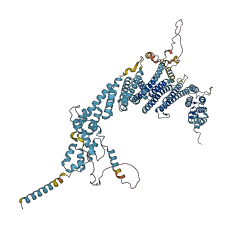
Descriptions
The autoinhibited protein was predicted that may have potential autoinhibitory elements via cis-regPred.
Autoinhibitory domains (AIDs)
Target domain |
|
Relief mechanism |
|
Assay |
cis-regPred |
Accessory elements
No accessory elements
Autoinhibited structure

Activated structure
1 structures for O74854
| Entry ID | Method | Resolution | Chain | Position | Source |
|---|---|---|---|---|---|
| AF-O74854-F1 | Predicted | AlphaFoldDB |
No variants for O74854
| Variant ID(s) | Position | Change | Description | Diseaes Association | Provenance |
|---|---|---|---|---|---|
| No variants for O74854 | |||||
No associated diseases with O74854
7 regional properties for O74854
| Type | Name | Position | InterPro Accession |
|---|---|---|---|
| repeat | WD40 repeat | 7 - 88 | IPR001680-1 |
| repeat | WD40 repeat | 91 - 298 | IPR001680-2 |
| conserved_site | WD40 repeat, conserved site | 33 - 47 | IPR019775-1 |
| conserved_site | WD40 repeat, conserved site | 201 - 215 | IPR019775-2 |
| repeat | G-protein beta WD-40 repeat | 117 - 131 | IPR020472-1 |
| repeat | G-protein beta WD-40 repeat | 159 - 173 | IPR020472-2 |
| repeat | G-protein beta WD-40 repeat | 201 - 215 | IPR020472-3 |
Functions
8 GO annotations of cellular component
| Name | Definition |
|---|---|
| cell division site | The eventual plane of cell division (also known as cell cleavage or cytokinesis) in a dividing cell. In Eukaryotes, the cleavage apparatus, composed of septin structures and the actomyosin contractile ring, forms along this plane, and the mitotic, or meiotic, spindle is aligned perpendicular to the division plane. In bacteria, the cell division site is generally located at mid-cell and is the site at which the cytoskeletal structure, the Z-ring, assembles. |
| cell septum | A structure composed of peptidoglycan and often chitin in addition to other materials. It usually forms perpendicular to the long axis of a cell or hypha and grows centripetally from the cell wall to the center of the cell and often functions in the compartmentalization of a cell into two daughter cells. |
| cell tip | The region at the end of the longest axis of a cylindrical or elongated cell. |
| cytoplasm | The contents of a cell excluding the plasma membrane and nucleus, but including other subcellular structures. |
| cytosol | The part of the cytoplasm that does not contain organelles but which does contain other particulate matter, such as protein complexes. |
| exocyst | A protein complex peripherally associated with the plasma membrane that determines where vesicles dock and fuse. At least eight complex components are conserved between yeast and mammals. |
| nucleus | A membrane-bounded organelle of eukaryotic cells in which chromosomes are housed and replicated. In most cells, the nucleus contains all of the cell's chromosomes except the organellar chromosomes, and is the site of RNA synthesis and processing. In some species, or in specialized cell types, RNA metabolism or DNA replication may be absent. |
| ubiquitin ligase complex | A protein complex that includes a ubiquitin-protein ligase and enables ubiquitin protein ligase activity. The complex also contains other proteins that may confer substrate specificity on the complex. |
1 GO annotations of molecular function
| Name | Definition |
|---|---|
| protein-macromolecule adaptor activity | The binding activity of a protein that brings together two or more macromolecules in contact, permitting those molecules to function in a coordinated way. The adaptor can bring together two proteins, or a protein and another macromolecule such as a lipid or a nucleic acid. |
5 GO annotations of biological process
| Name | Definition |
|---|---|
| cell cycle | The progression of biochemical and morphological phases and events that occur in a cell during successive cell replication or nuclear replication events. Canonically, the cell cycle comprises the replication and segregation of genetic material followed by the division of the cell, but in endocycles or syncytial cells nuclear replication or nuclear division may not be followed by cell division. |
| endocytosis | A vesicle-mediated transport process in which cells take up external materials or membrane constituents by the invagination of a small region of the plasma membrane to form a new membrane-bounded vesicle. |
| exocytosis | A process of secretion by a cell that results in the release of intracellular molecules (e.g. hormones, matrix proteins) contained within a membrane-bounded vesicle. Exocytosis can occur either by full fusion, when the vesicle collapses into the plasma membrane, or by a kiss-and-run mechanism that involves the formation of a transient contact, a pore, between a granule (for exemple of chromaffin cells) and the plasma membrane. The latter process most of the time leads to only partial secretion of the granule content. Exocytosis begins with steps that prepare vesicles for fusion with the membrane (tethering and docking) and ends when molecules are secreted from the cell. |
| Golgi to plasma membrane transport | The directed movement of substances from the Golgi to the plasma membrane in transport vesicles that move from the trans-Golgi network to the plasma membrane, where they fuse and release their contents by exocytosis. |
| septum digestion after cytokinesis | The process of physically separating the septal cell wall material by enzymatic digestion, that occurs after daughter cells are separated by cytokinesis. |
No homologous proteins in AiPD
| UniProt AC | Gene Name | Protein Name | Species | Evidence Code |
|---|---|---|---|---|
| No homologous proteins | ||||
| 10 | 20 | 30 | 40 | 50 | 60 |
| MKPSEAREHA | IRKIKEYLER | RHKQQFKALF | GCLTINIYLK | IFTLISTPDL | CNCRLVCRKF |
| 70 | 80 | 90 | 100 | 110 | 120 |
| QQLCDYNSIY | VKKLLLMNAW | DVTLSRKLYY | ESQDGMSQAN | MSSNTSKGFH | LQSSDKKYAD |
| 130 | 140 | 150 | 160 | 170 | 180 |
| SDRPKLSSSS | LLSLPDQKIP | FPVDYSTVQG | KQVVLTVLDC | VSQRVEFARL | DYIKVWRALA |
| 190 | 200 | 210 | 220 | 230 | 240 |
| PIYRNLAYAS | NTIDPIAFSA | FRTPEEQSKV | LKYLIRFGNS | YPYGTYRQAM | QNAILDMASL |
| 250 | 260 | 270 | 280 | 290 | 300 |
| FEQACLDEFE | LGLHSRNLDL | LRKFSHVLHD | FSGPNAYVSM | YLAKQTDFVR | SFFHFDPYSL |
| 310 | 320 | 330 | 340 | 350 | 360 |
| FISNNLEEIH | INWNILESVV | NDTIKLLESE | SKFSEATLPE | PELVQVPYAK | DILGNSLKDY |
| 370 | 380 | 390 | 400 | 410 | 420 |
| VISICEHIGE | EETELFLVFI | SGFYGLCKKF | FSIPNGPALV | DTIFQPQIDI | FISQELHYFK |
| 430 | 440 | 450 | 460 | 470 | 480 |
| TVGWSLVDQW | DQKLEEKEDA | TECFFYKNVS | QNTAKNNFLE | TFKNVMLLPV | SLFTIPSENN |
| 490 | 500 | 510 | 520 | 530 | 540 |
| SASNLAEKAI | EQKEEEDPEL | SKLDAARFVP | ANIYVSKDRL | KHLPTTELAA | QAAVLDSKLE |
| 550 | 560 | 570 | 580 | 590 | 600 |
| GISTMFSLEL | ALKIVHLCKV | SLARAKVFMG | TSVPQDDDIK | GLSKDLFVQL | LRELGQGHLK |
| 610 | 620 | 630 | 640 | 650 | 660 |
| HGFDRAIEHL | SSFDPRRDFS | SNTVEPVVKF | LELINVGDMI | QQMMDSFFNE | EMSPICVKDD |
| 670 | 680 | 690 | 700 | 710 | 720 |
| MFDPAIAEKK | KFEQLLDERA | AFGLHKGINV | LIEHADFLLE | TKTPMNLFSD | QTIGSITNTI |
| 730 | 740 | 750 | 760 | 770 | 780 |
| EPTAAAKNVV | QFLGFHMRIL | VGRADHEILD | VFYKEVGMRL | FDSLTRYIKS | HKFSVDGGLK |
| 790 | 800 | 810 | 820 | 830 | 840 |
| LLSDCNLYYE | FIHSLHQSSL | LPYFKTLKEI | AHLFIIDGKN | AEEIGKLATD | TSRFSSAFHT |
| 850 | 860 | 870 | |||
| EEVYEILHSR | IDWLNIKYEV | DKVIHGLACC | IM |