O74810
Gene name |
ubc1 (SPBC2D10.20) |
Protein name |
Ubiquitin-conjugating enzyme E2 1 |
Names |
E2 ubiquitin-conjugating enzyme 1, Ubiquitin carrier protein 1, Ubiquitin-protein ligase 1 |
Species |
Schizosaccharomyces pombe (strain 972 / ATCC 24843) (Fission yeast) |
KEGG Pathway |
spo:SPBC2D10.20 |
EC number |
2.3.2.23: Aminoacyltransferases |
Protein Class |
|
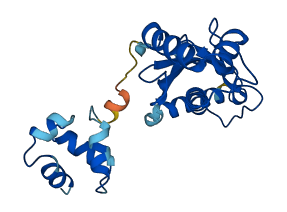
Descriptions
The autoinhibited protein was predicted that may have potential autoinhibitory elements via cis-regPred.
Autoinhibitory domains (AIDs)
Target domain |
|
Relief mechanism |
|
Assay |
cis-regPred |
Accessory elements
No accessory elements
Autoinhibited structure

Activated structure
1 structures for O74810
| Entry ID | Method | Resolution | Chain | Position | Source |
|---|---|---|---|---|---|
| AF-O74810-F1 | Predicted | AlphaFoldDB |
No variants for O74810
| Variant ID(s) | Position | Change | Description | Diseaes Association | Provenance |
|---|---|---|---|---|---|
| No variants for O74810 | |||||
No associated diseases with O74810
Functions
| Description | ||
|---|---|---|
| EC Number | 2.3.2.23 | Aminoacyltransferases |
| Subcellular Localization |
|
|
| PANTHER Family | ||
| PANTHER Subfamily | ||
| PANTHER Protein Class | ||
| PANTHER Pathway Category | No pathway information available | |
2 GO annotations of cellular component
| Name | Definition |
|---|---|
| cytosol | The part of the cytoplasm that does not contain organelles but which does contain other particulate matter, such as protein complexes. |
| nucleus | A membrane-bounded organelle of eukaryotic cells in which chromosomes are housed and replicated. In most cells, the nucleus contains all of the cell's chromosomes except the organellar chromosomes, and is the site of RNA synthesis and processing. In some species, or in specialized cell types, RNA metabolism or DNA replication may be absent. |
2 GO annotations of molecular function
| Name | Definition |
|---|---|
| ATP binding | Binding to ATP, adenosine 5'-triphosphate, a universally important coenzyme and enzyme regulator. |
| ubiquitin conjugating enzyme activity | Isoenergetic transfer of ubiquitin from one protein to another via the reaction X-ubiquitin + Y -> Y-ubiquitin + X, where both the X-ubiquitin and Y-ubiquitin linkages are thioester bonds between the C-terminal glycine of ubiquitin and a sulfhydryl side group of a cysteine residue. |
4 GO annotations of biological process
| Name | Definition |
|---|---|
| proteasome-mediated ubiquitin-dependent protein catabolic process | The chemical reactions and pathways resulting in the breakdown of a protein or peptide by hydrolysis of its peptide bonds, initiated by the covalent attachment of ubiquitin, and mediated by the proteasome. |
| protein modification by small protein conjugation or removal | A protein modification process in which one or more groups of a small protein, such as ubiquitin or a ubiquitin-like protein, are covalently attached to or removed from a target protein. |
| protein polyubiquitination | Addition of multiple ubiquitin groups to a protein, forming a ubiquitin chain. |
| ubiquitin-dependent ERAD pathway | The series of steps necessary to target endoplasmic reticulum (ER)-resident proteins for degradation by the cytoplasmic proteasome. Begins with recognition of the ER-resident protein, includes retrotranslocation (dislocation) of the protein from the ER to the cytosol, protein ubiquitination necessary for correct substrate transfer, transport of the protein to the proteasome, and ends with degradation of the protein by the cytoplasmic proteasome. |
No homologous proteins in AiPD
| UniProt AC | Gene Name | Protein Name | Species | Evidence Code |
|---|---|---|---|---|
| No homologous proteins | ||||
| 10 | 20 | 30 | 40 | 50 | 60 |
| MSDNRSRRIA | KELADVQQDK | QAGIQVWTIN | DDISHLKGMF | RGPEGTPYEG | GYFVVDIEIP |
| 70 | 80 | 90 | 100 | 110 | 120 |
| IDYPFRPPKM | NFDTKIYHPN | VSSQTGAICL | DILKDQWSPV | YTMKSALISL | QSLLCTPEPS |
| 130 | 140 | 150 | 160 | 170 | 180 |
| NPQDAQVAQV | YLQNYQQFVR | TAREWTSSYA | AAPAGVDLDA | ENTEFGGIDP | NIITNLQQFG |
| 190 | 200 | 210 | |||
| FSTELIVRVL | QREHIKSQED | LKDYPNGING | ILDQLLH |